
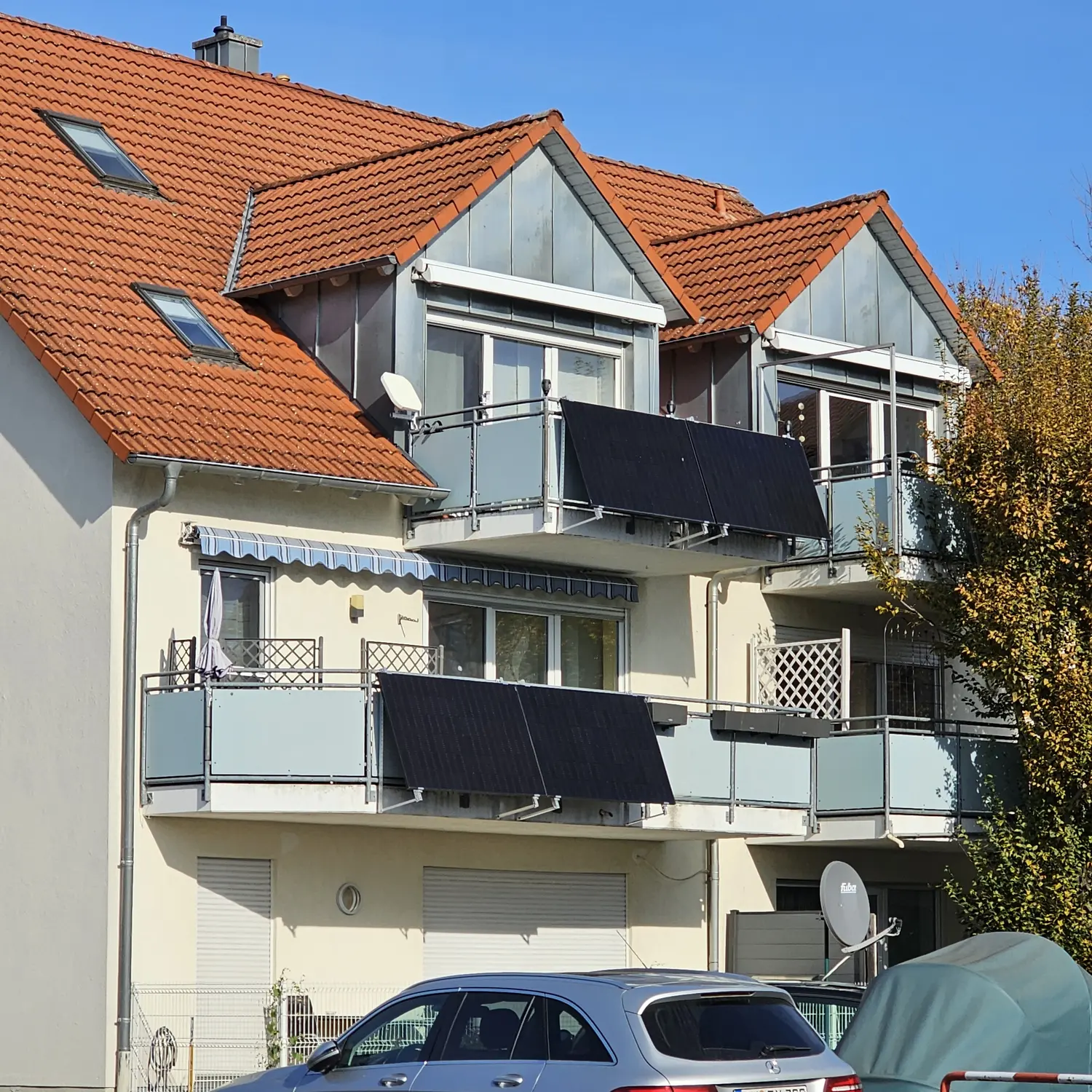

The short version
What you need to know.
- Industry concerns reported by ABC are competing positions, not a finding that every plug-in solar system causes fires.
- WA is still consulting; the public summary’s 800 W inverter description differs from the draft standard’s 800 VA and 3.5 A limits.
- Feedback closes at 5pm AWST on 9 December 2026. Wait for a legal pathway, compliant products and the permissions required at your property.
Access is the attraction; safety is the question
Plug-in solar has an appealing pitch: give renters and apartment owners a smaller way into solar, without needing control of an entire roof. The latest debate is about how to deliver that access safely, not whether saving money on electricity sounds nice. That bit is fairly uncontroversial.
Our earlier WA explainer covered the proposed pathway. The new development is the sharper disagreement over what safeguards households should need before these systems reach ordinary power points.
What changed this week?
In ABC reporting published on 12 November, electrical industry groups and unions raised concerns about a rushed rollout, misuse and fire risks. NECA and Master Electricians Australia want dedicated circuits and plugs that cannot fit ordinary outlets. WA Energy Minister Amber-Jade Sanderson said safety remains the priority, while arguing the conversation should focus on how the technology can be used safely.
Those are competing positions, not a finding that every plug-in system will cause a fire. Equally, enthusiasm for the technology does not settle the Australian safety questions.
What WA is actually proposing
The WA consultation, updated on 4 November, remains a proposal involving a regulatory amendment and technical standard. Its public summary describes up to 2 kW of solar panels and an 800 W inverter, with battery storage also contemplated. Feedback closes at 5pm AWST on 9 December 2026.
The draft technical standard uses the more specific limit of 800 VA apparent power and 3.5 A supplied to the installation. Watts and volt-amperes are not interchangeable labels. This is a small supplementary system, not a shortcut to adding a full-sized rooftop installation through a socket.
The draft also contains electrical, mechanical and environmental requirements. A product being sold overseas is not evidence that it satisfies whatever WA ultimately adopts.
Cheap access versus extra checks
There is a real consumer trade-off here. If the final pathway requires electrical work before a kit can be used, buyers will need to include that work in the installed cost. That could change the value proposition, particularly for somebody hoping to take a modest system between rentals.
On the other side, asking ordinary households to interpret technical restrictions is not the same thing as verifying that their home is suitable. The useful outcome would be a clear, enforceable pathway that buyers can understand before spending money.
WA’s own FAQ says an electrician’s inspection could still be beneficial. It also describes proposed safeguards including battery testing, protective electronics and placement guidance. These are details worth resolving, rather than waving away as fine print.
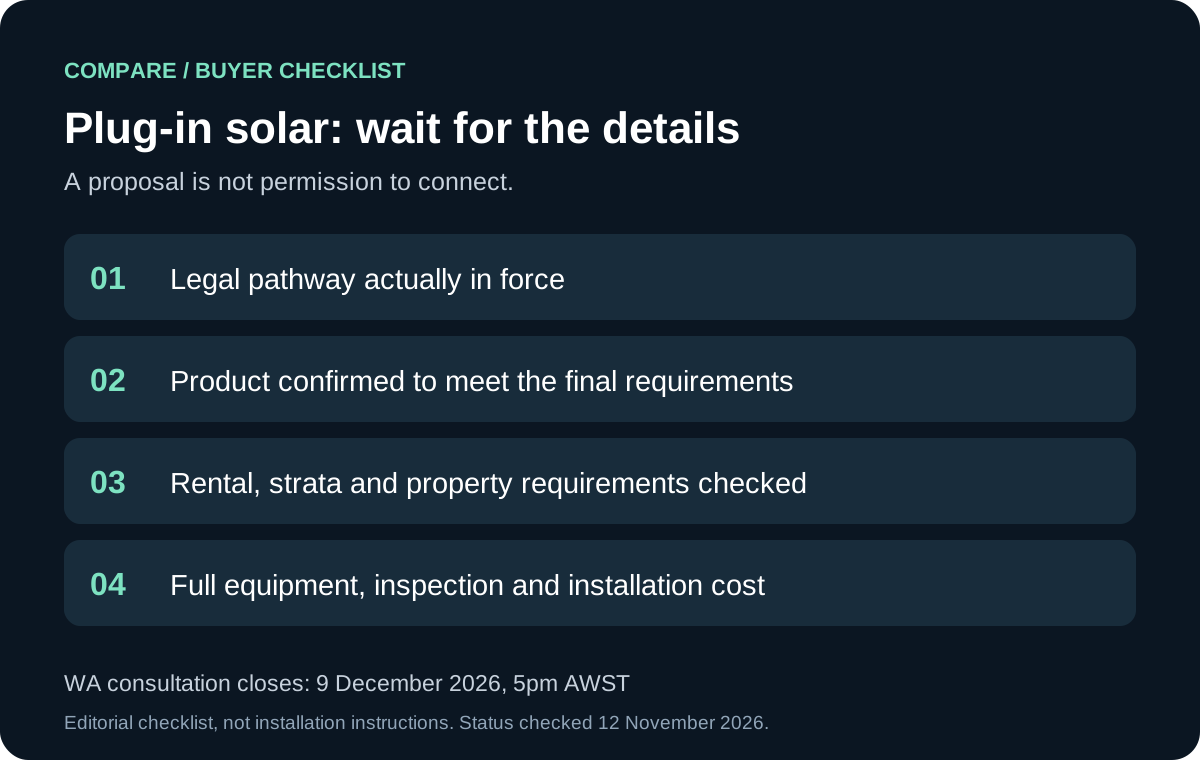
What should you do now?
First, wait for an actual legal pathway and products confirmed to meet it. The government’s current FAQ says imported systems are not yet legal to use. A checkout button does not overrule that advice.
Second, separate product approval from permission at your property. Rental access is still being worked through, and apartment owners may face strata rules. A national headline cannot answer those questions for your balcony.
Third, eventually compare the whole cost: equipment, any required inspection or electrical work, suitable mounting, warranty and local support. Ask for written evidence of compliance rather than a seller’s reassurance. Do not improvise adapters or connections to make an imported kit work.
I still think the access argument is compelling. But the best bargain is a system you can legally use, safely support and sensibly pay off. For now, this is a consultation to watch, not a shopping deadline to panic about.
Sources
Read the evidence.
- Plug-in solar safety debate, 12 November 2026ABC News ↗
- WA plug-in solar and batteries consultationGovernment of Western Australia ↗
- Draft technical standard for plug-in generatorsGovernment of Western Australia ↗
- Balcony solar consultation FAQGovernment of Western Australia ↗
Sources checked on 12 November 2026 (Australia/Perth). Source-based safety-policy follow-up, not hands-on testing, a safety certification or legal permission to connect. Industry positions are attributed to ABC’s reporting; the technical limits and current status come from WA government sources. No ABC/Getty imagery reproduced.
Community
Add to the article.
Useful experiences, questions and corrections make the next reader’s decision easier.
Comments appear here after moderation.