

The short version
What you need to know.
- Tesla Electric Dynamic combines time-of-use import charges with export credits linked to wholesale prices. That is an interesting alternative to a conventional fixed feed-in tariff.
- The published Ausgrid offer is invitation-only. Powerwall ownership and location restrictions mean this is not an open offer for every Australian home.
- My hope is that stronger competition delivers better bills and easier battery management. The full annual cost still matters more than the biggest export payment.
This is the kind of competition I want to see
I’m excited about this one. Tesla selling electricity in Australia could become more significant than another logo on the bill. It brings the company behind Powerwall into the conversation about what we pay for energy and what our batteries earn back.
The hope is that it shakes things up. Better offers, simpler software and more pressure on retailers to give households a worthwhile reason to stay. Even if you never become a Tesla customer, more serious competition could be a good thing.
But I would separate that hope from a verdict on the plan itself. A well-designed app is useful. A genuinely lower annual bill is better. We need both the idea and the numbers to work.
What has actually launched?
Zecar reported the new Australian Tesla Electric offer on 14 September. Tesla’s local website is live, and its Dynamic plan combines electricity retailing with Powerwall management. The contract names Tesla Energy Ventures Australia as the retailer.
There is an important qualification to the launch story. The current Ausgrid plan information document describes an invitation-only offer and a pilot participation credit. Its effective date is 8 July 2026. September’s reporting therefore should not be read as proof that unrestricted national sign-ups suddenly opened that day.
Tesla also publishes plan sheets and contract documents. I checked those alongside the news report, because they answer questions that a launch headline cannot.
Buying electricity and selling it use different prices
The basic structure is easy enough to understand. Electricity you import is charged at set time-of-use rates. Electricity you export earns a variable credit: Tesla advertises 90% of the real-time market price. These are different sides of the bill.
Tesla identifies the market reference as AEMO’s five-minute settlement prices, while your meter’s interval capability affects the calculation. Powerwall owners may also receive separate credits for grid support services, including frequency control. Think of those services as helping balance the grid, rather than simply selling another unit of electricity.
This is why I find the approach interesting. Someone may want predictable import prices without giving up the opportunity to earn more when their stored energy is particularly valuable. It offers a different balance of certainty and exposure to the market.
Predictable does not mean permanently locked. The published Ausgrid sheet allows changes to import and supply charges with at least five business days’ notice. The rates are not following every wholesale spike, but they can still change over time.
One NSW example, not an Australia-wide price
Tesla’s published Ausgrid Dynamic time-of-use sheet lists 49.71c/kWh from 3pm to 8:59pm, 24.02c/kWh from 9pm to 2:59pm, and a daily supply charge of 110.07c. Those import and supply figures include GST. They apply to this particular offer, not every network.
For scale, that supply charge alone is about $401.76 over 365 days. If a home imported 5kWh in the peak window and 10kWh off-peak every day, imports plus supply would cost about $2,185.69 a year before export credits, other rewards, concessions or additional fees. That is my illustrative arithmetic, not a forecast for a Powerwall household.
The sheet also displays a 1c feed-in figure alongside wording describing variable wholesale-linked export credits. I would ask Tesla to reconcile that presentation in the written offer before joining. I would not assume it establishes a guaranteed minimum, or an extra 1c on top of the advertised wholesale share.
A high export payment can look impressive on a screenshot. What I want to know is how the whole bill compares across a year, including the quieter months.
Why timing could make stored energy more valuable
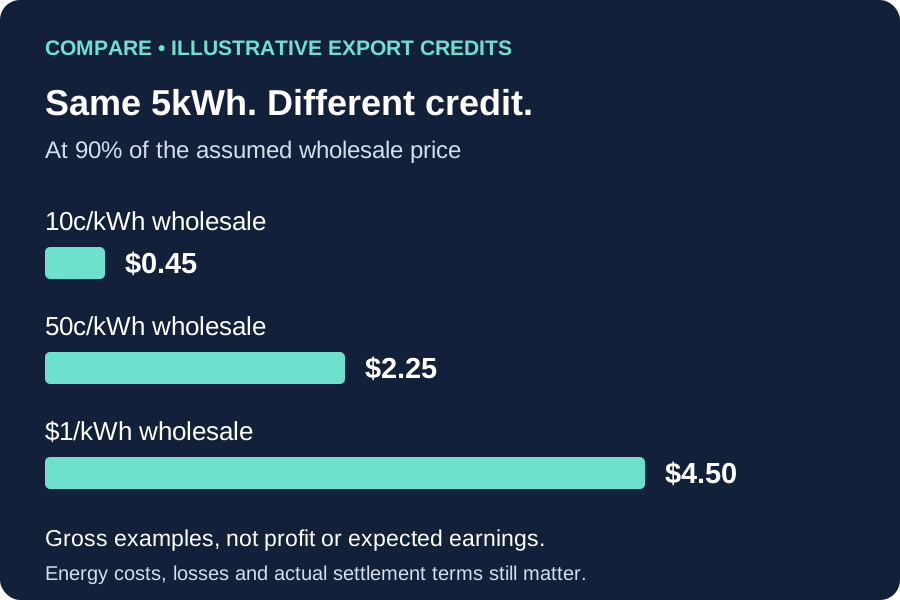
Here is a simple illustration of the advertised 90% share. At a wholesale price of 10c/kWh, the corresponding share is 9c. At 50c, it is 45c. At $1, it is 90c. Exporting 5kWh at those respective prices would produce $0.45, $2.25 or $4.50.
Those are examples, not an expected earnings range. They exclude other billing adjustments and are not profit calculations. Energy stored in the battery has a cost: either electricity bought from the grid, or solar that could have been used or exported earlier. Charging and discharging also involve losses.
There is an opportunity cost too. If exporting leaves you buying expensive electricity later, the export credit alone does not tell you whether you won. The useful job for the software is choosing when to store, use and export energy across the household’s needs.
Negative wholesale prices deserve the same attention as high ones. Ask exactly how they affect your export credit and whether there is a floor. A percentage of a market price does not, by itself, guarantee a positive payment.
Who can join, and what control are you handing over?
The Dynamic terms require a residential customer with Powerwall 2 or 3, an eligible smart meter and the Tesla app and payment setup. They list eligible parts of NSW, ACT, Victoria, South Australia and south-east Queensland, and exclude embedded networks. Having a Tesla car alone does not satisfy those requirements.
The terms also permit remote battery control, require internet connectivity at least 95% of the time, and prohibit another Powerwall optimisation program running alongside it. They describe solar curtailment during negative prices for Powerwall 3, with that capability unavailable for Powerwall 2.
Here in Perth, the location list is the immediate limitation: WA is not included. I can be enthusiastic about the model without pretending I can switch my own house onto it.
The public fact-sheet page lists Dynamic documents for NSW, SA, Energex in Queensland and the ACT. Although Victoria appears in the eligibility terms, I would confirm a live Victorian offer and its fact sheet directly. An eligible region does not guarantee an invitation or an offer at every address.
Blackout reserve belongs in this conversation
I would not choose a battery plan on trading credits alone. Part of the appeal of home storage is having energy available when the power goes out. I want that considered alongside the savings.
Tesla’s general Backup Reserve guidance explains the trade-off: reserving more energy for outages leaves less available for everyday savings. Before joining this particular plan, get written confirmation of how its remote control respects your reserve, what you can change and what happens during a grid event.
I would also ask about expected cycling, warranty treatment and what happens when communications fail. Those answers help establish whether the automation fits the way you want to use the battery.
The general market terms say there is no exit fee, although distributor charges can still apply for a physical disconnection. Switching retailer and disconnecting the property are different actions.
The disruption I am hoping for
The exciting part is the possibility of making household energy easier to manage well. Most people do not want a second job watching electricity prices. They want the car charged, the house comfortable and the bill under control.
If Tesla can combine useful automation with a competitive tariff, that gives other retailers something meaningful to respond to. I would like to see clearer battery rewards, better explanations of control and fewer offers that only look good when one number is pulled out of context.
I also hope competition spreads beyond a single hardware ecosystem. Plenty of households own other batteries, and plenty cannot install one at all. A strong market should keep improving the options for them too.
None of that is guaranteed by this launch. It is what I would like this kind of competition to encourage, and why I think it is worth watching.
Compare the full bill before switching
Start with twelve months of your actual import and export data, then compare your current plan with the Tesla offer available to your address. Include supply charges, peak imports, realistic export values, fees and the backup reserve you intend to keep.
Use our energy plans and VPP comparison category to explore the alternatives, then verify the final rates and eligibility with the retailer. I would test a cautious export-income scenario as well as an optimistic one. A plan should not need a handful of spectacular price spikes to look sensible.
My take is positive: I want Tesla to make this work and give the market a push. But the win for households will be proven by useful service and better annual costs. That is the result I am excited to see.
Primary sources
Read the evidence.
- 14 September report on Tesla Electric’s Australian launchZecar / Danny Thai ↗
- Tesla Electric: advertised import, export and grid-services modelTesla Australia ↗
- Dynamic plan terms: eligibility, hardware and remote controlTesla Australia ↗
- Ausgrid Dynamic plan sheet: prices, pilot invitation and conditionsTesla Energy Ventures Australia ↗
- Published network-specific plan information documentsTesla Australia ↗
- General market terms, including cancellation and exit feesTesla Australia ↗
- Powerwall Backup Reserve guidanceTesla Australia ↗
- Representative home-energy photographyTesla Australia ↗
Independent reporting and opinion by Patryk Lazarz, checked on 15 September 2026. We have not enrolled in or tested Tesla Electric. The calculations are illustrative, not personalised quotes or promised returns. The published pilot documents and the offer in your Tesla app should be checked for current eligibility and pricing. Hardware costs and annual trading earnings are not modelled.
Community
Add to the article.
Useful experiences, questions and corrections make the next reader’s decision easier.
Comments appear here after moderation.