

The short version
What you need to know.
- The $5,000 headline covers electrifying the home and car. It is not a battery-only saving or a guarantee for every household.
- My view: higher savings are possible when substantial fuel and energy bills are replaced, but the upfront price and financing must stack up.
- Blackout protection and lower grid reliance have value too. Backup must be designed into the installation; owning a battery does not automatically provide it.
The number is exciting. The system behind it matters more.
If someone tells me I could save $5,000 a year by changing how my house and car use energy, they have my attention. That is proper household money.
And honestly, I do not think $5,000 has to be the ceiling. A family spending heavily on petrol, gas and electricity could do better with the right combination of efficient appliances, solar, storage and sensible charging.
But I also do not want to save money so enthusiastically that I spend far too much doing it. The system has to suit the house and the budget. A bigger battery and a longer equipment list are not automatically a better outcome.
There is another part of the decision I would put on the table from the start: keeping essential things running during a blackout, and having more control over when you need the grid. Those benefits matter, even when they do not fit neatly into an annual savings headline.
What is behind today’s $5,000 claim?
RenewEconomy’s 14 September reporting describes a push by more than 30 organisations for stronger support for electrification, citing potential household savings of $5,000 a year across homes and cars.
That scope matters. This is about replacing several bills and sources of energy. It is not a claim that a battery sitting beside the garage will take $5,000 off an ordinary electricity bill.
The Australian Government’s Your Home guide also supports electrification, including planning upgrades around the end of an appliance’s life. The practical starting point is your own spending: twelve months of electricity, gas and fuel, together with when you use energy.
If those costs are already low, your savings opportunity will be smaller. If you already have solar and an EV, compare the next upgrade against what you have now. Do not credit a new battery with savings your existing equipment already delivers.
Two examples show why the answer varies so much
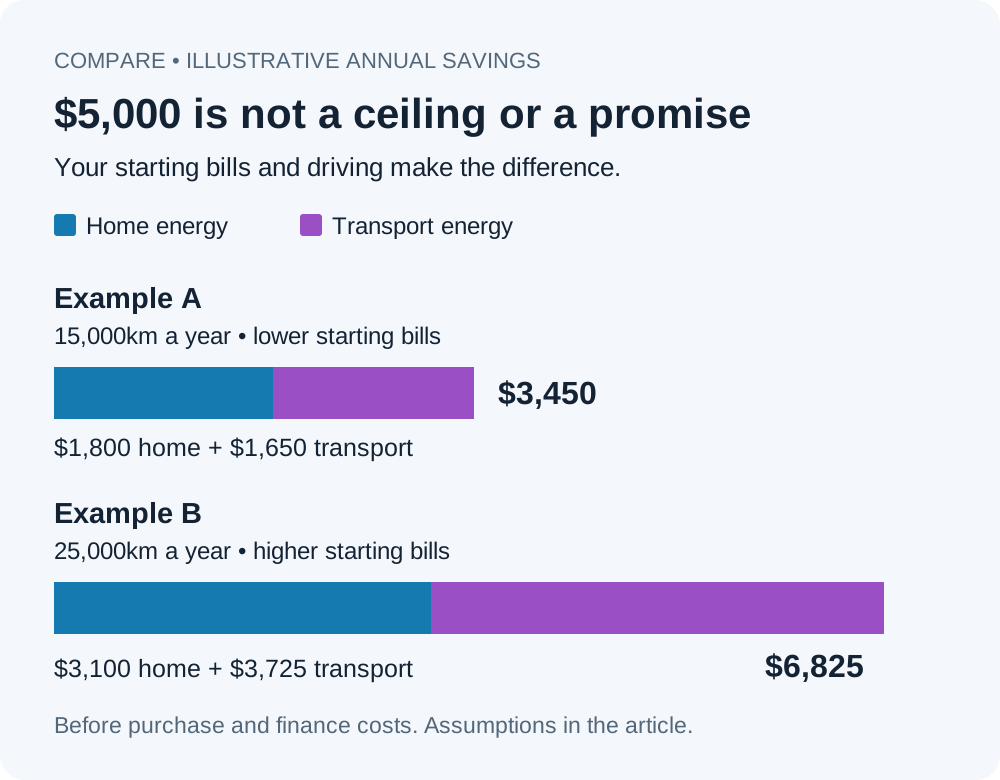
These are deliberately hypothetical household budgets, calculated by Compare. They are not government forecasts, installer quotes or estimates of an average Australian home. Their job is to show which assumptions drive the answer.
In the first example, a car travels 15,000km a year, uses 8L/100km and runs on $2/L petrol: $2,400 annually. An EV using 20kWh/100km measured at the charger, including charging losses, would use 3,000kWh. At an assumed effective charging cost of 25c/kWh, that is $750, saving $1,650.
If that household’s combined electricity and gas bill fell from $3,800 to $2,000 after its home upgrades, another $1,800 would be saved. Total annual energy saving: $3,450.
Now take a heavier-use household driving 25,000km in a vehicle using 9L/100km, with petrol at $2.10/L. Fuel costs $4,725. At the same EV consumption and an assumed effective charging cost of 20c/kWh, charging costs $1,000. Transport saves $3,725.
If its home energy bill also fell from $5,000 to $1,900, the household would save $6,825 a year across home and transport. That is the kind of situation where I can see the headline being exceeded.
The upfront price has to earn its place
Before signing anything, I would ask for the full installed price after confirmed incentives: equipment, electrical work, switchboard changes, backup hardware and any gas disconnection costs. Then I would ask what that package saves compared with my current setup.
For a simple illustration, an $18,000 home upgrade saving $1,800 a year takes ten years to recover its purchase price. At $3,000 a year, the same cost takes six years. Neither figure accounts for financing, repairs, degradation or changing tariffs. They are a first check, not a complete investment calculation.
Keep the car comparison separate. If you are replacing a car anyway, compare the EV’s total ownership cost with the petrol alternative you would genuinely buy. If your current car has years left, bringing that purchase forward is a different and potentially much more expensive decision.
I would also want a cautious case. What happens if savings come in 25% lower, your driving drops or your cheap charging window disappears? A plan that only works when everything goes perfectly is not a plan I would feel comfortable buying.
I would upgrade in stages, starting with the waste
I would start with the things that stop the house wasting energy: draughts, insulation, shading, settings and running suitable loads at better times. They may be less exciting than a battery app, but I want the equipment working for a house that is reasonably efficient.
Then plan for the expensive appliances before they fail. Heat-pump hot water deserves a look when replacing an inefficient system. Tank size, local climate, noise, installation cost and the ability to heat during useful solar hours all matter.
If reverse-cycle air conditioning can replace gas heating in your home, price that properly too. Cooking may complete the switch, but I would not assume the cooktop alone is where the biggest savings sit. Once the last gas appliance is gone, ask the retailer about ending supply charges and the cost of disconnecting.
Next, size solar around the roof and expected electricity use, including future appliances or an EV. Then compare battery sizes against the energy you can actually store and use. I would want the installer to show why the extra capacity earns its extra cost.
A lower-cost option that covers most of the useful work may beat the largest package. Conversely, a larger system can make sense for a genuinely high-use household. The usage data should decide.
Blackout protection is worth something to me
I would not judge a system entirely by its payback period. If it can keep the fridge, lights and other essentials running when the street loses power, that is a benefit I would willingly consider paying for.
But get that capability written into the quote. Solar Victoria explains that solar and batteries need a backup configuration to supply power during an outage. A normal grid-connected solar system cannot simply keep feeding the house as though nothing happened.
Ask the installer to specify the circuits and phases supplied, continuous and starting power limits, switchover behaviour, and whether solar can recharge the battery while the grid is down. Essential-circuit backup and whole-home backup can be very different purchases.
A useful illustration: 10kWh available to your backed-up appliances would support an average 500W load for roughly 20 hours. At 2kW, that becomes five hours. That is simple energy divided by power, not a runtime guarantee; actual available energy, changing loads and system limits matter.
I would rather have a clearly explained essentials setup than discover during the first blackout that the feature I thought I bought was an optional extra.

Savings and backup reserve need a balance too
Keeping charge aside for a blackout means that energy is not available for ordinary bill reduction. Tesla’s Backup Reserve guidance is a clear example of the trade-off: increasing the reserve leaves less capacity for everyday self-consumption or tariff savings.
For me, that is a choice to make deliberately. I might accept slightly lower savings for a useful buffer. Someone with very reliable supply might prioritise daily bill reduction. Your installer should model the reserve you intend to use, rather than showing a best-case saving based on draining the battery every night.
The same thinking applies to a virtual power plant. Check who can discharge the battery, what reserve is protected and how payments work. Do not count uncertain trading income as though it were a guaranteed discount on next year’s bills.
Less dependent on the grid does not have to mean disconnecting
I like the idea of producing more of our own energy and needing less electricity at the most expensive times. That feels like useful control over a household expense.
But I would separate that from permanently going off-grid. Keeping the connection can be valuable during poor solar weather, heavy use or equipment downtime. The Government’s battery guide notes that off-grid designs must allow for periods of low generation and may need a backup generator.
The distinction also changes the budget. A grid-connected home can still have supply charges even when imports are tiny. And a battery charged on a cheap grid tariff may save money without reducing grid dependence to the same degree as solar self-supply.
Here in WA, I would use local tariffs and network conditions for the calculation. An eastern-states example is a starting point for a conversation, not a ready-made forecast for a Perth home.
Renters and apartment owners also have less control over roofs and shared electrical infrastructure. They need feasible permissions and installation options before anyone starts promising the same outcome as a detached owner-occupied house.
My take: buy a balanced system, not a headline saving
I am positive about where this is going. The right household could save more than $5,000 a year on energy, and better equipment and competition should give us more worthwhile options.
But my enthusiasm comes with a budget. I want a sensible installed cost, assumptions based on actual usage, and a clear explanation of what works during a blackout. I would rather build towards that in stages than overspend chasing the biggest number.
The aim is lower ongoing costs, useful backup and more control over where our energy comes from. If a system delivers those things at a price the household can comfortably justify, that is something worth getting excited about.
Primary sources
Read the evidence.
- 14 September news: household electrification campaign and $5,000 savings claimRenewEconomy / Jennifer Dudley-Nicholson ↗
- Electrification: planning upgrades and replacing gas appliancesAustralian Government — Your Home ↗
- Battery sizing, financial considerations, VPPs and off-grid systemsAustralian Government — Your Home ↗
- Hot water: comparing heat pumps, sizing and operating timesAustralian Government — Your Home ↗
- Power outages and all-electric homesSolar Victoria ↗
- Backup Reserve: the trade-off between daily savings and stored backup energyTesla ↗
- Representative ESA product imageryGoodWe Australia ↗
- Solar home and electric vehicle photographyTesla Australia ↗
Independent analysis and opinion by Patryk Lazarz, researched on 14 September 2026. The two household scenarios and payback examples are original illustrative arithmetic, not site-specific energy simulations, current product quotes or reproductions of the campaign’s modelling. No product shown is claimed to deliver the illustrated savings. Confirm system design, local tariffs, current incentive eligibility and backup behaviour with an appropriately qualified installer.
Community
Add to the article.
Useful experiences, questions and corrections make the next reader’s decision easier.
Comments appear here after moderation.