

The short version
What you need to know.
- Fire and Rescue NSW was called on 17 August and handed the site back on 22 August after cooling and safely removing affected batteries; that does not establish that open flames burned continuously for five days.
- The cause remains under investigation, and public reporting has not identified the battery manufacturer, model, chemistry, capacity, condition or original purpose.
- A professionally installed home battery is not the same risk proposition as a commercial battery room, an e-bike pack charged indoors or a damaged power-tool battery used with an incompatible charger.
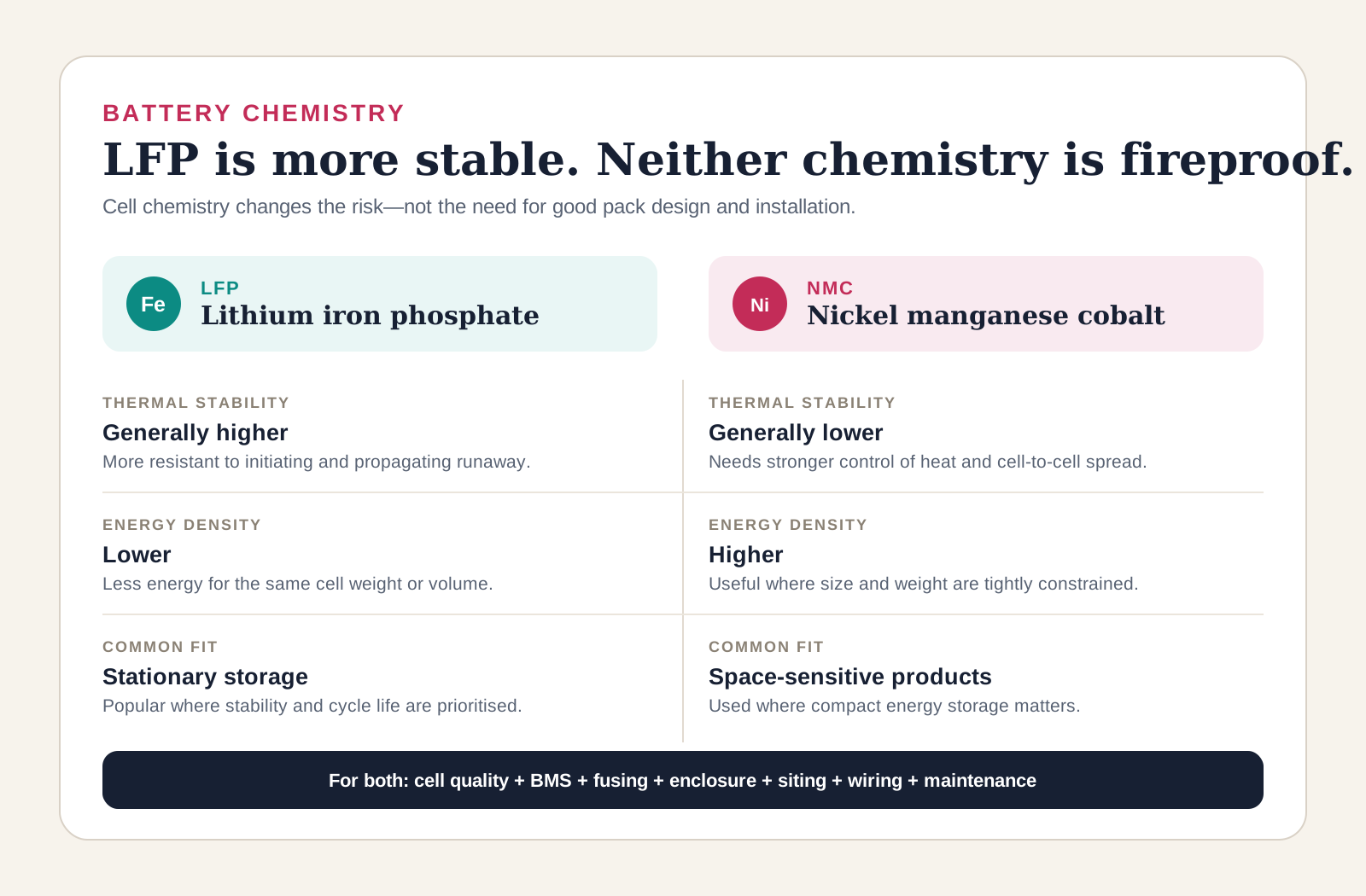
- LFP is generally more thermally stable than NMC, but neither chemistry is fireproof. Pack design, battery management, wiring, location, workmanship and maintenance all matter.
- Australian buyers should verify the exact product is CEC approved, use an SAA-accredited battery installer, insist on compliant siting and labels, retain the emergency procedure and check recalls.
What happened in Chatswood—and what has not been established
According to incident reporting, Fire and Rescue NSW crews were called shortly after noon on 17 August after a fire alarm activated at Chatswood Golf Course and Retirement Village. Firefighters found a battery energy-storage system in a storeroom attached to a car park, with some batteries on fire. Nearby residents were briefly evacuated and were allowed to return after crews determined the incident was contained and would not spread to the units.
The site was not handed back to technicians until late on 22 August. Firefighters described a protracted operation involving cooling and safely removing affected batteries. That is a five-day emergency response, but the available account does not prove there were visible flames for every hour of those five days.
More importantly, the public information stops well short of identifying the system. We do not know the manufacturer, model, cell chemistry, energy capacity, age, installation standard, maintenance history, whether the batteries powered a building or mobile equipment, or what initiated the failure. The cause remains under investigation.
Those are not small gaps. Without them, it is impossible to calculate what this incident says about the risk of a certified home battery—or even to confirm that the equipment was comparable with one.
Why can a battery incident take days to make safe?
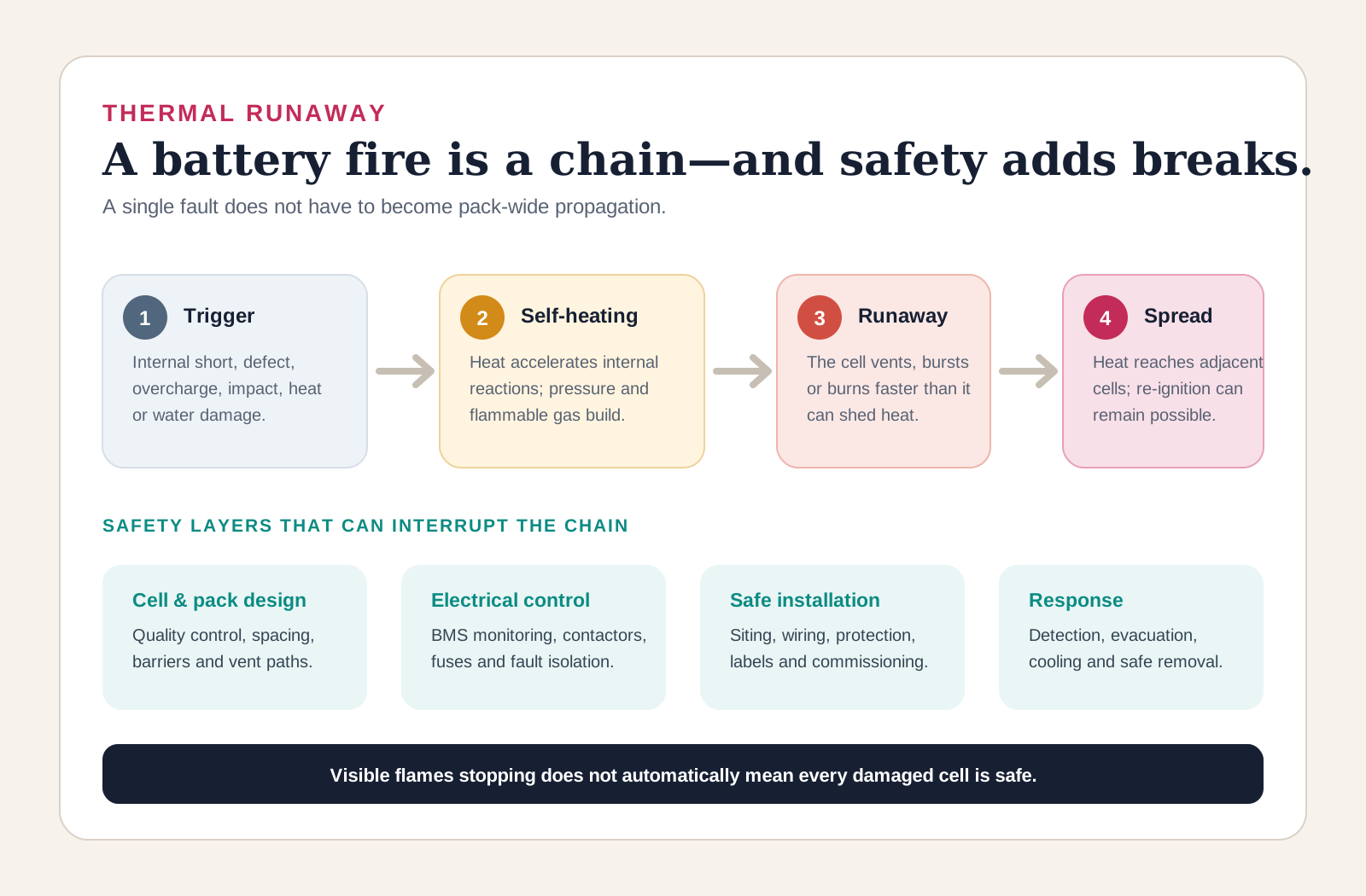
A lithium-ion fire is not managed like a burning chair. A damaged cell can enter thermal runaway: an internal reaction generates heat faster than it can escape, vents flammable and toxic gases and can heat neighbouring cells until they fail too. Extinguishing visible flame does not necessarily remove the stored energy or the possibility of re-ignition.
That is why firefighters may cool a pack for an extended period, monitor temperatures, establish an exclusion area and remove affected modules one at a time. Access, ventilation, system size and the number of damaged cells can all lengthen the job. The ACCC's general guidance notes that lithium-ion fires may reignite and, depending on battery size, can sometimes take days to burn.
Those are general characteristics, not a diagnosis of Chatswood. The long response tells us the crews treated the damaged batteries cautiously. It does not reveal the original defect, the chemistry or whether five days of active flames occurred.
Home batteries, commercial systems, e-bikes and power tools are not interchangeable
“Lithium battery” describes a family of rechargeable technologies, not one product class. Grouping every incident together is like using a truck fire to judge the safety of a laptop because both contain diesel in their supply chain: the scale, controls and way the equipment is used are materially different.
A residential battery is a fixed electrical installation. The cells sit inside a purpose-built enclosure with a battery-management system, electrical protection and manufacturer-defined operating limits. It should use an approved product, be installed by a qualified battery installer and be positioned to AS/NZS 5139 and local electrical-safety requirements.
A commercial battery energy-storage system may store far more energy, use multiple racks or cabinets and require a site-specific fire strategy. A five-day response to a multi-battery room therefore cannot be translated into the probability or consequence of a fault in a single residential unit without knowing its scale and layout.
E-bike and e-scooter packs are portable, exposed to impacts and weather, and often brought into living areas for charging. Compatible chargers, pack condition and the escape route around the charging location are crucial. Power-tool packs are smaller again, but can be dropped, crushed, left in hot vehicles or paired with third-party chargers. NSW data cited by the Coroners Court says the state's lithium-ion fires have been predominantly linked to e-bikes, e-scooters and smaller household items—not residential battery systems as one undifferentiated class.
- Fixed home battery: professionally installed, enclosed, monitored and connected to household wiring.
- Commercial BESS: site-specific scale and layout, often with many modules and a more complex emergency plan.
- E-bike or e-scooter: portable, impact-exposed and frequently charged inside homes using detachable chargers.
- Power-tool pack: smaller and removable, with risks amplified by physical damage, heat, ageing or incompatible replacements.
LFP versus NMC: one chemistry is more stable, but neither is a safety certificate
The two lithium-ion families most relevant to this discussion are lithium iron phosphate, or LFP, and nickel manganese cobalt, or NMC. LFP's phosphate cathode is generally more thermally stable and releases energy less aggressively during failure. That is one reason LFP has become popular for stationary storage, where weight and volume matter less than in a car or handheld tool.
NMC stores more energy for a given weight and volume, which is useful where compactness matters. It can still be engineered into a safe complete system, but comparative research has found that NMC-811 cells place greater demands on thermal-runaway protection than LFP cells. The same study also stresses that propagation depends on cell spacing, materials and the full pack design—not cathode chemistry alone.
LFP can still overheat, vent toxic and flammable gases, catch fire and propagate when it is defective, abused or poorly integrated. An unknown LFP pack from an unverified supplier is not automatically safer than a certified NMC product with robust controls. Chemistry is a useful question for the quote; it is not permission to ignore the exact model, approvals, enclosure, battery-management system or installer.
What the latest Australian inspection evidence actually says
The Clean Energy Regulator now publishes results from inspections of batteries installed under the Cheaper Home Batteries Program. In the current sample, 0.76% of installations were rated unsafe, 62.28% were technically non-compliant but safe to remain in operation, and 36.95% were adequate and safe. That middle number looks alarming until the category is read properly: the most common technical non-compliance was labelling, not a burning or defective cell.
The regulator says no inspected installation had an issue with the solar battery itself. Unsafe findings involved wiring, loose connections with signs of heat, electrical work outside the standards and protection issues. The result is not proof that every battery is safe, and inspection data should not be converted into a national fire rate. It does show why installation quality and emergency labelling deserve as much attention as chemistry.
Australia has also experienced genuine home-battery product failures. LG Energy Solution recalls have affected thousands of solar-storage batteries, and the ACCC reported property-damage incidents. That history is the reason buyers should check the national recalls database and exact model or serial number—not reassurance that a familiar brand or approved product can never fail.
What Australian homeowners should check before installation
I would not accept “it is LFP” as the installer’s entire safety pitch. Ask for the exact model, where it will be mounted, who will commission it and what happens if monitoring detects a fault. A good proposal should make the safety case visible before a deposit is paid.
- Check the exact battery configuration—not only the brand family—is on the Clean Energy Council approved battery list.
- Verify the installer holds the relevant electrical licence and current Solar Accreditation Australia accreditation with battery endorsement.
- Ask the installer to show how the proposed location complies with AS/NZS 5139 and local rules, including clearances, barriers and protection from heat, water, impact and escape routes.
- Ask which cell chemistry is used, but also what the battery-management system monitors and how the enclosure limits propagation.
- Confirm the final job will include the required energy-storage, backed-up-circuit and shutdown labels for residents, electricians and emergency services.
- Keep the shutdown procedure, installer and manufacturer contacts near the meter box, and save digital copies with the invoice and warranty.
- Check the ACCC Product Safety recalls database before installation and periodically during the battery's life.
- Ask who monitors fault alerts, how firmware is updated and who provides local warranty service if the retailer disappears.
- Discuss smoke or heat detection for the battery area with the installer and follow your state fire service's guidance.
- Arrange the recommended maintenance schedule; the Clean Energy Regulator advises an annual safety check by a licensed electrician accredited by SAA.
If you already have a home battery
There is no reason to switch off a healthy, non-recalled home battery because of an unrelated incident whose equipment is unknown. Instead, confirm the model and serial number, check for recalls, keep the software current and make sure your switchboard and meter box have legible energy-storage and shutdown labels.
Periodically look for visible damage, water ingress, corrosion, debris or vermin around the enclosure without opening it or touching wiring. If the system has been flooded, struck, exposed to fire or is reporting a serious fault, do not restart it until the manufacturer or an authorised technician has inspected it.
If you notice smoke, vapour, an unusual smell, hissing, popping, swelling or rapidly rising heat, do not approach the battery or attempt a repair. Evacuate, call Triple Zero and tell the operator that a battery energy-storage system is involved. Do not re-enter until emergency services give the all-clear.
So, are home batteries unsafe?
Home batteries contain significant stored energy and their failure can be severe, so “perfectly safe” would be the wrong promise. But this Chatswood event does not establish that a compliant residential system presents the same risk as an unidentified battery room, e-bike fleet or collection of power-tool packs. We do not yet know which comparison is relevant.
I would not cancel a planned home battery because firefighters spent five days managing this incident. I would use it to ask harder questions about product approval, installer accreditation, siting, wiring, labels, monitoring, recalls and the emergency plan. Those controls are more useful than relying on the word “lithium”—or even “LFP”—as a complete safety verdict.
The responsible conclusion may change when investigators identify the equipment and cause. Until then, the honest answer is narrower: the fire demonstrates why battery incidents can demand long, specialist responses. It does not demonstrate that Australian home batteries as a category are unsafe.
Primary sources
Read the evidence.
- Chatswood five-day battery incident reportingThe Daily Telegraph ↗
- Residential battery energy-storage system safetyFire and Rescue NSW ↗
- Solar battery eligibility, installation and maintenance requirementsClean Energy Regulator ↗
- Solar battery installer and designer requirementsClean Energy Regulator ↗
- Solar battery inspection results reportClean Energy Regulator ↗
- AS/NZS 5139:2019—battery-system installation safety requirementsStandards Australia ↗
- Thermal-runaway propagation in NMC-811 and LFP cellseTransportation ↗
- NSW lithium-ion battery fire inquest and product-category contextNSW Department of Communities and Justice ↗
- Lithium-ion battery safety guideACCC Product Safety ↗
- LG solar battery recall safety warningACCC Product Safety ↗
Information was checked on 29 August 2026. Public reporting has not identified the Chatswood system's manufacturer, model, chemistry, capacity, purpose or cause. The incident description therefore must not be read as a finding against any named home-battery brand or chemistry. Inspection percentages describe the Clean Energy Regulator's published inspection sample, not a calculated national fire rate.
Community
Add to the article.
Useful experiences, questions and corrections make the next reader’s decision easier.
Comments appear here after moderation.