
The short version
What you need to know.
- ARENA funding supports a manufacturing pilot, not a confirmed retail launch.
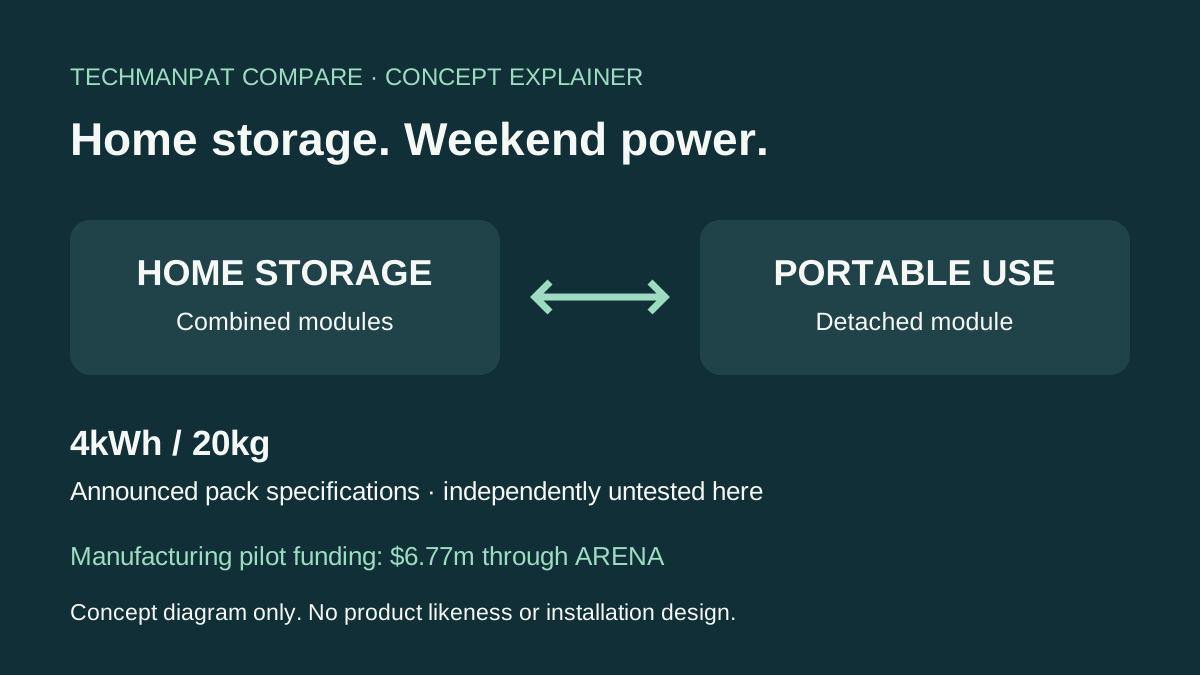
- The announced pack is 4kWh and 20kg; usable capacity and output need checking.
- Home integration, safety evidence, price and warranty remain buyer questions.
One battery, two very different jobs
Imagine using a battery at home during the week, then taking part of that stored energy camping. It is an appealing idea if you already juggle a home-energy wish list and a boot full of weekend gear. The useful question is whether one system can handle both jobs well.
The 30 October government announcement commits $6.77 million through ARENA to Clutch Industries’ $19.35 million manufacturing project in Coburg North, Victoria. Its PowerNet concept combines detachable portable packs into a home battery system. This is funding for development and manufacturing capability; it does not establish a shop-ready product.
Disclosure: Fox ESS, SAJ, Sunterra and Solis Storage sponsor Compare’s home-battery category. This article is independent editorial.
What the 4kWh headline actually tells you
The announcement describes a 4kWh pack weighing 20kg. Treat those as announced specifications, rather than our test results. We have not used PowerNet or independently measured its capacity, weight or performance.
Capacity is the amount of energy stored. Output power determines which appliances can run together. A 4kWh headline alone cannot tell you whether a particular system will start your fridge, run a kettle or handle both at once.
For illustration, 4kWh divided by a steady 100W load gives 40 hours before losses or reserve limits. That is simple arithmetic, not a PowerNet runtime claim. Ask for usable capacity and measured runtime at your actual load. Also try lifting 20kg safely before deciding how portable that sounds for your trips.
A pilot line still has work to prove
ARENA’s project page describes a pilot line assembling pre-conditioned solid-state cells into complete systems, with real-world validation supporting broader commercial uptake. Australian system assembly does not establish Australian-made cells. Its listed project runs from 8 September 2026 to 13 December 2029; neither date is a retail launch promise.
The solid-state label is a reason to follow the testing, rather than skip it. Ask for independent safety evidence, applicable certification and operating-temperature limits for the finished system. We have not verified consumer certification or a fireproofness claim.
In a camping setup, check weather protection, connectors, charging options and the accessories needed for your appliances. At home, ask a qualified installer what inverter, switching and protection equipment would be required. Never assume a portable unit can simply plug into the house and provide safe backup.
The modular catch: energy can only be in one place
Taking a module away means its stored energy is unavailable at home. Plan around what stays behind for evening use or backup. Ask whether removing a module changes available output, whether disconnection requires shutdown and how the system manages modules with different charge levels.
Compare the complete installed home setup plus portable accessories against buying separate equipment. Include installation, replacement modules, service arrangements and any subscription costs in that comparison. A clever modular design still needs a competitive total price.
As checked on 2 November, these official sources do not establish retail pricing, shipping, consumer warranty terms or rebate eligibility. Named project partners are not proof of retail stock. I would wait for those details before making a purchase decision around PowerNet.
My take: sharing storage between home and weekends is worth watching. The next useful milestone is a tested, supported system with a clear price. Meanwhile, use our home battery comparison and solar, battery and charger compatibility guide to work out the jobs your equipment actually needs to do.
Primary sources
Read the evidence.
- Funding announcement, 30 October 2026Australian Government ministers ↗
- PowerNet pilot manufacturing projectAustralian Renewable Energy Agency ↗
Checked 2 November 2026 against the two original official sources. Announcement analysis, not hands-on testing. Project dates are not retail dates; partner names do not establish stock. No verified pricing, shipping, consumer warranty, certification or rebate eligibility. Original Compare graphic shows a concept without a product likeness.
Community
Add to the article.
Useful experiences, questions and corrections make the next reader’s decision easier.
Comments appear here after moderation.