
The short version
What you need to know.
- On 11 September 2026, Australian energy ministers endorsed a national technical regulatory framework for consumer energy equipment. The detailed code and regulator are still being established.
- A future national baseline does not confirm that any particular solar inverter, battery and charger can already share one app or automate charging together.
- Ask the installer to specify the exact models and show how solar charging, load control, backup and future upgrades will work in your home.
The new national framework is a useful signal, not a compatibility badge
On 11 September 2026, Australia’s Energy and Climate Change Ministerial Council endorsed a Consumer Energy National Technical Regulatory Framework. It sets a path for a national technical code covering equipment such as solar and battery inverters and EV chargers, along with product registration and installer accreditation for regulated products.
The aim is to make equipment reliable on the grid and easier to connect across products and services. But the framework describes how rules will be established. It is not an announcement that every device on sale today will talk to every other device.
There is useful groundwork: energy ministers endorsed 18 initial device requirements in December 2025, published in March 2026 as guidance for future equipment. The government says existing installed devices will not have to be retrofitted to meet those requirements. If you are shopping now, ask about the equipment you are actually being offered.
Start with the job you expect the system to do
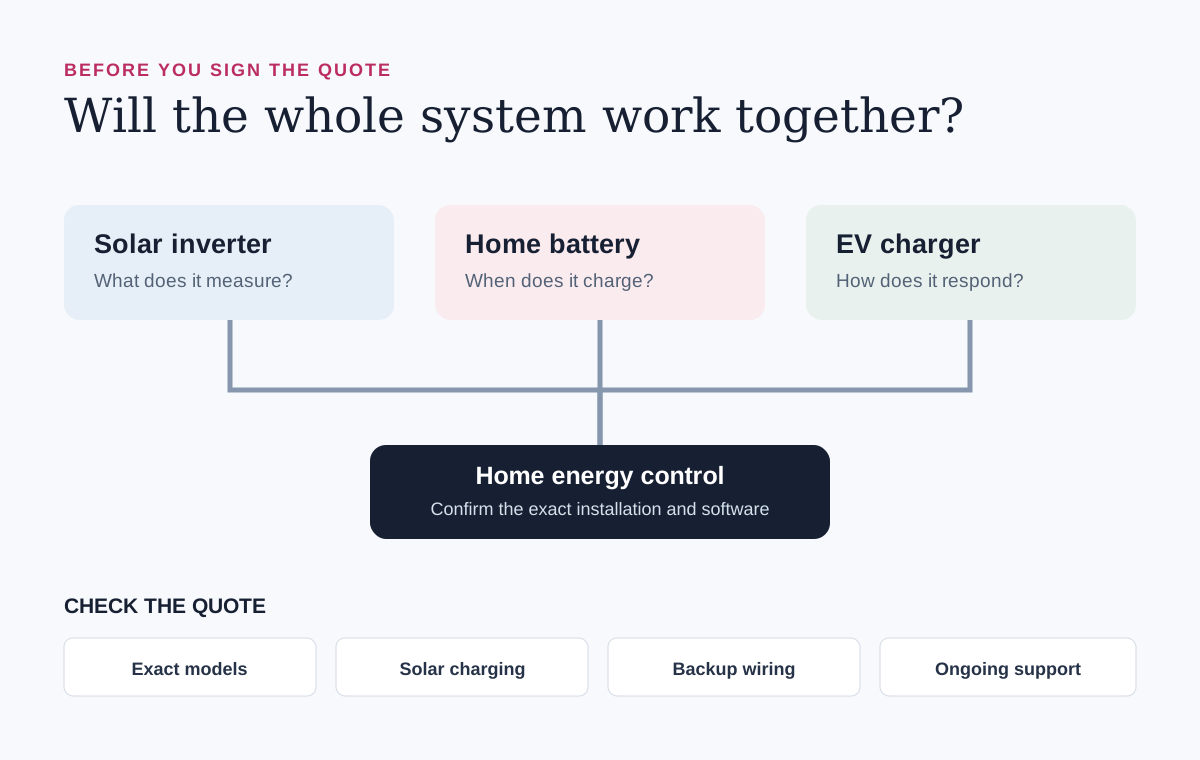
A house can have solar panels, a battery and an EV charger that all operate safely and still fall short of the experience you imagined. The charger may draw from the grid while the panels export, or two separate apps may leave you to manage schedules yourself. Compatibility is more than the physical ability to connect.
Write down the outcome you want: charge the car only with surplus solar, protect the household’s grid connection from overload, fill the battery before the evening peak, or keep selected circuits running during a blackout. Ask the installer to explain which device makes each decision and whether those functions are supported by the quoted model and firmware.
My practical rule is to have the installer demonstrate the workflow with documentation for the exact models, not just say the brands are compatible.
Six questions to put on the installation quote
These questions give you something specific to compare between installers. A written answer also helps when a product is substituted before installation.
- What are the exact model numbers, inverter configuration and software or control-system requirements? Identify any separate meter, energy manager or subscription needed.
- Can the charger use surplus solar automatically, and does that still work when the home battery is charging or discharging? Ask how the system prioritises the car versus the battery.
- How is household load managed if the EV, oven and air conditioning run together? Ask whether dynamic load management is included, where it measures consumption and whether the switchboard needs work.
- Which circuits stay powered in a blackout? Ask whether the EV charger is on a backed-up circuit and what happens to charging when grid power fails.
- Can you add or change an EV charger, battery or energy retailer later? Request the supported integration list for your exact equipment and ask what happens if a cloud service or subscription ends.
- Who handles commissioning, firmware updates and support if two brands point at each other? Have the installer document the handover and the party responsible for diagnosing integration faults.
Solar charging and backup are two different promises
Solar-aware EV charging usually needs a way to measure what the whole house is importing or exporting, plus a control path that tells the charger what to do. Owning panels and a smart charger does not establish that this measurement and control are included in your quote.
Backup needs its own design. A battery with backup capability may power only selected circuits, and a home charger can be outside that backed-up section. If charging during an outage matters to you, ask the electrician to show it on the proposed wiring diagram and explain the available power and conditions. Do not infer whole-home backup from a battery capacity figure.
That distinction matters when comparing price. A quote for hardware alone can look cheaper than one that includes compatible metering, a backup gateway, switchboard work and commissioning.
Compare Australian home batteries and their backup details →
Think ahead without buying a promise
Australia’s proposed code is intended to set a national technical baseline, while the framework says states and territories may retain requirements above that baseline. It also places ongoing conformance responsibilities on suppliers of regulated products. Those are valuable directions for the market, but they do not turn an unverified future software feature into one you can rely on today.
If you want to change energy plans or join a virtual power plant later, ask what controls the retailer or VPP will need, what data is shared, and whether your proposed battery is supported. Treat future vehicle-to-home or vehicle-to-grid capability as a separate, model-specific question rather than assuming an ordinary EV charger can provide it.
I would favour a quote that clearly delivers today’s required functions and leaves sensible expansion options. The best system is the one whose behaviour, wiring and support you can verify before paying.
Primary sources
Read the evidence.
- Consumer Energy National Technical Regulatory Framework, endorsed 11 September 2026Australian Government ↗
- Full national technical regulatory framework (PDF)Australian Government ↗
- Consumer energy device interoperability and existing equipmentAustralian Government ↗
- Initial device requirements, published 30 March 2026Australian Government ↗
Government framework and guidance checked 23 September 2026. Product compatibility must be verified for the exact models, firmware and installation.
Community
Add to the article.
Useful experiences, questions and corrections make the next reader’s decision easier.
Comments appear here after moderation.