
The short version
What you need to know.
- Peugeot advertises the E-Expert Pro Long Auto from $56,990 drive-away while stocks last—a stated $26,805 saving and about 32 per cent below the previous drive-away figure.
- The like-for-like diesel Expert Pro Long Auto is currently advertised from $45,990 drive-away, making the electric premium $11,000. The often-quoted $13,000 gap compares the electric Long with the shorter diesel Pro.
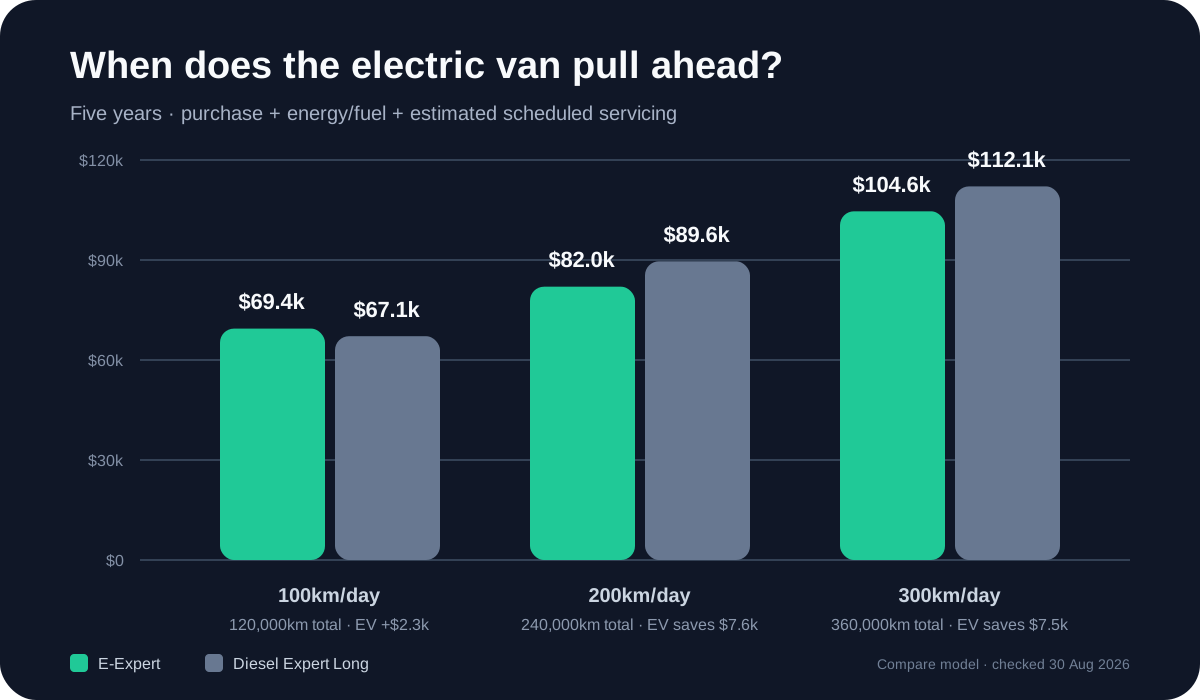
- Our five-year model puts the EV about $2,300 behind at 100km per workday, about $7,600 ahead at 200km and about $7,500 ahead at 300km when that longest schedule includes some public DC charging.
- The E-Expert carries 1,001kg and 6.1 cubic metres, but the diesel can carry up to 1,350kg. The EV's 1,000kg braked tow rating is also a hard check for trailer users.
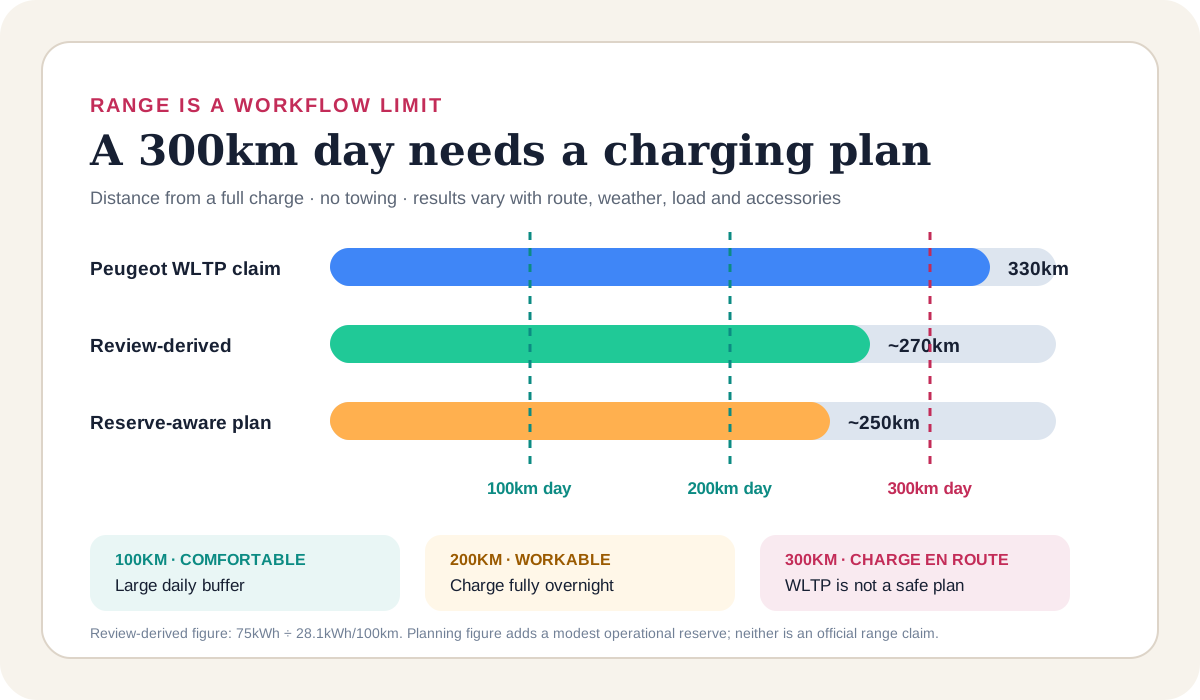
- A 300km workday should not be planned around the 330km WLTP claim. Independent testing recorded about 28kWh/100km, implying roughly 250–270km before allowing a sensible reserve.
The discount is real—but compare the correct diesel van
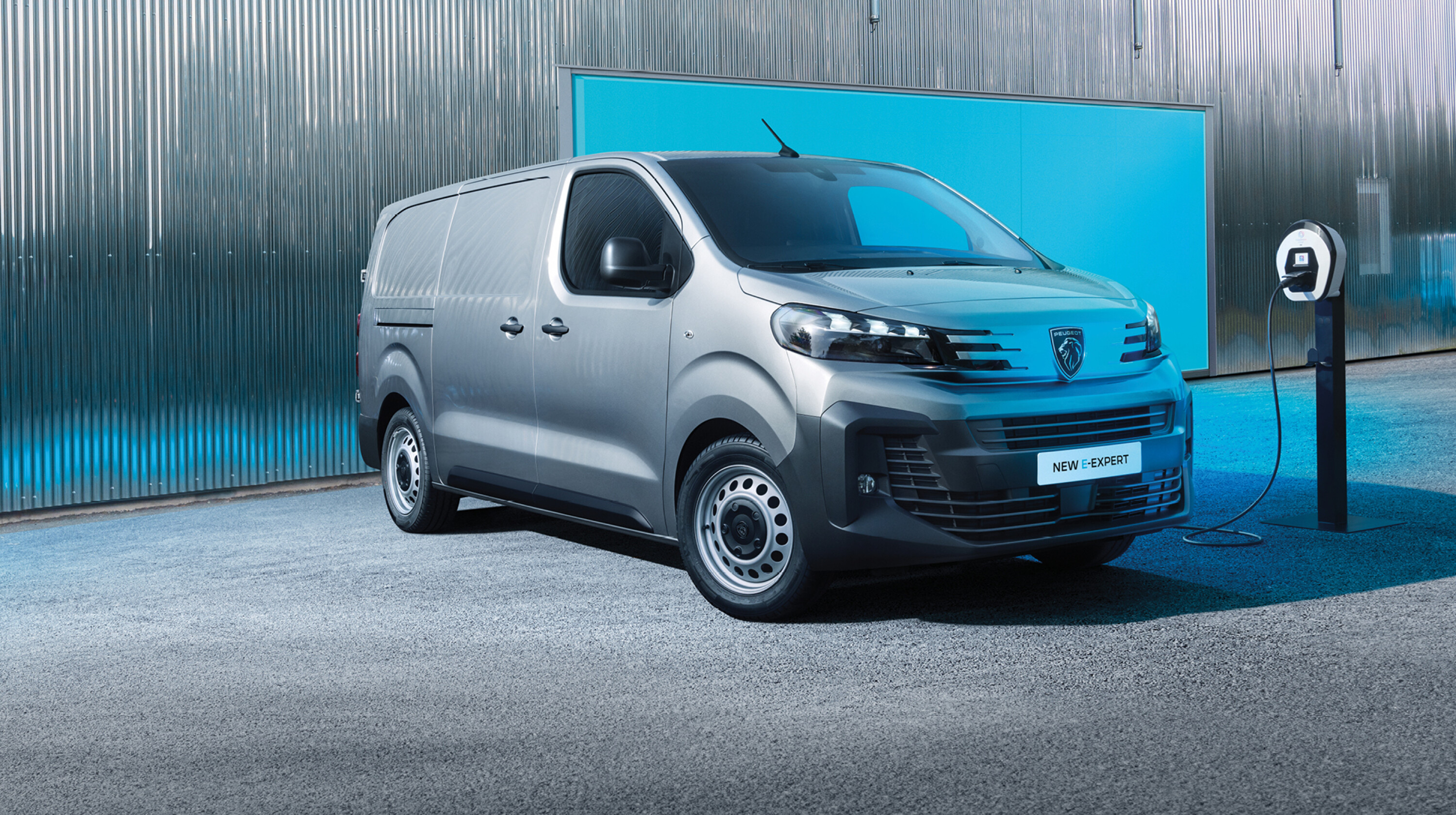
Peugeot Australia is advertising the single E-Expert Pro Long Auto from $56,990 drive-away while stocks last. The company says that is a $26,805 saving, which works out to almost exactly 32 per cent off the previous drive-away figure. For an electric commercial vehicle, that is not a token rebate.
There is one useful correction to the early reporting. Peugeot currently advertises the diesel Expert Pro Short Auto from $43,990 and the Pro Long Auto from $45,990. Because the electric van is only sold as a Long, the like-for-like purchase gap is $11,000—not $13,000. The larger figure compares two different body lengths.
The offer is still a stock-clearance price rather than a permanent new list price. Colour, dealer availability, build date and the exact offer terms need confirming before a business orders accessories or sells an existing van.
What a tradie actually gets
The E-Expert uses a 75kWh battery and a 100kW front motor producing 260Nm. Peugeot claims up to 330km on the WLTP laboratory cycle. It can charge at up to 11kW AC or 100kW DC; Peugeot quotes 7.5 hours from empty on three-phase 11kW AC and 45 minutes from zero to 80 per cent on a suitable DC charger.
The working numbers matter more. Peugeot publishes a 1,001kg payload, 6.1 cubic metres of cargo volume and a 1,000kg braked towing limit. The diesel Expert range offers up to 1,350kg payload, so a shelving system, permanent tool load, passengers and towball download can erase the EV's legal carrying margin faster.
An independent CarExpert test averaged 28.1kWh/100km in urban use and 27.5kWh/100km with 650kg of ballast. Interestingly, the load did not make that particular test worse. It does show why dividing 75kWh by the brochure range is too optimistic for budgeting: around 28kWh/100km points to roughly 268km before allowing for usable battery limits and a reserve.
How I calculated five-year ownership
I used 240 workdays a year, giving 120,000km, 240,000km and 360,000km over five years. The EV is modelled at 28kWh/100km plus 10 per cent charging loss. Depot or home charging costs 30 cents per kWh. The 300km case uses 75 per cent AC and 25 per cent public DC at 65 cents per kWh because that route is unlikely to fit inside a realistic single-charge workday.
The diesel Long starts at $45,990 drive-away, uses Peugeot's official 6.3L/100km combined figure and pays $2.40 per litre. That fuel price is a round planning assumption reflecting current volatility, not a five-year forecast.
Servicing uses Peugeot's current five-year prepaid prices: $1,350 for the electric Expert and $2,295 for the diesel. For kilometres beyond the included five scheduled visits, I extrapolated the current average pay-as-you-go cost at each published interval—25,000km for the EV and 20,000km for the diesel. That is an estimate, because Peugeot does not promise today's prices beyond the first five services.
- Included: advertised purchase price, electricity or diesel and scheduled servicing.
- Excluded: finance, insurance, registration after purchase, tyres, repairs, charger installation, downtime, accessories and resale value.
- All figures are GST-inclusive consumer amounts. A business's GST, depreciation and finance treatment can change the cash result—ask an accountant rather than treating this as tax advice.
The result: kilometres make the EV case
At 100km per workday, the five-year totals are almost level: about $69,400 for the E-Expert and $67,100 for the diesel. The EV saves roughly $9,100 in energy and around $1,700 in scheduled servicing, but that does not quite recover the $11,000 purchase premium.
At 200km per day, the E-Expert comes out around $7,600 ahead. At 300km, it is about $7,500 ahead even after assigning one quarter of its energy to more expensive public charging. If every kilowatt-hour in that longest case came from 30-cent depot charging, the calculated saving would rise to about $17,200—but the route would still need a charging opportunity.
These totals are not a promise. A diesel price nearer $2.00/L delays EV break-even; cheap solar or overnight electricity accelerates it. Resale is the biggest unknown because the discount may lower used values as well as the entry cost. The useful conclusion is that the new price makes the running-cost conversation credible, not automatic.
Tools affect range—and payload legality
Weight is only one range variable. Roof racks, ladders and conduit can hurt a van's aerodynamics; motorway speeds, headwinds, hills, cabin heating or cooling and repeated acceleration also matter. Peugeot itself warns that load, journey type, configuration, battery condition and climate change real-world range.
The independent 650kg test is a helpful reminder not to invent a fixed payload penalty. It recorded 27.5kWh/100km, slightly better than the review's unladen urban use. Route and speed can matter more than mass once a van is moving. For planning, however, a tradie still needs reserve rather than assuming the 330km laboratory number will appear every day.
At 100km, even a difficult day leaves ample buffer. At 200km, overnight charging should make the van workable for many metropolitan rounds. At 300km, a 20-minute interruption can become much longer when the charger is occupied, broken or away from the job. That operational cost is not captured in the ownership chart.
Charging is a workflow decision, not a specification
The best E-Expert owner returns to a depot or home every night, has a dedicated circuit and starts each morning full. Three-phase 11kW charging is ideal, but a 7.4kW single-phase wallbox can also replenish a typical 100–200km day overnight. Peugeot's quoted 23-hour full charge at 7.4kW looks unusually conservative, so the installer should size the electrical work against the vehicle and charger documentation rather than marketing arithmetic.
Public DC should be a backup or a planned lunch stop, not the only operating model. A claimed 45-minute zero-to-80 charge is acceptable when the van would otherwise be parked, but expensive labour and missed appointments can overwhelm a few thousand dollars of annual energy savings.
High-kilometre buyers should also notice the warranty limits. The vehicle is covered for five years or 200,000km and the battery for eight years or 160,000km, whichever comes first. At 200km per workday the battery distance limit arrives after roughly 3.3 years; at 300km it arrives after about 2.2 years. That is a commercial risk to price, not a reason to panic.
So, is an EV van finally practical for tradies?
For an urban electrician, plumber, facilities team or delivery operator covering 120–220km a day and charging at base, yes—the E-Expert is now financially and operationally credible. It is quiet, avoids diesel stops, carries a genuine tonne and can recover its price premium through use.
For 300km days, regional work, unpredictable call-outs, heavy trailers or a fit-out pushing toward one tonne, I would still choose the diesel unless a dependable mid-shift charger is part of the route. The spreadsheet can favour the EV while the job diary rejects it.
Before signing, weigh the finished van with driver, passengers, shelves and normal tools; log actual daily kilometres for a month; quote the charger installation; confirm the stock vehicle and warranty start date; and ask the dealer for written servicing coverage at your annual distance. The $26,805 discount gets the E-Expert onto a tradie's shortlist. The route decides whether it stays there.
Primary sources
Read the evidence.
- Peugeot E-Expert offer and Australian specificationsPeugeot Australia ↗
- Peugeot Expert diesel offer and specificationsPeugeot Australia ↗
- Peugeot prepaid service-plan pricingPeugeot Australia ↗
- Peugeot E-Expert price and specification guideCarExpert ↗
- Peugeot E-Expert independent road and load testCarExpert ↗
- Peugeot E-Expert GVM testCarsGuide ↗
- Australian electric-van price-cut reportingThe Driven ↗
- Weekly Australian diesel-price reportingAustralian Institute of Petroleum ↗
Offer, specifications and service pricing were checked on 30 August 2026. Cost results are a transparent planning model, not a quotation or forecast. Electricity, diesel, route efficiency, service prices, tax treatment and vehicle availability will vary. Independent consumption data came from one review vehicle and should not be treated as a guaranteed result.
Community
Add to the article.
Useful experiences, questions and corrections make the next reader’s decision easier.
Comments appear here after moderation.