
The short version
What you need to know.
- FCAI reported 23,510 battery-electric vehicle sales from all reporting sources in July 2026, equal to 21.7% of the Australian new-vehicle market.
- Australians bought 127,244 BEVs in the first seven months of 2026, giving them a 17.3% year-to-date share—already more vehicles than were sold in all of 2025.
- Lower entry prices, far more models, fuel-price volatility, the New Vehicle Efficiency Standard and the FBT exemption for eligible electric cars are all contributing.
- The tipping point has likely arrived for new-car consideration, but home charging, regional infrastructure, insurance, servicing and resale risk still make the decision household-specific.
One in five is no longer a niche result
Australia's electric-car market has spent years being described as almost ready to take off. The July 2026 result is different. The Federal Chamber of Automotive Industries reported 23,510 battery-electric vehicle sales from all reporting sources, representing 21.7% of the total new-vehicle market.
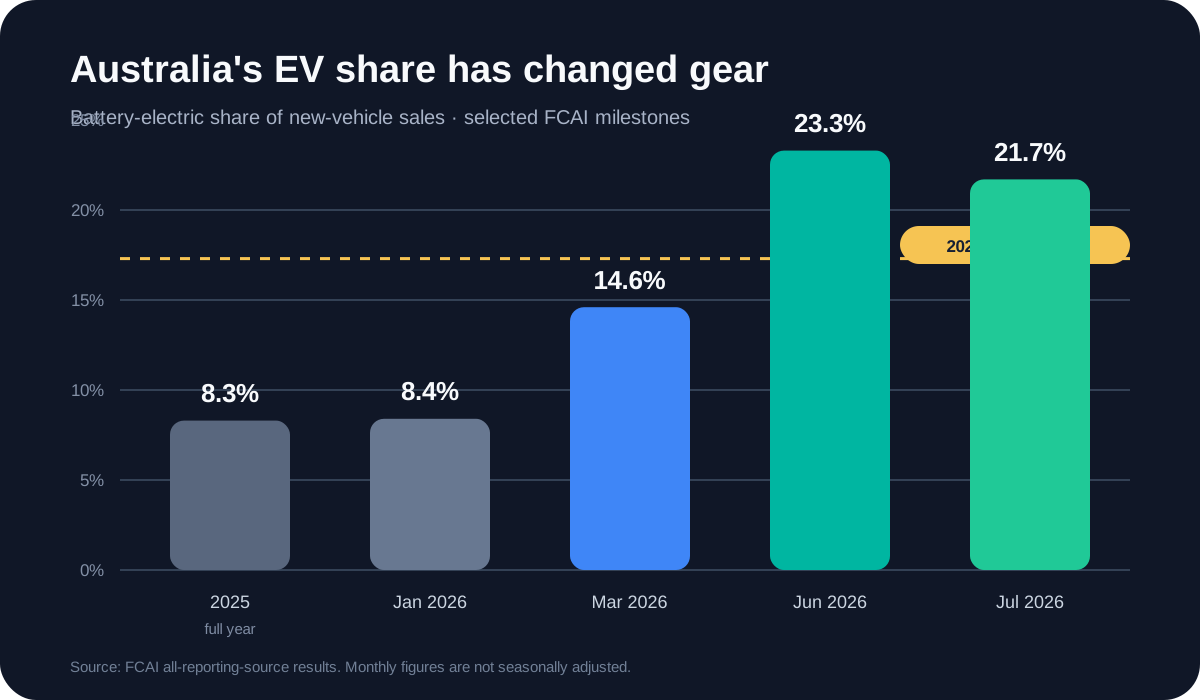
This was not a one-month spike created by an end-of-financial-year delivery rush. June reached a record 23.3% share, while May also cleared one in five. July therefore became the third consecutive month in which battery-electric cars represented more than 20% of Australian new-vehicle sales.
The year-to-date number adds weight to the change. Australians bought 127,244 BEVs in the first seven months of 2026, giving the category a 17.3% share. That is already more battery-electric vehicles than the 103,269 sold throughout 2025, when BEVs represented 8.3% of the annual market.
So, has the tipping point arrived?
If a tipping point means an EV is now a normal option on an Australian new-car shortlist, the answer is yes. A category holding more than one-fifth of new sales for three consecutive months is no longer dependent on a small group of enthusiasts. Electric SUVs, hatches, sedans and people movers now compete across a much wider spread of budgets.
If a tipping point means the transition is guaranteed to continue at the same pace, the answer is not yet. New-car deliveries are lumpy, incentives can move demand between months, and a relatively small number of high-volume models can have an outsized effect. The more important test is whether a high share persists after fuel prices settle, tax settings change and the first wave of discounted stock clears.
The best description is that Australia has entered the acceleration phase of EV adoption. Buyers are no longer asking only whether electric cars work. They are comparing which one fits, how they will charge it and whether the whole ownership equation beats a petrol, diesel or hybrid alternative.
The purchase-price barrier is finally moving
The most visible change is price. For years, Australia's cheapest electric cars sat well above familiar petrol hatches. In 2026, multiple BEVs are advertised below $40,000, including genuine drive-away offers as well as lower list prices before state charges.
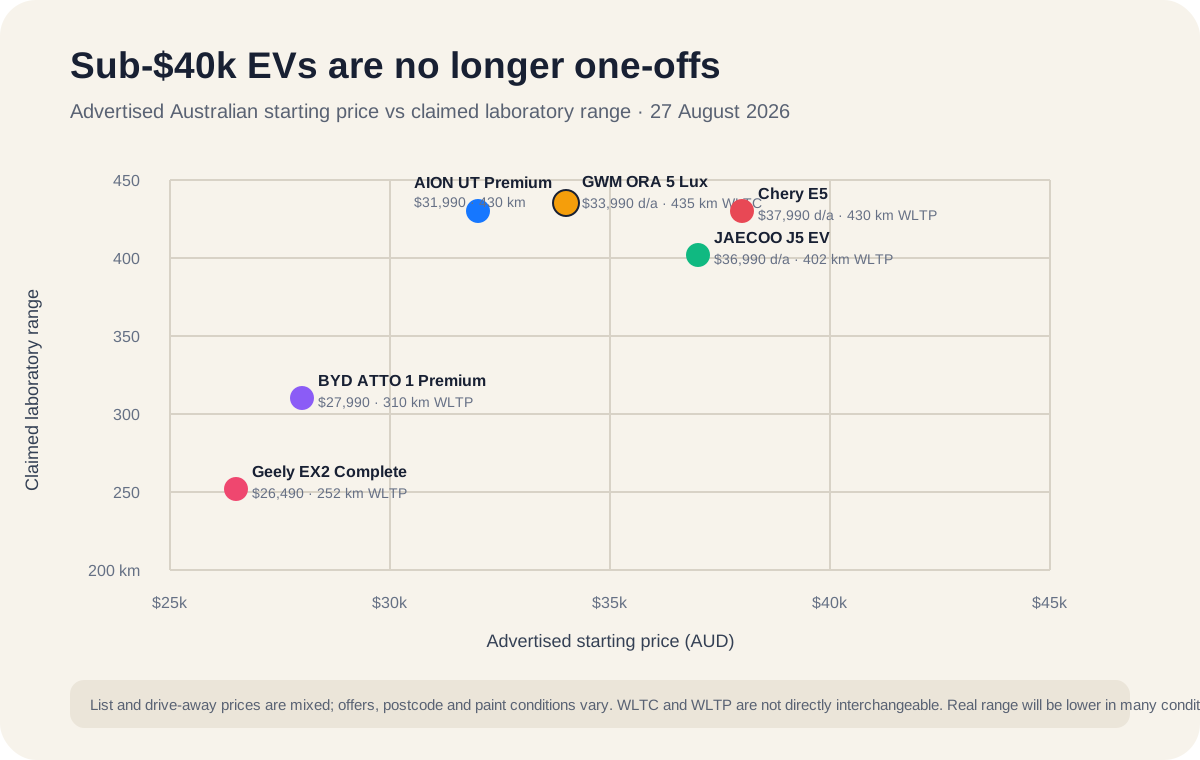
The Geely EX2 Complete starts at $26,490 before on-road costs with a 252km WLTP claim. The BYD ATTO 1 Premium is listed at $27,990 before on-roads with 310km WLTP. Higher-range options now include the AION UT Premium from $31,990 with a 430km claim, the GWM ORA 5 SUV Lux from $33,990 drive-away in Victoria with 435km on the WLTC cycle, the JAECOO J5 EV from $36,990 drive-away with 402km WLTP, and the Chery E5 from $37,990 drive-away with 430km WLTP.
Those figures are not perfectly like-for-like. Some are manufacturer list prices, others are postcode-dependent drive-away offers, and GWM publishes WLTC rather than WLTP for the ORA 5. They still demonstrate the structural change: an Australian buyer can now cross-shop several electric body styles without beginning at $50,000.
Petrol prices sharpened the running-cost argument
Lower EV prices arrived as fuel became less predictable. The ACCC increased its fuel-market monitoring after conflict in the Middle East began in late February. Its March reporting showed average retail petrol across the five largest capital cities rising by 48.8 cents per litre between 20 February and 11 March, with Perth recording the largest capital-city increase at 59.5 cents per litre over that period.
Fuel prices do not explain the entire sales surge, but they make the comparison more immediate. A household that can charge at home—particularly from rooftop solar or a cheap overnight tariff—can put a stable figure against most daily driving. Petrol drivers remain exposed to both the retail price cycle and international supply shocks.
That advantage is not automatic. Public fast charging can cost much more than home charging, apartment residents may not have a dedicated bay, and an inefficient EV on an expensive electricity plan can narrow the saving. Buyers should compare their own kilometres, home electricity rate, public-charging reliance and petrol alternative rather than repeating a national average.
Policy helped move EVs from premium to mainstream
The market did not change in isolation. Australia's New Vehicle Efficiency Standard gives manufacturers a stronger reason to supply efficient vehicles and a broader model range. It does not force an individual buyer to choose an EV, but it changes the commercial calculation behind which models manufacturers bring here and how aggressively they price them.
The electric-car fringe benefits tax exemption is another powerful driver. Under current ATO rules, eligible battery-electric cars and associated expenses can be exempt from FBT when the conditions are met. For employees with access to a novated lease, that can materially change the after-tax cost of a qualifying vehicle. It is a tax arrangement, not a universal discount, and buyers should obtain advice using their own income, lease costs and residual value.
Charging investment is also expanding. The federal Driving the Nation program includes a national highway backbone of up to 77 charging stations and grants supporting dealership, repairer and public-charging capability. That improves confidence, but it does not make every route or apartment building equally easy today.
More choice matters as much as lower price
Early Australian EV sales were concentrated in a handful of models. The current market is harder to summarise because buyers can choose compact city cars, affordable small SUVs, family crossovers, long-range sedans, seven-seat SUVs, performance cars and electric vans. That breadth allows people to choose around boot space, rear-seat access, towing, charging speed and dealer coverage rather than accepting whichever EV happens to be available.
Competition is also forcing brands to explain more than battery size. Warranty terms, service locations, spare-wheel provision, smartphone integration, vehicle-to-load power, sunshades, physical controls and real Australian stock all matter. A cheap price can start the conversation; it cannot replace a proper household fit check.
The shift is visible at the top of the sales table too. Tesla's Model Y and BYD's Sealion 7 have become high-volume family SUVs, while newer brands including Geely, Zeekr and JAECOO are building meaningful Australian sales. The transition is no longer one manufacturer carrying the entire category.
What can still stop an EV being the right buy?
The biggest dividing line remains charging access. A driver with a garage, a modest daily commute and off-peak or solar electricity can begin most mornings with enough energy. A renter relying entirely on busy public chargers is buying into a different cost and convenience equation.
Regional travel also needs route-specific planning. Australia's fast-charging network is improving, but a map pin does not guarantee that a charger is working, available, fast enough or compatible with the stop a family wants to make. Owners should identify a backup charger and check the car's actual DC charging curve, not only its maximum advertised kilowatt number.
Insurance, tyre cost, depreciation and repair access deserve the same attention. New brands can offer excellent products and long headline warranties, while still having a smaller service network or limited Australian parts history. A low purchase price does not prove low total ownership cost.
- Home charging: confirm a safe power point or obtain a fixed-charger quote before ordering the car.
- Real range: plan from a conservative highway figure, not the best laboratory result.
- Insurance: obtain a quote for the exact variant and postcode before paying a deposit.
- Service and repairs: check the nearest authorised repairer and ask how body and battery work is handled.
- Long trips: inspect the routes actually driven, including a backup charging stop.
- Resale: treat future value as uncertain, particularly for new brands and rapidly repriced models.
What the sales result changes for buyers today
The July result does not mean everyone should buy an electric car. It does mean an EV now deserves a place on almost every Australian new-car shortlist where the budget, body style and charging access line up. Dismissing the category on the assumption that every EV costs $70,000 or cannot leave the city is no longer consistent with the market.
Start with the household rather than the drivetrain. Set the real drive-away budget, measure the garage, list the longest regular trip, calculate weekly kilometres and establish where the car will charge. Then compare an EV with the closest petrol and hybrid alternatives on purchase price, finance, energy, insurance, servicing and likely resale.
Australia's EV tipping point has arrived in buyer attention and new-car demand. The ownership tipping point remains personal. For a home-charging commuter, the case can already be compelling; for an apartment resident travelling remote routes, waiting or choosing a hybrid can still be completely rational.
Primary sources
Read the evidence.
- EV sales remain strong during record-best JulyFederal Chamber of Automotive Industries ↗
- New vehicle market records strongest month everFederal Chamber of Automotive Industries ↗
- Australia's 2025 new-vehicle sales resultFederal Chamber of Automotive Industries ↗
- Weekly fuel price monitoring update — 21 August 2026Australian Competition and Consumer Commission ↗
- Electric cars FBT exemptionAustralian Taxation Office ↗
- National Electric Vehicle StrategyAustralian Government ↗
- Driving the Nation FundAustralian Government ↗
- Geely EX2 Australian build and priceGeely Australia ↗
- BYD ATTO 1 specificationsBYD Australia ↗
- AION UT Australian specificationsGAC Australia ↗
- GWM ORA 5 SUV Australian specificationsGWM Australia ↗
- JAECOO J5 EV Australian specificationsOMODA JAECOO Australia ↗
- Chery E5 Australian specificationsChery Australia ↗
Sales, policy, prices and specifications were checked on 27 August 2026. FCAI's all-sources figures incorporate reporting beyond the VFACTS dataset. Vehicle prices can be list prices or postcode- and time-dependent drive-away offers. Claimed WLTP and WLTC ranges are laboratory results and should not be treated as guaranteed real-world range.
Community
Add to the article.
Useful experiences, questions and corrections make the next reader’s decision easier.
Comments appear here after moderation.