
The short version
What you need to know.
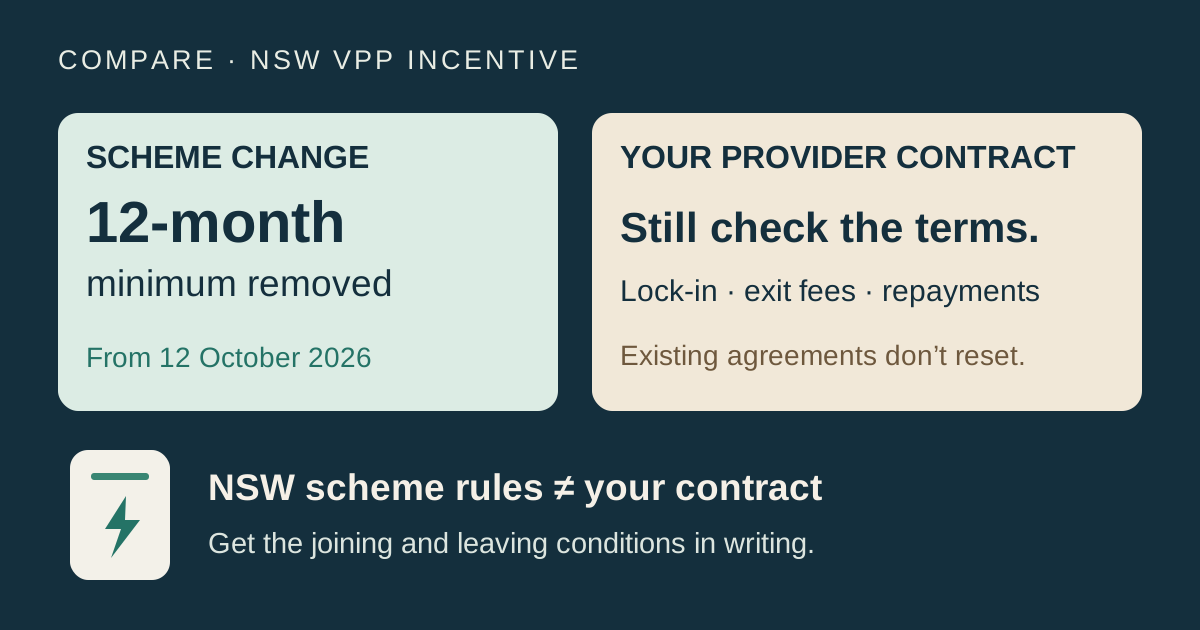
- NSW removed the BESS2 scheme requirement for a minimum 12-month VPP contract from 12 October 2026.
- The change does not automatically remove provider lock-ins, exit fees or restrictions in an existing agreement.
- Check eligibility, the full electricity plan, payment conditions and battery control. This is a NSW scheme change, not a WA or national rule.
One rule changed, not every contract
A battery incentive is useful. Discovering the exit conditions after signing is considerably less useful. NSW’s latest VPP change is worth understanding before treating “no 12-month requirement” as a promise of complete freedom.
IPART’s 12 October announcement says the Peak Demand Reduction Scheme removed the BESS2 requirement for a virtual power plant contract to last at least 12 months. The change commenced that day; all other scheme requirements still apply.
This is a NSW scheme change. It does not change WA arrangements or create a national right to leave any VPP whenever you like.
The provider agreement still matters
IPART’s rule-change guidance identifies the removed condition as the minimum duration of the demand-response contract. Removing that scheme requirement does not automatically remove a provider’s own lock-in, exit fee or restrictions in an existing contract.
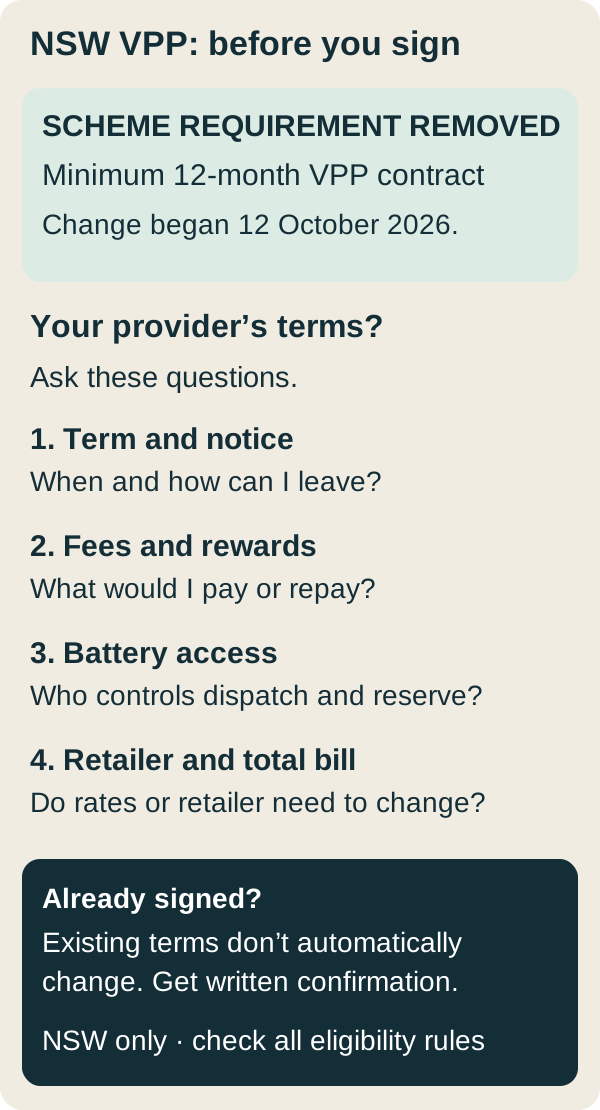
Before joining, ask whether there is a fixed term, how much notice you must give, and whether leaving triggers a fee or repayment of an upfront reward. Ask what happens if you change electricity retailer, move house or sell the battery.
If you already signed, get written confirmation of what changes for your agreement before switching or cancelling. A government headline is not a cancellation receipt.
Confirm eligibility before counting the payment
The current Rule’s BESS2 requirements specify usable battery capacity greater than 2kWh and up to 50kWh on the approved product list. Your exact battery, site and proposed arrangement must meet the remaining requirements. Ask the provider to confirm eligibility rather than assuming the brand name is enough.
The NSW incentive page says providers choose which models and locations they support, and you need one offering this incentive. A compatible electricity retailer is also required, so joining may mean changing retailer.
The same page distinguishes the eligible battery size from the incentive calculation: the incentive depends on capacity made available to the grid, capped at 28kWh. It can only be claimed once per National Metering Identifier, so check any earlier claim. The rule change is not an automatic second payout.
Compare the whole bill, not just the bonus
Get the actual incentive amount and payment timing in writing. Is it paid upfront, in instalments or as bill credit? Separate the NSW incentive from any provider-funded joining reward and ongoing VPP payments.
Then compare daily supply charges, import tariffs, solar feed-in payments and any VPP charges using your household’s usage. An attractive joining payment can be undermined by an electricity plan that costs more through the year. Ask for the assumptions behind projected savings; a forecast is not guaranteed income.
Check who can use your stored energy
NSW’s VPP guidance explains that providers remotely coordinate compatible batteries and offer different conditions for payments and battery access. Ask when yours can be charged or discharged, how much capacity is available, and whether you can change the settings.
If blackout backup matters, confirm the protected reserve and how VPP operation interacts with it. Also check internet requirements, warranty conditions and where you can see dispatches and payments.
IPART’s updated Method Guide confirms the scheme change; it does not replace your provider paperwork. My advice is to compare a couple of written offers, including the cost of leaving. Less compulsory commitment is welcome. A good deal still needs to work once the joining bonus has been spent.
Primary sources
Read the evidence.
- 12 October 2026 BESS2 contract-duration announcementIPART ↗
- Current PDRS rule changes and transitional arrangementsIPART ↗
- PDRS Rule effective 12 October 2026 — BESS2 requirementsNSW Government Gazette / IPART ↗
- PDRS Method Guide V3.2, updated 15 October 2026IPART ↗
- NSW VPP incentive eligibility, payments and nomination processNSW Climate and Energy Action ↗
- VPP operation, provider conditions and retailer compatibilityNSW Climate and Energy Action ↗
Primary sources checked on 19 October 2026. NSW-specific consumer analysis, not a provider recommendation or an interpretation of an individual contract. The 12 October Rule and updated IPART guidance take precedence over older summaries. Both graphics are original Compare illustrations; no provider logo, third-party photograph or actual contract is depicted.
Community
Add to the article.
Useful experiences, questions and corrections make the next reader’s decision easier.
Comments appear here after moderation.