
The short version
What you need to know.
- 15.3 GWh is the announcement’s approved program capacity, not a verified count of operating systems.
- Usable kWh determines stored energy; battery and inverter kW limit what can run together.
- Size around overnight demand, realistic solar surplus, your tariff and the energy you hold for outages.
A big number needs the right label
Australia’s home-battery numbers keep getting bigger. Good. But buying a battery because the national total looks impressive is a bit like buying a bigger fridge because the supermarket expanded.
The 15 October government announcement says approved capacity under the Cheaper Home Batteries Program reached 15.3 GWh by the end of September, up from 5.0 GWh at the end of 2025. That is approved program capacity. It should not be presented as independently verified, operational installations, or as the number of households powered through a blackout.
The growth is the news. Choosing the size for your place is a separate job. Here is where I would start.
kWh is the tank. kW is the tap.
Usable capacity, measured in kilowatt-hours, is the energy available within the battery’s permitted operating limits. Nominal capacity is the larger total storage figure. Ask which one the quote uses; you cannot spend the same kilowatt-hour twice.
Power, measured in kilowatts, tells you how quickly energy can flow. Check the battery’s discharge limit and the inverter’s continuous output, plus any separate backup limits. A large battery behind a small inverter can still struggle with several hungry appliances running together.
For illustration, 10 kWh supplying a steady 2 kW would last five hours before losses and reserve. That arithmetic does not promise five hours of air conditioning, cooking and EV charging. The kettle has not read your spreadsheet.
Measure the night, then check the refill
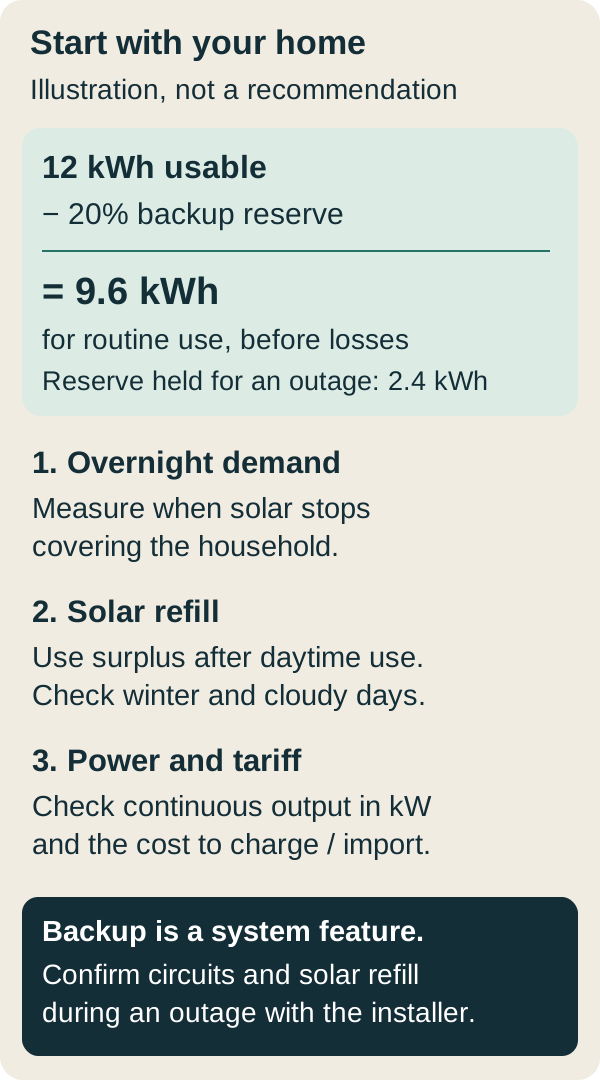
Pull your retailer’s interval data and solar monitoring across different seasons. Look at demand from when solar stops covering the house until it picks up again. A quarterly bill total hides when you actually need stored energy.
Solar Victoria’s sizing guidance starts with solar size, overnight consumption and backup needs. Allow for genuine planned changes, such as electric heating, but check whether hot water or the dishwasher can run during solar hours first.
Then check the solar surplus after daytime household use. A roof producing 25 kWh does not have 25 kWh left to charge a battery. Winter, clouds and shade matter. Extra storage that rarely fills is expensive shelf space.
Your tariff changes the sums
Compare the import price you avoid with the feed-in payment you give up, allowing for losses. If charging from the grid, compare the charging rate with the later import rate. Solar Victoria’s financial guide also stresses usage patterns and system sizing.
Check peak windows, daily charges and any VPP conditions. Ask the installer to model your actual plan and realistic cycling, rather than promising every day will behave like a sunny Tuesday. Charging controls and inverter compatibility matter too.
Backup needs its own budget
A backup reserve holds energy aside for an outage, reducing what is available for everyday bill savings. In a simplified example, 12 kWh usable with a 20% reserve leaves 9.6 kWh for routine use before conversion losses.
Backup also needs the right system design. Confirm protected circuits, starting loads and whether solar can recharge during an outage. A battery on the wall does not automatically mean the whole house stays on.
My advice: get two itemised sizes modelled against the same usage data, tariff and reserve. Compare installed cost, warranty and realistic savings. Buy the capacity your household can use, rather than trying to keep up with a national headline.
Primary sources
Read the evidence.
- 15 October 2026 renewable investment and battery capacity announcementMinister for Climate Change and Energy ↗
- Battery capacity and usable storage explainedAustralian Government — energy.gov.au ↗
- How solar and battery energy flows workSolar Victoria ↗
- Battery systems, inverters and charging controlsSolar Victoria ↗
- Working out battery costs and benefitsSolar Victoria ↗
- Sizing, overnight demand and backup designSolar Victoria ↗
- How backup reserve reduces everyday energy availabilityTesla Support Australia ↗
Primary sources checked on 17 October 2026. Independent buying analysis, not a hands-on battery test or personalised savings forecast. The capacity milestone is attributed to the government announcement and retains its approved-capacity label. Both graphics are original Compare illustrations; numerical examples are hypothetical.
Community
Add to the article.
Useful experiences, questions and corrections make the next reader’s decision easier.
Comments appear here after moderation.