
The short version
What you need to know.
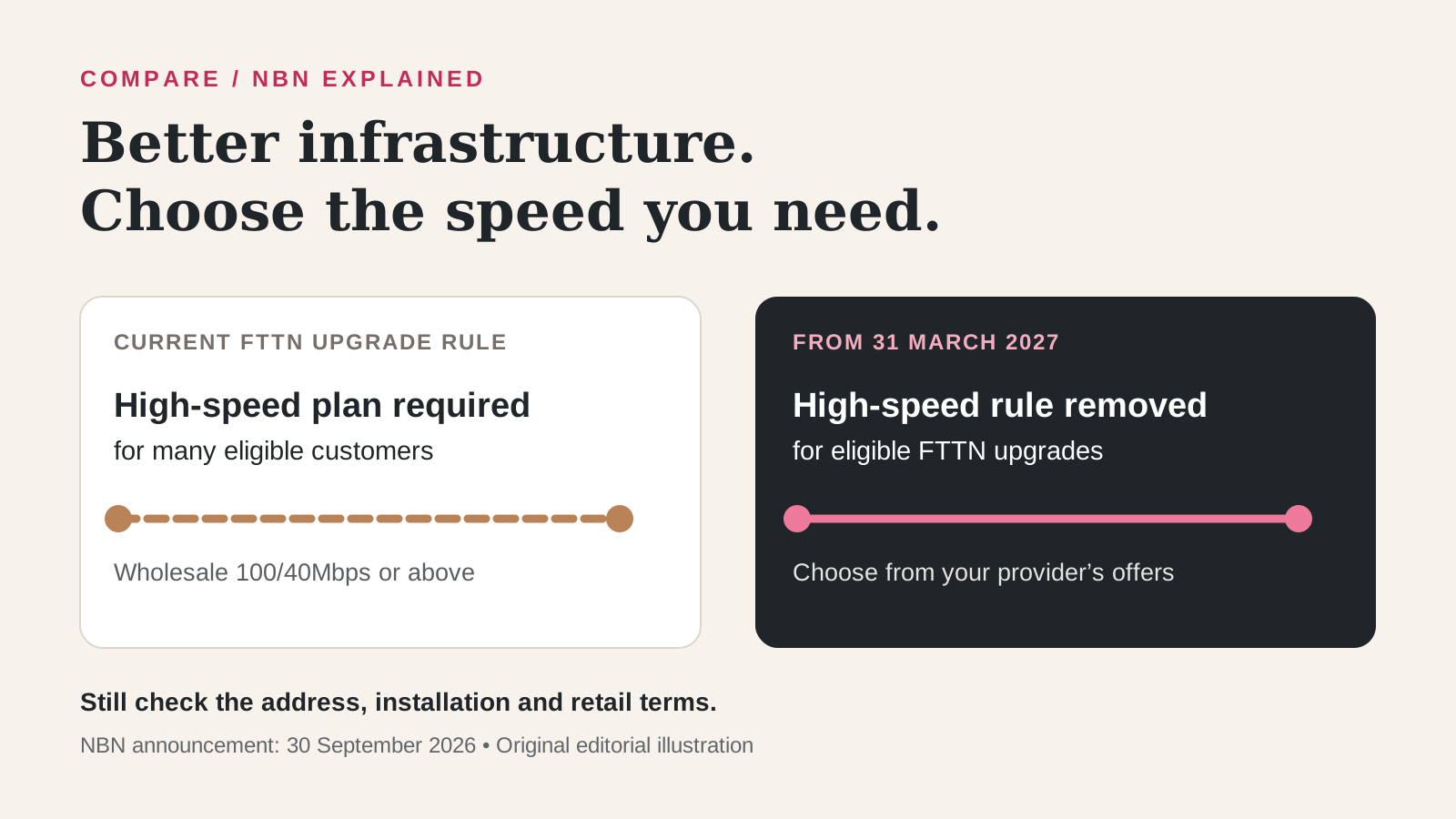
- From 31 March 2027, eligible FTTN customers will be able to access an FTTP upgrade without NBN requiring a high-speed wholesale plan.
- The announcement does not make every address eligible, set retail prices or automatically arrange an installation.
- Waiting can make sense if your connection works well and a qualifying plan costs more. A troublesome line deserves attention now.
A sensible change, with a date worth circling
NBN is removing another reason for people to stay on copper. In its 30 September announcement, the company confirmed that eligible Fibre to the Node customers will no longer need a high-speed wholesale plan to unlock a full-fibre upgrade from 31 March 2027.
Today, many FTTN upgrades require a retail service backed by a wholesale tier of 100/40Mbps or above. Those numbers mean download and upload speed respectively. A retailer’s plan name alone is not enough to establish eligibility; ask which offer actually qualifies.
The change gives providers more room to offer fibre to households happy with a lower-speed plan. It does not prescribe what those providers must charge. And despite the present-tense excitement a headline can generate, the new rule has not started yet.
Why the connection and the plan deserve separate decisions
FTTN brings fibre to a neighbourhood node, usually a street cabinet. Existing copper carries the connection from there to your home, where a compatible VDSL2 modem handles the service. Fibre to the Premises, or FTTP, brings fibre all the way to the property and uses an NBN connection box connected to your router by Ethernet.
That distinction is useful even for someone who has no interest in winning the family speed-test competition. A household may want the copper section replaced without needing a premium download tier. Paying for capacity you rarely use is still paying for capacity you rarely use, however impressive the number looks.
The earlier FTTC change already separated those decisions for eligible Fibre to the Curb customers. We covered that in August. This announcement extends the same basic direction to FTTN, with a later start date.
Should you wait until 31 March?
For a household with a stable connection and a modest speed requirement, waiting is reasonable if the current upgrade offer means a meaningful increase in the bill. Get an actual quote first. A discounted qualifying plan might be competitive with what you already pay, while another offer might become much dearer once its introductory price expires.
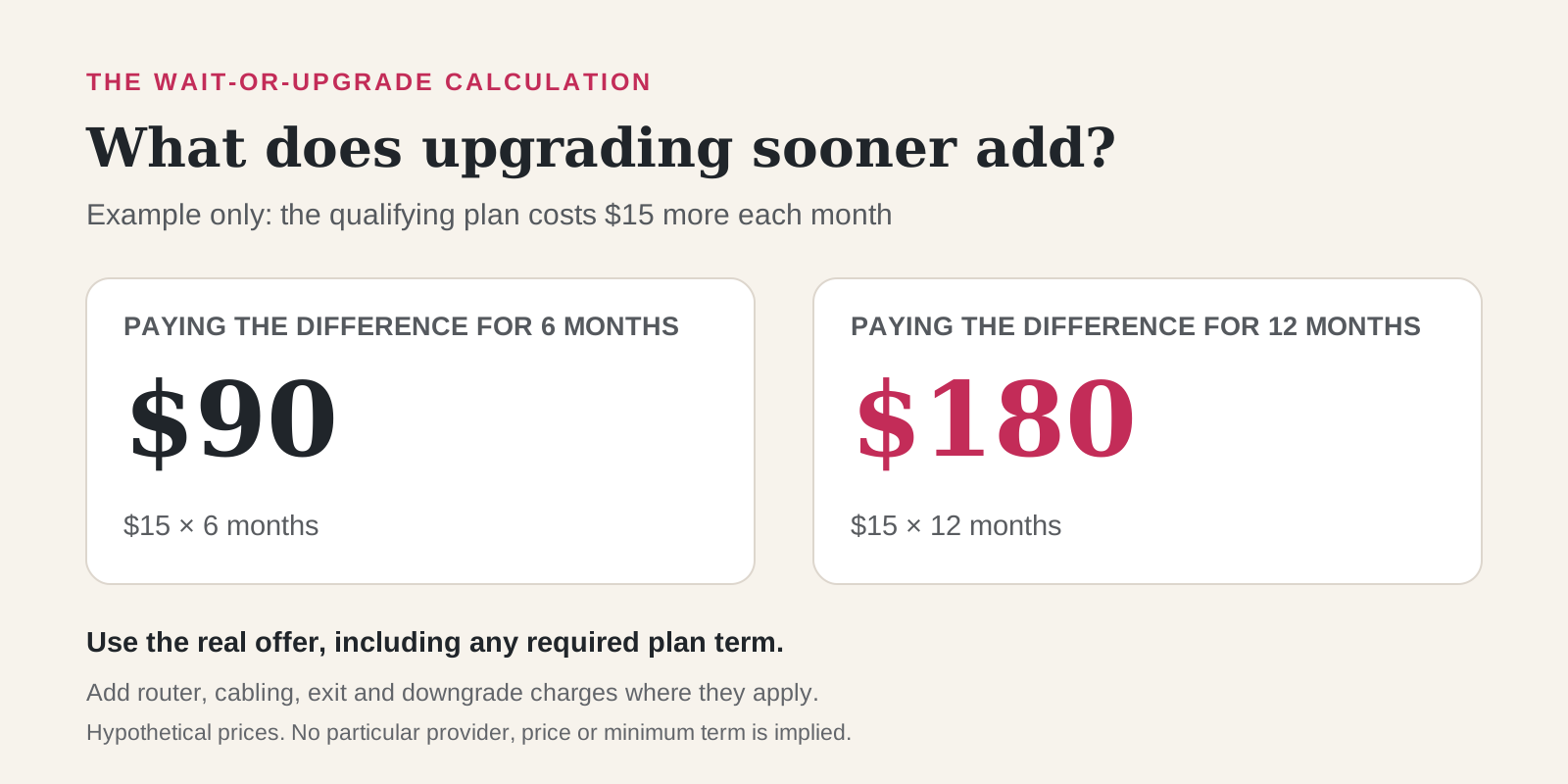
Here is a simple illustration: an extra $15 a month for six months adds $90. If the provider requires you to keep that plan for twelve months, the difference becomes $180. These are made-up prices to show the calculation, not an advertised offer or a universal minimum term. Include any router charge and exit or downgrade conditions before deciding.
Now put that extra cost beside the value of improving the connection sooner. Someone whose line regularly interrupts work has a different decision from someone whose only complaint is that the postcode next door has a nicer technology acronym. Report faults to your provider rather than treating six more months of dropouts as the required waiting room for fibre.
The announcement alone is not a reason to cancel a good upgrade booking. Compare the terms you actually have with the likely benefit of waiting; March’s retail offers are not guaranteed today.
Check the address before choosing the month
NBN’s upgrade checker and a participating provider remain the starting points. Removing a speed condition does not complete the network build outside your house. The upgrade FAQ says availability can differ within the same area because of construction complexity and environmental factors.
If you live in an apartment, townhouse development or another property with shared infrastructure, ask whether the building needs NBN’s separate complex-upgrade process. A policy announcement cannot replace the necessary access or approvals.
Ask the provider to confirm the complete price and any charges for downgrading or disconnecting. NBN is the wholesaler, so the same monthly price is not promised just because the physical connection changes. Get those answers in writing while the offer is in front of you.
Check the official fibre-upgrade process and address availability →
There is still an installation to organise
A provider arranges the appointment. NBN’s current guide says the work typically takes two to four hours, although a difficult job can take longer or need another visit. Someone over 18 must be present throughout, and renters need landlord permission before the day because drilling or digging may be involved.
Think about the connection-box location before approving it. The box and router need power, and the router’s position affects the rooms where you actually use the internet. A convenient wall in the garage can create an inconvenient Wi-Fi problem upstairs.
NBN installs the new connection alongside the existing service. Once the provider confirms fibre is working, check that the old service has been cancelled so two bills do not become your first experience of an upgraded network.
Fibre will not move your router out of the cupboard
Before spending more, compare a wired Ethernet test with Wi-Fi results beside the router and in the troublesome room. NBN’s own optimisation advice recommends this approach. If wired performance is good but the far bedroom struggles, the home network needs attention too.
Check whether your existing modem-router supports the Ethernet WAN connection needed for FTTP and whether your provider supports that setup. The upgrade is not automatically a shopping list for a new router, mesh kit and every other box in the networking aisle.
The practical answer
Choose the timing around the household. If the current service is dependable and the qualifying plan adds cost you would rather avoid, ask about lower-speed upgrade offers once the new rule starts. If you already want a faster plan, or the copper connection is causing real disruption, price an upgrade now.
The welcome part is being able to choose better infrastructure without using a more expensive plan as the entry ticket. Before ordering, confirm the address, the total bill, the installation arrangements and the provider’s terms. Those four answers matter more than the biggest speed number on the page.
Primary sources
Read the evidence.
- FTTN high-speed requirement removal announced 30 September 2026, effective 31 March 2027NBN Co ↗
- FTTN connection technology and VDSL2 equipmentNBN Co ↗
- FTTP connection technologyNBN Co ↗
- Earlier removal of the FTTC high-speed requirementNBN Co ↗
- Fibre upgrade eligibility, costs and old-service cancellationNBN Co ↗
- Installation time, adult attendance, landlord consent and equipment placementNBN Co ↗
- Wired and Wi-Fi testing to identify home-network limitationsNBN Co ↗
Written from the cited NBN announcements and consumer guidance checked on 1 October 2026. Plan-cost examples are illustrative; confirm eligibility, prices and conditions with a participating provider. Original Compare diagrams are explanatory artwork, not photographs of an installation.
Community
Add to the article.
Useful experiences, questions and corrections make the next reader’s decision easier.
Comments appear here after moderation.