
The short version
What you need to know.
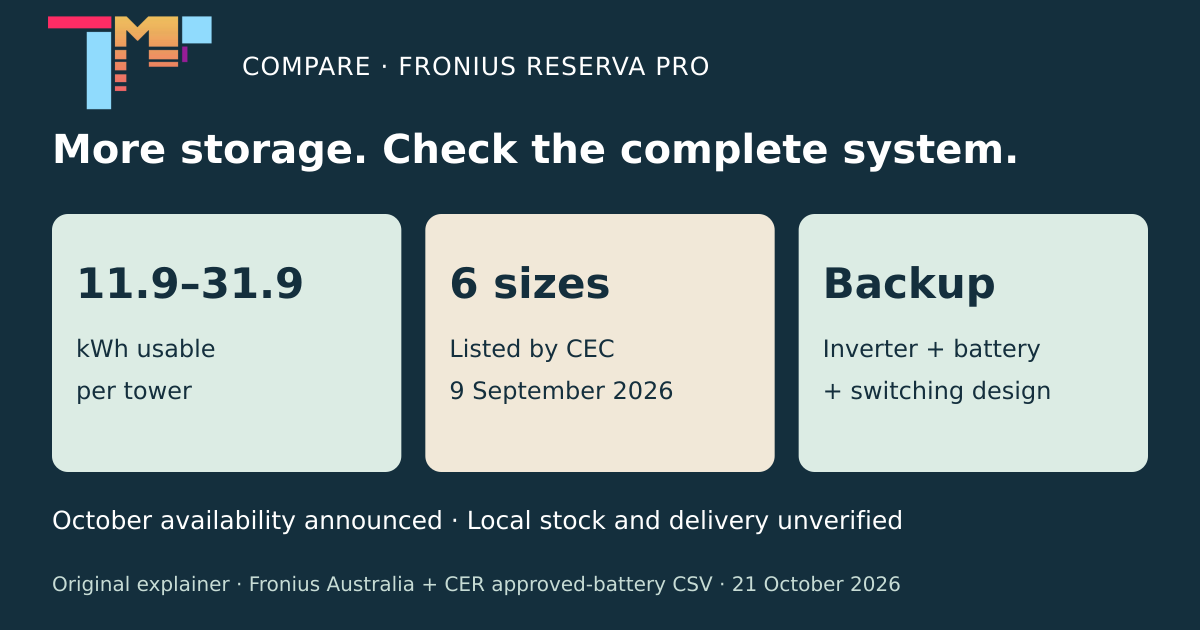
- Six Australian-listed sizes provide 11.9–31.9 kWh usable per tower.
- Inverter compatibility changes with tower size; output and backup depend on the complete configuration.
- October availability was announced in August. CEC listing is confirmed; local stock and delivery remain unverified.
October availability, with an approval we can check
A bigger home battery gets interesting when the evening now includes cooking, air conditioning and an electric car. It gets less interesting if you buy extra capacity expecting it to solve a backup-power limit somewhere else in the system.
Fronius announced Reserva Pro on 25 August, with Australian availability from October 2026 through authorised installers. This is a look at that Australian offering, rather than a launch that happened today. I could not establish a firm local stock or delivery date, so get the supply commitment on your quote.
The approval question has a firmer answer. The Clean Energy Regulator’s published approved-battery CSV lists all six Reserva Pro models, 12.0 through 32.0, with approval dated 9 September 2026. Listing does not guarantee your whole installation qualifies for an incentive, or that an installer has a tower waiting in the van.
Capacity is the size of the tank
The Australian technical table gives 11.9, 15.9, 19.9, 23.9, 27.9 and 31.9 kWh usable capacity, using three to eight modules per tower. Those precise numbers matter more than rounding the range to 12–32 kWh.
Up to four towers can be connected in parallel. Four of the largest therefore total 127.6 kWh usable, even though the marketing rounds the system headline to 128 kWh. That is a substantial installation, not a sensible default for every garage.
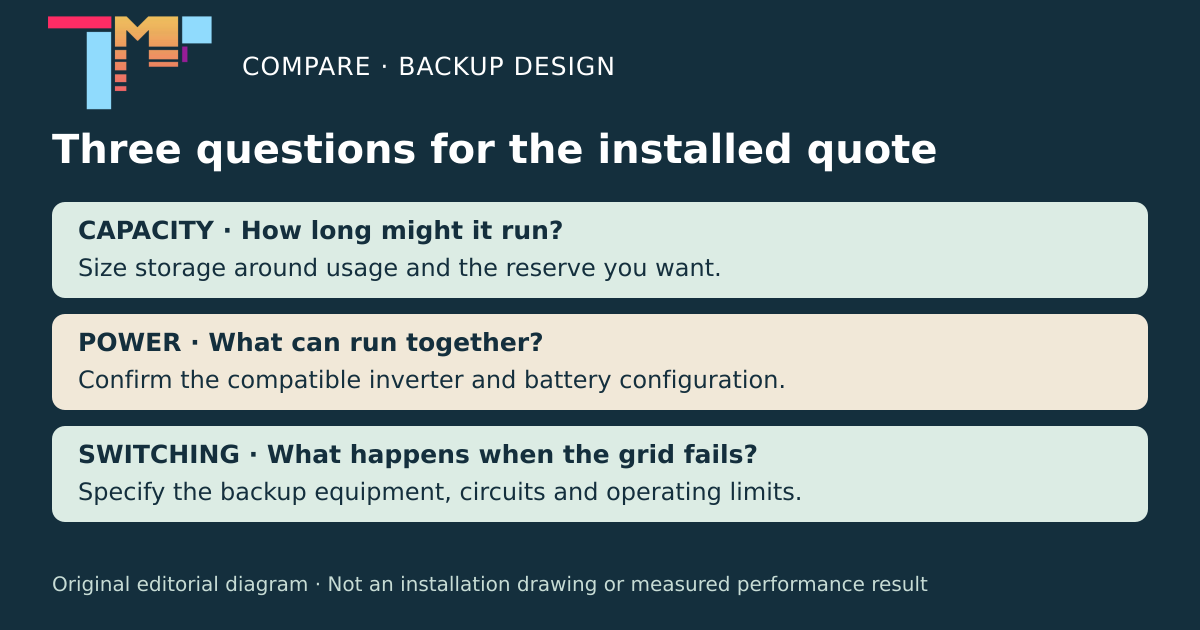
Capacity tells you how much energy can be stored. Power tells you how quickly it can be delivered. Extra storage can extend runtime, but it does not automatically increase what your inverter can run simultaneously. Start with actual interval usage and the loads you want supported.
Read the inverter column before ordering
Compatibility changes across the sizes. The local table lists Primo GEN24 Plus (SC), Symo GEN24 Plus (SC) and Verto Plus for the three smallest configurations. For the larger three, it lists Symo GEN24 Plus (SC) and Verto Plus, without Primo.
That is a useful reason to ask for exact model numbers rather than accepting “works with Fronius”. An existing inverter’s badge is not enough to establish the combination. Ask the installer to confirm the current compatibility requirements, any software work and whether equipment needs replacing.
Fronius advertises up to 28.3 kW charging and discharging with Verto Plus. Treat that as a configuration-dependent system claim, not the output of every Reserva Pro tower. The technical table explicitly says the inverter limits current, and temperature can limit charging or discharging.
Backup needs its own equipment list
Fronius distinguishes basic PV Point backup from Full Backup. Full Backup uses a compatible hybrid inverter, battery and suitable switching equipment. The battery alone does not establish that the house will transfer automatically or that every circuit can run.
I’d have the installer mark the backed-up circuits and write down continuous output, starting-load limits, switching behaviour and what happens when the reserve runs low. If keeping a pump or ducted air conditioner running is the reason for buying, make it a specific design requirement.
My take: Reserva Pro belongs on the shortlist for households or businesses that can use the capacity. Compare the complete installed system, support and applicable warranty terms before stretching the budget. A taller stack is impressive; the fridge staying on is the part you actually notice.
Primary sources
Read the evidence.
- Australian product specificationsFronius Australia ↗
- Announcement dated 25 August 2026Fronius Australia ↗
- Published CEC-approved solar-battery CSVClean Energy Regulator ↗
- Backup power options and switching requirementsFronius Australia ↗
CEC listing independently checked against the regulator-hosted CSV. No Australian installed price, firm stock date or measured backup performance is asserted. Checked on 21 October 2026 (Australia/Perth). This is document-based editorial, not hands-on testing.
Community
Add to the article.
Useful experiences, questions and corrections make the next reader’s decision easier.
Comments appear here after moderation.