
The short version
What you need to know.
- The Australian single-phase PQ1 range has 5, 8, 10 and 12 kW variants; three-phase remains coming soon in the launch announcement.
- Two to nine EQ5500-S modules provide 10.92–49.14 kWh of stated usable storage.
- Gateway bypass current and battery backup output are different ratings. Confirm the exact model and proposed loads.
One stack, with a few useful details
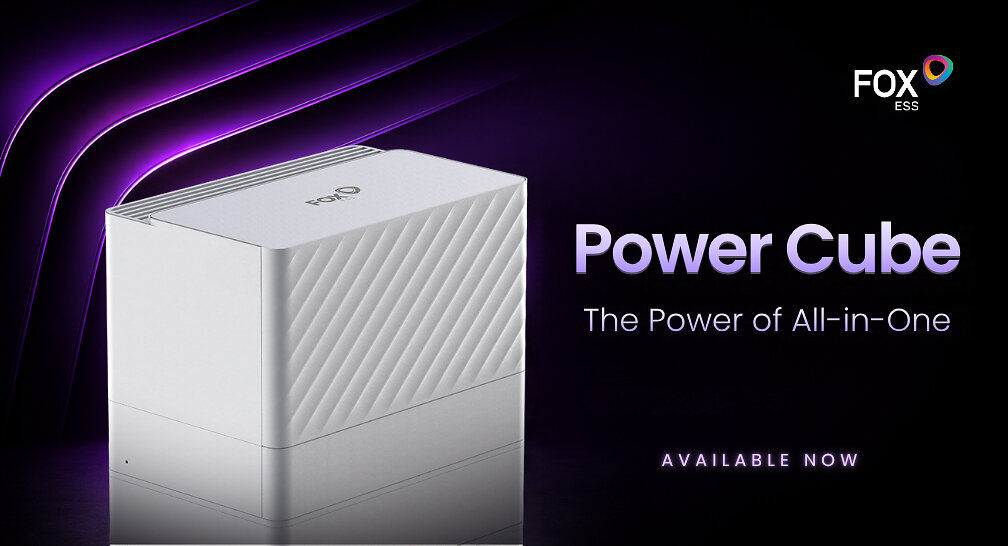
Fox ESS has officially launched Power Cube in Australia, putting a hybrid inverter and modular batteries into one stack. Less equipment competing for garage space sounds sensible. Whether it makes your installation cheaper is something I’d want to see on the quote.
The company’s 20 October announcement describes single-phase models as CEC approved and three-phase models as coming soon. Its launch artwork says “Available Now”, but there is no firm stock or delivery schedule, or official Australian price, in the announcement. Get your installer to confirm supply before booking around it.
Which Australian Power Cube?
The Australian single-phase datasheet, version 6.0 dated 13 October, lists PQ1-5.0, PQ1-8.0, PQ1-10.0 and PQ1-12.0 inverters. They pair with EQ5500-S lithium iron phosphate battery modules, each rated at 5.46 kWh.
Two modules start at 10.92 kWh; nine reach 49.14 kWh. The table lists the same nominal and usable energy figures. That is stored capacity, not a promise that every kilowatt-hour arrives at your appliances after conversion losses and operating reserves.
Also, the Australian 10 kW variant is limited to 9,999 VA maximum apparent power under the datasheet’s local footnote. Use Australian documentation for the equipment on your quote; an overseas brochure is not a substitute.
The announced three-phase range is 5–15 kW. I would not treat that as a confirmed installation date. Ask for the exact model’s current approval and your network’s connection permission rather than assuming the launch covers every configuration.
63 amps does not mean unlimited backup
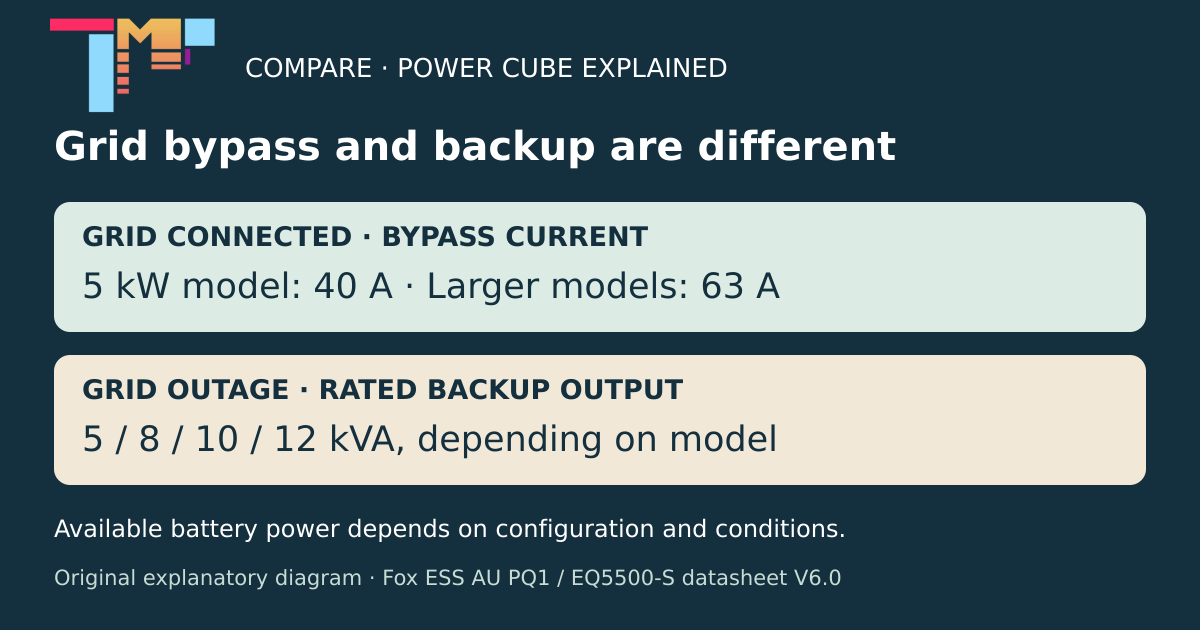
This is the number I’d slow down for. Fox markets an integrated gateway with 63 A bypass. The detailed Australian table specifies 40 A bypass on the 5 kW model and 63 A on the larger variants.
Bypass lets grid power pass through the system. During an outage, the listed backup apparent-power ratings are 5, 8, 10 and 12 kVA respectively. Available battery power also depends on the battery configuration and operating conditions. Adding storage does not automatically make every appliance run together.
Ask the installer what will actually stay powered: the fridge and lights, or cooking and air conditioning as well? Get the simultaneous-load limits and any circuit changes written down. “Whole home” is a wiring arrangement, not permission to turn the house into a kettle showroom.
The promising bits, and the buying checks
Fox lists IP66 protection and a design without cables between inverter and battery modules. Its launch release also describes heating, cell insulation and an aerosol protection unit per module. Those are manufacturer claims, not independent safety or performance findings from Compare.
The current Australian page and datasheet advertise a 10-year product warranty. The Power Cube Australian policy also sets a battery retention promise of at least 70% until 10 years or the specified throughput, whichever comes first, subject to conditions. For two modules, that throughput is 46.07 MWh; for nine, 207.32 MWh. Ask for the terms covering your configuration, component coverage and claim costs.
My take: the integrated design deserves a look, especially for a new solar-and-storage setup. For an existing system, ask what stays and what needs replacing. Start with your evening usage, backup needs and complete installed quote, then use our home-battery comparison to weigh alternatives. The right-sized stack beats the tallest one.
Primary sources
Read the evidence.
- Australian launch announcement, 20 October 2026Fox ESS via PR Newswire ↗
- Australian PQ1 / EQ5500-S datasheet V6.0, 13 October 2026Fox ESS Australia ↗
- Australian Power Cube product overviewFox ESS Australia ↗
- Power Cube all-in-one Australian warranty, V1.1, 16 September 2026Fox ESS Australia ↗
Checked on 21 October 2026 (Australia/Perth). Specifications and approval language are attributed to Fox ESS; CEC listings were not independently matched model by model. No official Australian price or firm stock/delivery date was established. No overseas warranty, independent test result or three-phase availability is assumed.
Community
Add to the article.
Useful experiences, questions and corrections make the next reader’s decision easier.
Comments appear here after moderation.