


The short version
What you need to know.
- The peer-reviewed Flinders research reports more than 60,000 charge-discharge cycles with extremely low capacity fade in laboratory zinc-iodine cells.
- The 60,000-cycle configuration traded some capacity for speed: Flinders says it charged in about three minutes at 150 mAh/g, while a seven-minute configuration delivered 200 mAh/g over 8,000 cycles.
- Those figures describe active-material performance under controlled testing—not a complete battery pack with usable kilowatt-hours, an inverter, warranty or Australian approval.
- The chemistry may suit stationary and grid storage, but there is no announced home product, price, launch date or reason for an Australian buyer to delay a battery purchase today.
The 60,000-cycle result is real—and worth taking seriously
A research team led by Flinders University has demonstrated an aqueous zinc-iodine battery that can be charged and discharged more than 60,000 times. The work was peer-reviewed and published in Angewandte Chemie International Edition, rather than existing only as a company presentation or patent claim.
The researchers used a polymer derived from beta-cyclodextrin, a relatively inexpensive and biodegradable carbohydrate, to hold reactive iodine species at the battery's cathode. In the journal paper, the team reports capacity fade of just 0.0001% to 0.0003% per cycle across two tested storage mechanisms. That is a notable materials-science result because unwanted iodine movement has been a persistent weakness in rechargeable zinc-iodine batteries.
Flinders describes two useful test points. At a roughly seven-minute charge, the cell operated around 1.3 to 1.4 volts and maintained 200 mAh/g over 8,000 cycles. At the faster setting, it charged in about three minutes and exceeded 60,000 cycles at 150 mAh/g. That rate-versus-capacity trade-off matters; the biggest number did not arrive with the highest capacity.
A molecular cage tackles the iodine shuttle problem
A battery needs ions to move, but not every kind of movement is helpful. In a zinc-iodine cell, soluble polyiodide species can leave the cathode and travel through the electrolyte. This so-called shuttle effect wastes active material, causes unwanted reactions and accelerates self-discharge and capacity loss.
The Flinders approach uses the ring-shaped cavities in cyclodextrin as molecular cages. The polymer binds the polyhalide species strongly enough to keep them under control, but still allows the chemistry needed to store and release energy. Bromide was also used to stabilise part of the reaction and suppress hydrolysis.
It is a clever solution because the host material is organic, low-cost in research terms and derived from a material already used widely in food, pharmaceutical and cosmetic applications. The important achievement is not simply that the cell contains zinc and iodine; it is that the researchers found a more effective way to manage iodine inside it.
Why 60,000 cycles does not mean a 164-year home battery
Divide 60,000 by one full cycle per day and the calculator returns more than 164 years. That makes an irresistible social-media headline and a useless household forecast. Laboratory cycle counts only have meaning when the depth of discharge, current rate, test temperature, rest periods, cell format, material loading and end-of-life threshold are also comparable.
The very fast three-minute setting means each laboratory cycle was short. The result demonstrates that this cell architecture tolerates repeated high-rate operation; it does not recreate decades of mornings, hot sheds, winter nights, long periods at high charge, inverter demands and occasional blackouts. Calendar ageing can damage a battery while it is simply sitting there, and a rapid cycling test does not wait long enough to measure decades of it.
The reported capacity is also expressed in milliampere-hours per gram of cathode material. A home-battery buyer needs usable kilowatt-hours for the complete installed pack. The casing, electrolyte, zinc anode, current collectors, separators, cooling or heating, electronics and safety margins all add mass, volume and cost. Cathode capacity cannot be converted into a Powerwall-sized product by multiplying one headline number.
Zinc-iodine and lithium-ion are being judged at different stages
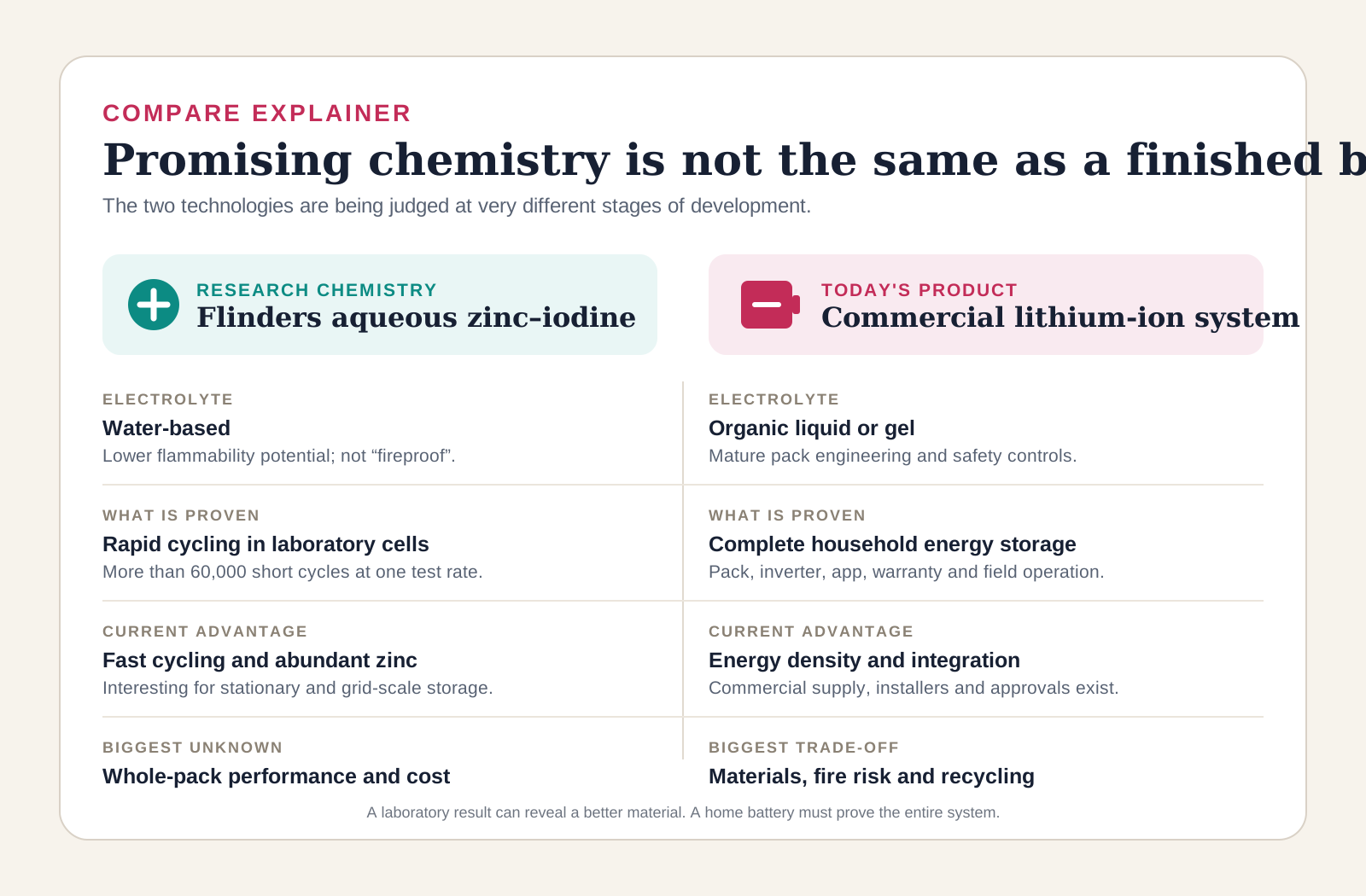
It is tempting to position every new chemistry as the battery that will kill lithium-ion. The fairer comparison is between a promising laboratory cell and a mature commercial system. Today's home batteries combine cells with a battery-management system, power electronics, an enclosure, monitoring software, installer documentation, safety certification, a warranty and a service channel.
Tesla says Powerwall 3 is a self-contained home system with an integrated solar inverter, outage operation, an app and a certified-installer pathway. Other commercial batteries package the same jobs differently, but the point is consistent: households buy a supported energy-storage appliance, not a beaker of high-performing active material.
Zinc-iodine does not need to beat lithium-ion at every job to matter. Its water-based electrolyte, fast-rate durability and use of abundant zinc could be valuable where stationary storage has more room and prioritises cost, safety and cycle life over minimum weight. Grid and industrial projects may therefore be a more natural early target than a compact battery mounted beside an Australian home.
Water-based should mean lower fire risk—not ‘fireproof’
Aqueous batteries replace the flammable organic electrolyte used in conventional lithium-ion cells with a water-based electrolyte. That can materially reduce one route to ignition and thermal runaway. It is one reason aqueous chemistries are attractive for large stationary installations where many cells sit together.
It would still be wrong to describe an unbuilt zinc-iodine system as fireproof or automatically safe. A commercial battery includes electrical connections, power electronics, packaging and fault scenarios that do not exist in a small test cell. Zinc systems can also face dendrite growth, corrosion, gas evolution and electrolyte-management problems depending on their design.
Safety has to be demonstrated at cell, module and system level. In Australia, products seeking a place on the Clean Energy Council's approved battery list must be tested and certified against the relevant requirements. The new SA TS 5398 specification is being phased into those requirements. The Flinders chemistry has not reached that product-assessment stage.
The missing numbers matter more than the record
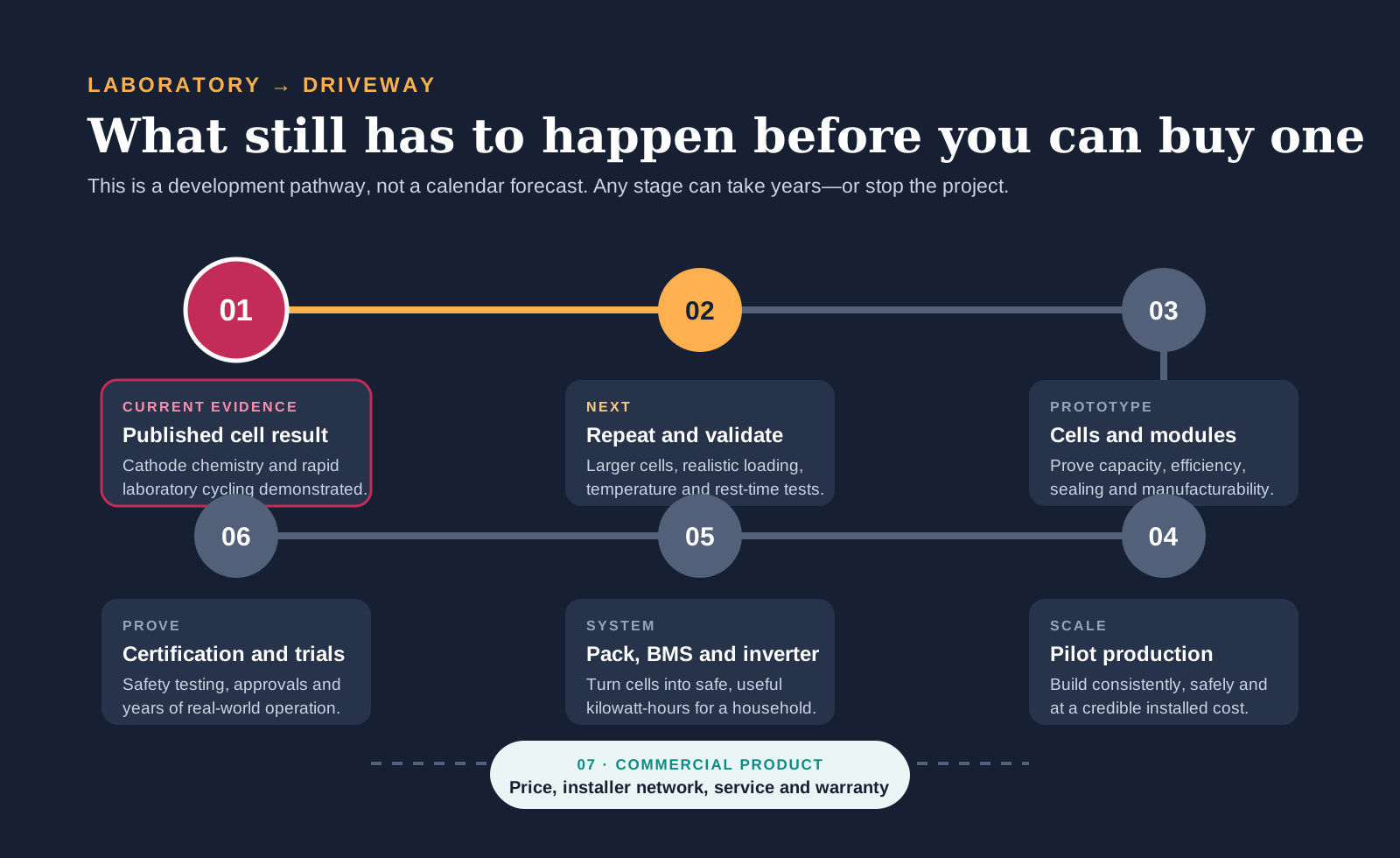
Before this chemistry can be compared with a home battery, a prototype must disclose usable energy in kWh, continuous and peak power in kW, round-trip efficiency, self-discharge, operating-temperature range, pack dimensions, weight, noise and standby consumption. It also has to show how degradation changes under realistic daily profiles rather than one repeated laboratory rate.
Then comes the engineering around the cells: a battery-management system, inverter compatibility, isolation and fault protection, weatherproof enclosure, software, grid connection, installation manual and end-of-life plan. Manufacturing yield and material supply determine whether an inexpensive ingredient becomes an inexpensive product. Certification, field trials, insurance, installer training, spare parts and warranty reserves determine whether it becomes a product somebody should put on a wall.
None of those gaps discredits the research. They explain why Flinders' announcement talks about large-scale energy storage and a prototype platform, not pre-orders. Moving from a coin-sized or laboratory-format cell to a durable module is the next experiment, not an administrative detail.
Australia still has a credible opportunity
The national angle is stronger than a catchy ‘Australian Powerwall killer’ label. Geoscience Australia says the country holds more than 20% of the world's known zinc-lead resources, and its 2025 assessment ranks Australia first for economic demonstrated zinc resources and third for mine production. A chemistry based on zinc could connect local research, mining expertise and stationary-energy demand.
That does not guarantee local battery manufacturing. Iodine supply, polymer production, cell equipment, intellectual property, capital and customers all matter. Australia has produced world-class battery research before without capturing the entire manufacturing chain. The Flinders team working with industry on a prototype platform is therefore one of the most important lines in the announcement.
If the chemistry scales, its best contribution may be a safer and durable option for community batteries, commercial sites, renewable-energy firming or grid storage where physical size is less constrained. A successful stationary product would be valuable even if it never competes directly with a Powerwall in a suburban garage.
Should home-battery buyers wait? No
There is no announced retail product, Australian price, installer network, warranty or launch date to wait for. A household that can make a current battery pay through solar self-consumption, time-of-use tariffs, backup value or the federal battery discount should compare products that are approved and supported now. Research news should not freeze a sound buying decision.
Start with usable capacity, inverter power, blackout behaviour, installed cost, warranty conditions and local service. Check that the exact battery and inverter combination appears on the relevant approved lists and that the installer has the required accreditation. A chemistry label alone cannot tell you whether a system fits the household.
The Flinders result deserves attention because it solves a real electrochemical problem and produced unusually long rapid-cycle performance. The disciplined verdict is also the optimistic one: this is a meaningful first stage, not a failed home battery. Watch the prototype data next—and do not confuse a promising path with a product already at the destination.
Primary sources
Read the evidence.
- Longer lasting rechargeable batteries take shapeFlinders University ↗
- Caging Polyhalide Anions in Polycyclodextrin for Long-Lasting Aqueous Zinc-Iodine BatteriesAngewandte Chemie International Edition ↗
- Peer-reviewed publication record and abstractResearch @ Flinders ↗
- Approved batteries and SA TS 5398 transitionClean Energy Council ↗
- Battery product testing and certification requirementsClean Energy Council ↗
- Powerwall home battery overviewTesla Australia ↗
- Australia's Identified Mineral Resources 2025 world rankingsGeoscience Australia ↗
- Australian zinc factsGeoscience Australia ↗
Research, product and standards information was checked on 27 August 2026. Laboratory capacity figures are reported per gram of active cathode material and are not complete-pack specifications. Flinders has announced work toward a prototype platform, but no home-battery product, price, certification or commercial release date.
Community
Add to the article.
Useful experiences, questions and corrections make the next reader’s decision easier.
Comments appear here after moderation.