

The short version
What you need to know.
- New NEM technical access rules commenced on 12 November 2026.
- The changes address how large inverter-based loads behave during grid disturbances.
- Separate cost-recovery proposals are still being assessed. This is not a guaranteed bill saving.
- The NEM does not include Western Australia or the Northern Territory.
One part of the data-centre problem just moved forward
When we covered the data-centre power boom, the uncomfortable question was whether households could end up carrying costs created by enormous new customers. There is now a concrete update, but it is worth keeping two different problems separate.
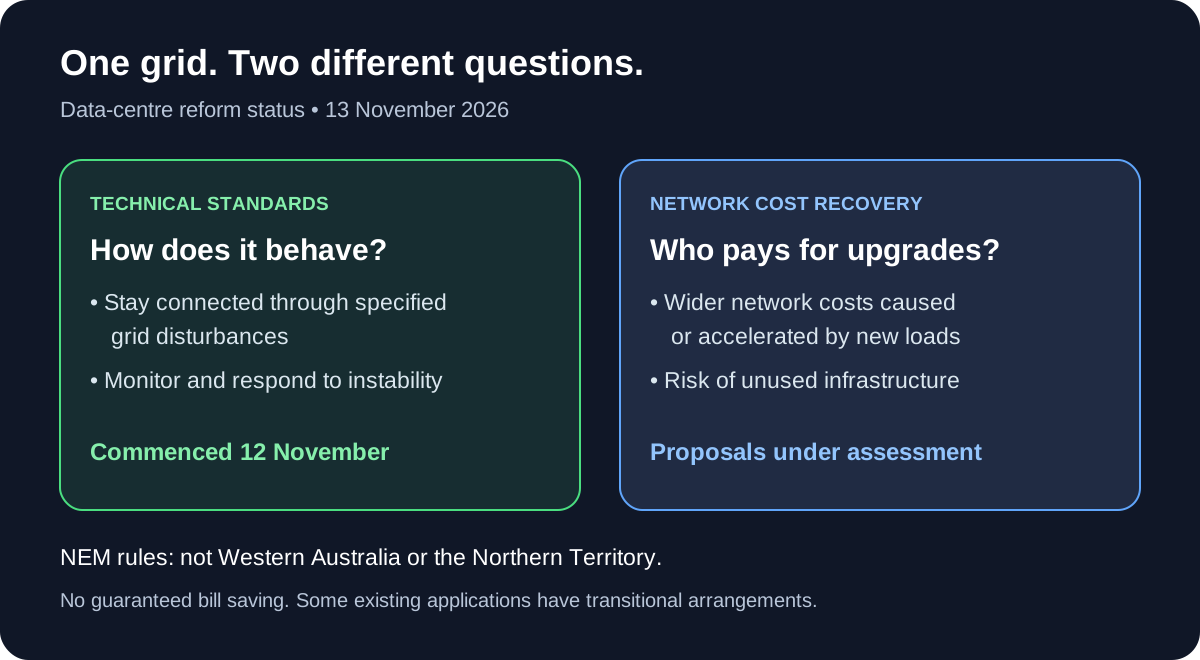
On 12 November, the Australian Energy Market Commission made and commenced its final Package 2 access-standards rule. It strengthens the technical framework for connecting large inverter-based loads, including data centres, to the National Electricity Market.
That is about how these facilities behave on the grid. It is not a decision that suddenly makes every shared network upgrade free for households. Think better road rules, not a promise that somebody else has paid for the motorway.
Why a server building needs grid manners
Large data centres use power electronics in their power supplies and uninterruptible power supply systems. Those systems can react quickly when electrical conditions change. If many big loads disconnect together, the sudden drop in demand can make a disturbance worse.
The new requirements cover riding through specified voltage and frequency disturbances, recovering power consumption afterwards, and monitoring instability. The point is to avoid a facility protecting itself in a way that creates a bigger problem outside its fence.
The final framework uses a 30 MW nameplate threshold for automatic application of the relevant standards, whether connected to transmission or distribution. Smaller loads can still be assessed where they could adversely affect the system, and related clusters may be considered together.
This is not a claim that every data centre causes blackouts. It is recognition that a very large, electronically controlled customer needs more careful assessment than another office building.
The power-bill question is still a separate job
AEMC’s network-augmentation cost-recovery proposals remain open. They examine whether connecting customers properly contribute to wider network costs they cause or accelerate, and how to avoid other consumers carrying stranded-asset risk if promised demand fails to arrive.
That distinction matters. A project can satisfy technical connection standards while leaving a separate argument about how a shared substation or transmission upgrade should be funded. Passing one test does not answer the other.
The published timetable for the cost-recovery work lists a draft determination for 1 April 2027. That is a future decision point, not a household saving already locked into next quarter’s bill.
My view has not changed: consumers should not be the default financial backstop for somebody else’s speculative expansion. Equally, a well-planned new customer should not be treated as a villain simply because it uses a lot of electricity. The allocation of costs and risks is what deserves scrutiny.
Two caveats before calling this an Australia-wide fix
First, commencement does not mean every existing project changed overnight. A six-month grace period applies to some connection applications and plant-alteration proposals already underway. It is a defined transition, not a blanket delay of the whole rule.
Second, the NEM covers eastern and south-eastern Australia. Western Australia and the Northern Territory are not connected to it. These changes should not be presented as new rules governing Perth’s electricity market or a direct change to a Synergy bill.
For households, there is nothing to sign up for here. Keep judging an electricity plan on its actual rates and conditions, rather than assuming a data-centre headline means a price rise or saving.
Sources
Read the evidence.
- Final rule and commencement: NEM access standards Package 2Australian Energy Market Commission ↗
- Final determination information sheet, 12 November 2026Australian Energy Market Commission ↗
- Network augmentation cost recovery: Package 1Australian Energy Market Commission ↗
- Network augmentation cost recovery: Package 2Australian Energy Market Commission ↗
- About the National Electricity MarketAustralian Energy Market Operator ↗
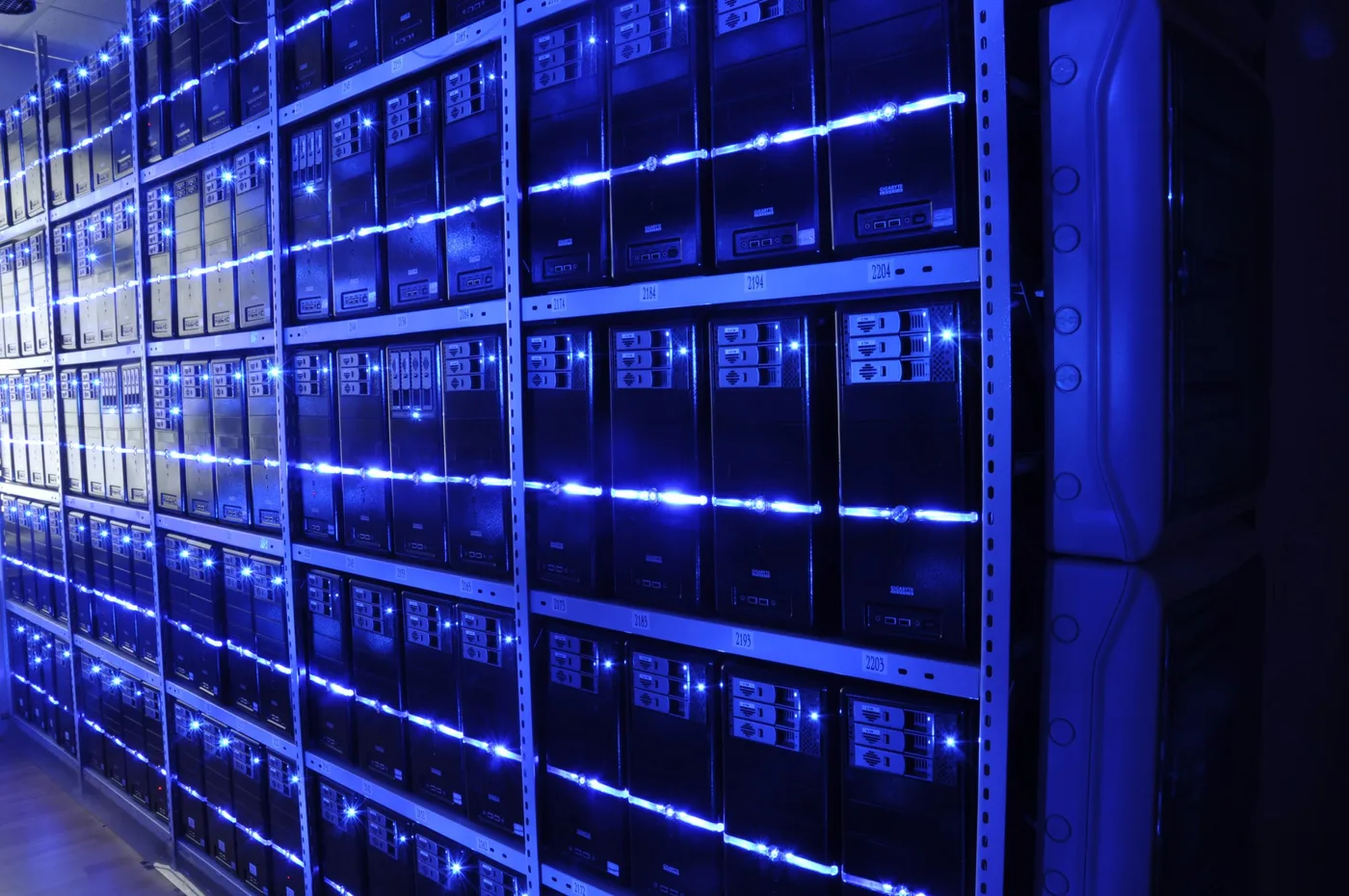
- BalticServers server-room photographBalticServers.com / Wikimedia Commons ↗
- Photograph licence: CC BY-SA 3.0Creative Commons ↗
Rule status checked on 13 November 2026. This is a follow-up to our September data-centre analysis, based on the new final technical rule. It does not forecast electricity prices or claim the separate cost-recovery proposals are final.
Community
Add to the article.
Useful experiences, questions and corrections make the next reader’s decision easier.
Comments appear here after moderation.