

The short version
What you need to know.
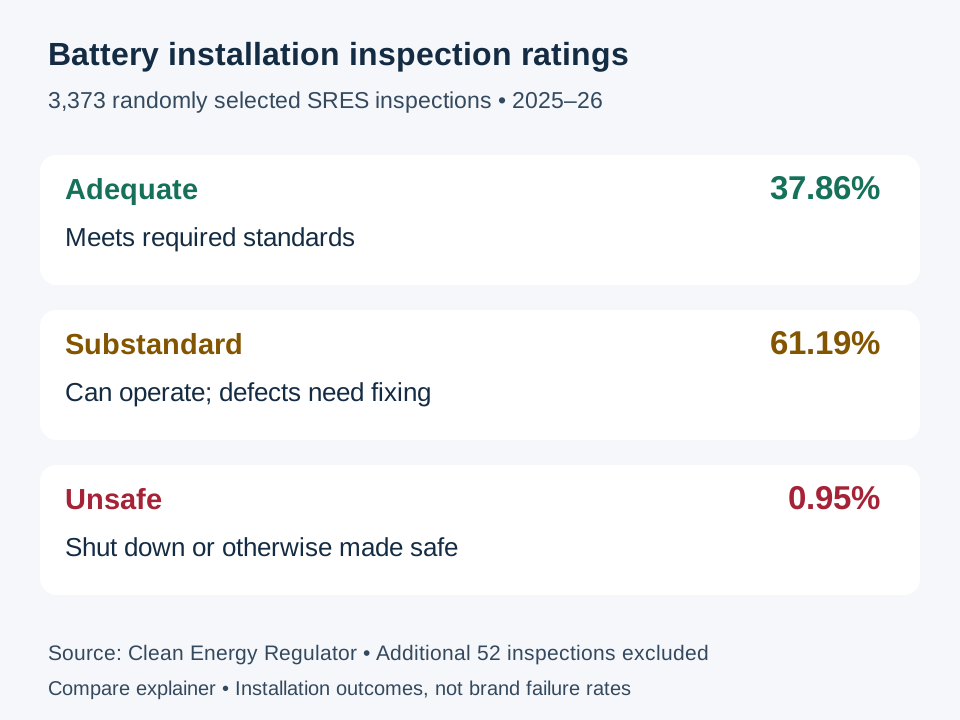
- Among 3,373 randomly selected battery inspections, 61.19% were substandard and 0.95% unsafe.
- Substandard systems could remain operating, but installation defects still needed rectification.
- These are inspected SRES installations, not a failure rate for every Australian battery.
A big number needs the right label
Seeing “61.19% substandard” beside home batteries is enough to make you look twice at the box in the garage. Fair enough. But before deciding the whole battery rollout has gone pear-shaped, read what the inspection rating actually means.
The Clean Energy Regulator’s announcement on 13 November covers the first annual battery inspection results under the Small-scale Renewable Energy Scheme, or SRES. It raises a serious installation-quality question. It does not say six in ten Australian batteries are unsafe.
What was actually inspected?
The 2025–26 report highlights record 3,425 battery inspections, covering systems installed from 1 July 2025 to 30 April 2026. Batteries became eligible under the SRES on 1 July; inspections began on 15 July 2025.
Of those inspections, 3,373 were randomly selected. Their ratings were 37.86% adequate, 61.19% substandard and 0.95% unsafe. Another 52 inspections sat outside the random sample and must not be quietly folded into those percentages.
That scope matters. These are installation inspection outcomes for the specified scheme and period, not a brand reliability ranking, a cell-failure rate or a verdict on every battery already sitting in an Australian home.
Substandard still means something needs fixing
An adequate rating means the installation meets the required standards. A substandard rating means the battery can remain operating safely, while the installation may miss one or more requirements in Australian standards. The regulator says that does not necessarily make the whole system non-compliant; an issue may become a problem later.
Unsafe is a different category: the installation cannot safely remain operating, so the inspector shuts it down immediately or otherwise makes it safe. Reassurance about the substandard definition should never overrule a specific shutdown instruction.
Nor should “still operating” become an excuse to ignore defects. The highlighted rectification categories include missing or incorrect warning labels, backup-circuit identification, wiring and residual-current-device issues, circuit protection, and physical protection for cables and batteries. A functioning app is not proof the installation ticks every box.
The questions to put to your installer
If you receive an adverse inspection report, ask for the exact findings in writing. Which items need correction? What does the inspector say about continued operation? Who is coming back, and when? Keep the report and the agreed repair plan together.
The regulator says installers with adverse outcomes must return to rectify identified installation issues and provide evidence to Solar Accreditation Australia. Ask what evidence will be supplied and how you will receive confirmation that the work is complete. If the response stalls, contact SAA or your state or territory electrical safety regulator with the report.
Leave electrical rectification to appropriately qualified people. A missing label and a protection-device problem are not interchangeable jobs, even when both appear under the same broad rating. Our battery handover paperwork guide helps organise the documents.
Buy the installation as well as the battery
For anyone still collecting quotes, ask how the installer checks labelling, backup circuits and protection before handover, and who handles inspection rectification afterwards. Get that responsibility into the paperwork alongside the equipment and warranty.
Our home-battery comparisons can help narrow the hardware shortlist. These results are a useful reminder that a tidy specification sheet is only half the purchase. The installation deserves just as much attention.
Sources
Read the evidence.
- Annual inspection announcement, published 13 November 2026Clean Energy Regulator ↗
- 2025–26 SRES inspection report highlights: sample, ratings and rectificationClean Energy Regulator ↗
Primary sources checked 16 November 2026. Announcement publication date verified in visible page text and datePublished metadata. Percentages apply only to 3,373 randomly selected battery inspections; 52 additional inspections are separate. Source-based reporting, not firsthand installation testing or advice on a particular system.
Community
Add to the article.
Useful experiences, questions and corrections make the next reader’s decision easier.
Comments appear here after moderation.