
The short version
What you need to know.
- Energy Safe Victoria announced 23 charges concerning allegedly unsafe work at three properties. Charges are allegations, not convictions.
- Victoria requires independent inspection of prescribed battery work before it is turned on or left on. WA has its own certificate rules, including a 28-day requirement with stated exceptions.
- Keep the contract, equipment details, commissioning and electrical documents, warranties, operating instructions and installer contacts together.
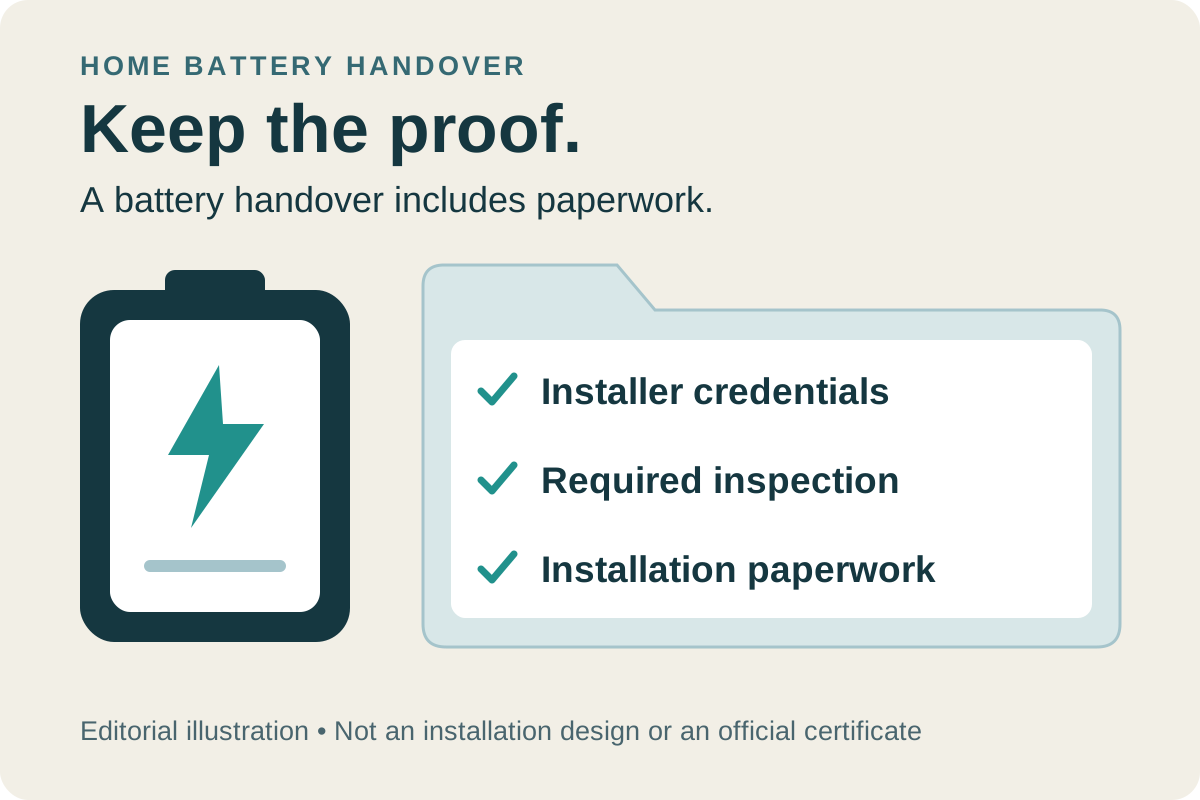
The handover includes more than the app
The battery is on the wall, the app has colourful graphs, and your installer has disappeared down the driveway. Job done? Not quite. The least exciting part of buying a home battery might be the bit you most need to keep: the paperwork.
A shiny box and a working app are not an electrical safety inspection. Neither is the classic Australian certification system of “yeah mate, she’ll be right”.
Why this matters now
On 5 November 2026, Energy Safe Victoria announced 23 charges against an electrical contracting business and its director, concerning allegedly unsafe solar and battery work at three Victorian properties. The installations date from April 2022 to May 2023. These are allegations, not convictions or findings that every allegation is proven.
The useful takeaway is not that home batteries are inherently unsafe. It is that buyers should know who installed their system, who checked it where required, and what documents record the work.
Check the person, not just the logo
Ask for the installing electrician’s details and check the relevant state or territory licensing register. The company selling you the battery and the people doing the installation may be different businesses.
For installations claiming the federal battery discount through the Small-scale Renewable Energy Scheme, the Clean Energy Regulator requires a Solar Accreditation Australia-accredited installer with battery endorsement, alongside the applicable standards and electrical safety laws. Accreditation and an electrical licence serve different purposes; check both where applicable.
An approved battery model is not a blanket approval of the way someone has installed it in your garage.
The certificate depends on where you live
In Victoria, battery storage installations fall within prescribed electrical installation work. Energy Safe’s guidance requires an independent Licensed Electrical Inspector, arranged by the contractor or electrician. Prescribed work cannot be turned on or left on before inspection. Ask for your Certificate of Electrical Safety and check that the inspector signing the inspection section actually attended.
Do not assume those exact Victorian arrangements apply everywhere. In Western Australia, the government says an electrical safety certificate must be supplied within 28 days for electrical work other than the stated maintenance and like-for-like replacement exceptions. Other jurisdictions have their own certificates, inspection and connection processes.
Ask your installer which requirements apply to your address, what is outstanding, and when the system may be used. “Installed” and “ready to switch on” are not always the same milestone.
Build one boring, very useful folder
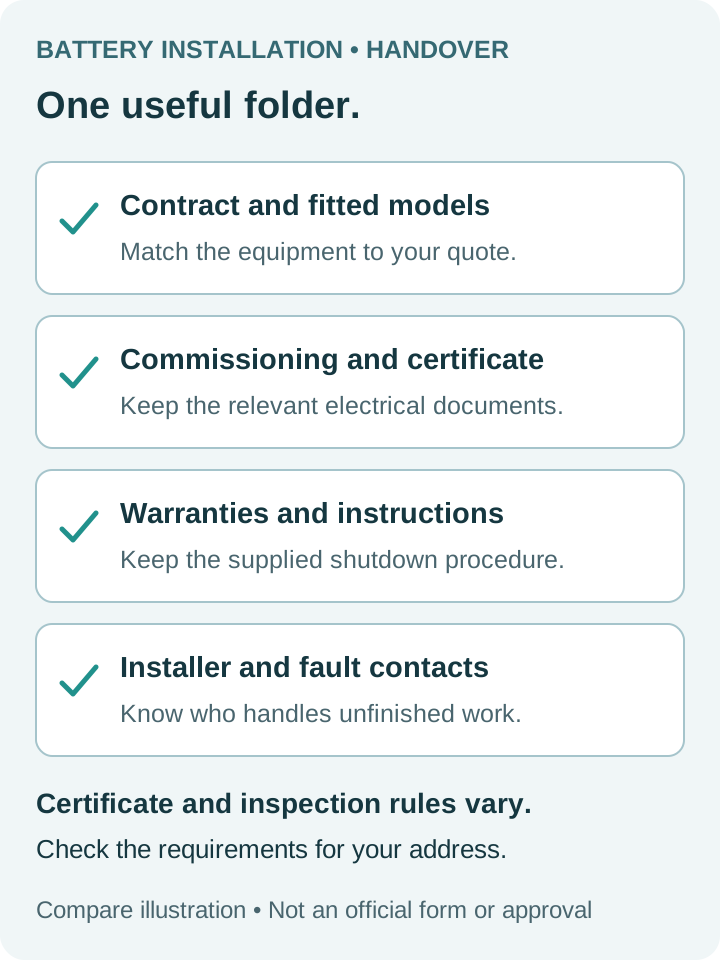
The Australian Government’s Solar Consumer Guide recommends keeping the sale contract, specifications, commissioning sheet, relevant electrical certificate, warranties, operating instructions and installer contacts.
For your battery, also ask the installer to walk you through:
- The actual battery and inverter models fitted, matched against your quote.
- Monitoring access, normal operation and the supplied shutdown instructions.
- What backup capability your particular installation includes, rather than what the brochure implies.
- Who to contact for faults, warranty claims and unfinished documentation.
Missing paperwork? Follow it up
Request outstanding documents in writing. In Victoria, Energy Safe says customers should report a contractor’s refusal to arrange the required inspection or provide a certificate. In WA, contact the contractor first, then the network operator if the certificate is not supplied.
Paperwork records compliance; it is not a promise that nothing can ever fail. If you suspect an electrical fault, do not open the equipment or attempt your own repair. Get qualified help.
Buy the battery for the savings. Keep the paperwork for everything the sales brochure leaves out.
Sources
Read the evidence.
- 23 charges relating to allegedly unsafe installations, 5 November 2026Energy Safe Victoria ↗
- Certificates of Electrical Safety: prescribed work and inspectionsEnergy Safe Victoria ↗
- Solar battery accreditation and scheme requirementsClean Energy Regulator ↗
- WA electrical work, licences and safety certificatesGovernment of Western Australia ↗
- Solar Consumer Guide: installation day and handover documentsAustralian Government ↗
Official sources checked 8 November 2026. The reported charges are allegations, not convictions. Victorian and WA requirements are described separately; other jurisdictions have their own rules. This is a consumer paperwork explainer, not an electrical inspection, installation design or a hands-on test. The hero and checklist are original editorial illustrations.
Community
Add to the article.
Useful experiences, questions and corrections make the next reader’s decision easier.
Comments appear here after moderation.