
The short version
What you need to know.
- The ACCC's Measuring Broadband Australia program concluded on 30 June 2026 after 33 reports and more than eight years of hardware-based testing in volunteer homes.
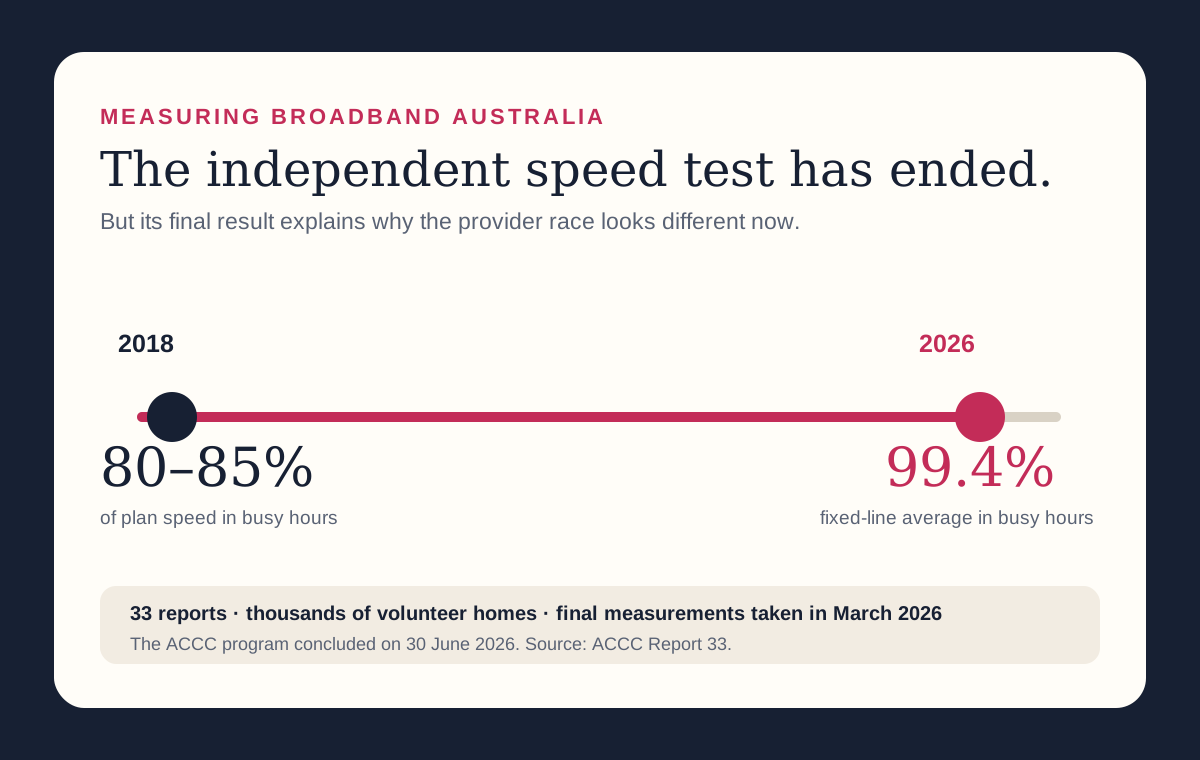
- Its final report measured fixed-line NBN downloads at an average 99.4% of plan speed during busy hours, up from roughly 80–85% in the program's early reports.
- Final provider averages ranged from 95.2% to 102.3% of plan speed, but overlapping confidence intervals, different plan mixes and overprovisioning mean the table cannot identify a permanent fastest provider.
- Compare the typical evening speed, upload speed, complete first-year price, connection technology, router capability, support and plan features—and test your existing service over Ethernet before switching.
Australia has lost a useful speed test, even if the result is mostly good news
For more than eight years, the ACCC's Measuring Broadband Australia program placed small hardware devices—known as Whiteboxes—in volunteer homes. Those boxes ran scheduled tests when the household connection was not being used, producing independent measurements of download speed, upload speed, streaming performance and outages across major retail providers and NBN technologies.
The 33rd report, released on 17 June 2026 using measurements collected during March, was the last. The program formally concluded at the end of June. This was more useful than another crowd-sourced speed-test ranking because the Whiteboxes tested consistently, separated the broadband service from active household use and allowed the ACCC to compare like periods over time.
The ACCC says the conclusion comes after major improvements in performance and changes to NBN wholesale products, including the removal of capacity-based charging on fixed-line and fixed-wireless services. It also says there is now less performance differentiation between providers than there was when reporting began in 2018.
That is a real success. Independent scrutiny helped turn evening congestion from an accepted feature of many NBN plans into something providers had to explain. But success does not make the lost comparison harmless. Consumers can still see advertised typical-evening speeds, but they will no longer receive a new quarterly independent table testing whether the major providers remain close together.
The final result shows how far fixed-line NBN performance moved
Across fixed-line connections, the final report measured average download performance at 99.4 per cent of plan speed between 7pm and 11pm on weekdays. The March 2026 report immediately before it recorded 98.5 per cent. In the early years of the program, the equivalent network-wide result sat around 80 to 85 per cent.
The proportion of fixed-line services classified as underperforming also fell from 13.9 per cent in May 2018 to 5.6 per cent in the final sample. The ACCC defined an underperforming service as one that exceeded 75 per cent of its plan speed in fewer than five per cent of download tests. That is a deliberately low bar, so 5.6 per cent should not be read as the complete number of households unhappy with their connection, but the direction is encouraging.
Fixed wireless remains a different story. Across the fixed-wireless plans in the final sample, average busy-hour download performance was 83.8 per cent of plan speed and upload performance was 63.7 per cent. The newer Home Fast plan averaged 160.5 Mbps down and 12.6 Mbps up in busy hours, while Fixed Wireless Plus approached 100 Mbps for downloads. Geography, radio conditions and the particular plan therefore matter far more than a single national provider ranking for these households.
Very-high-speed services also show why the number printed in a plan name is not a promise that every speed test will land on it. The final sample's 1000/100 Mbps wholesale services averaged 864.6 Mbps down and 89.8 Mbps up during busy hours. At these speeds, Ethernet ports, router throughput and the test device can become the bottleneck before the retailer's network does.
So which provider was fastest in the final ACCC report?
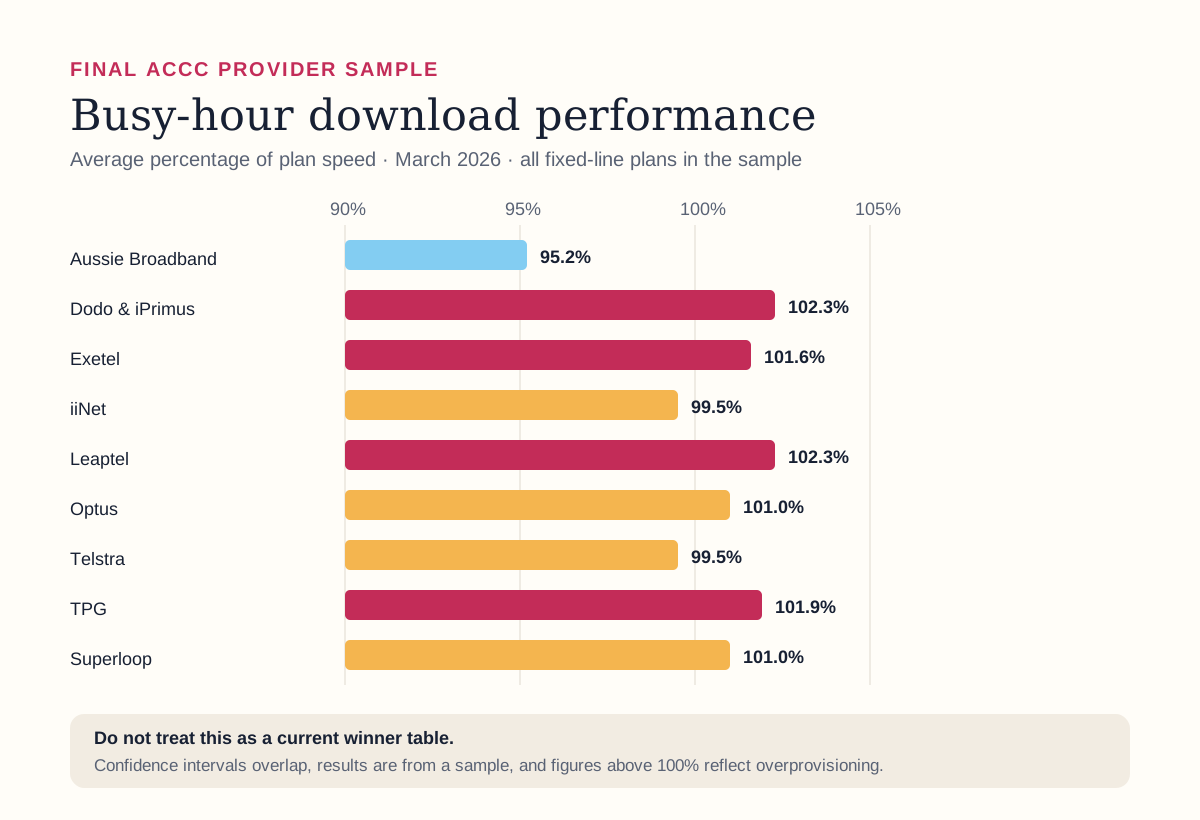
If I simply sort the final busy-hour averages, Dodo and iPrimus and Leaptel sit at 102.3 per cent of plan speed, followed by TPG at 101.9 per cent, Exetel at 101.6 per cent, Optus and Superloop at 101.0 per cent, iiNet and Telstra at 99.5 per cent, and Aussie Broadband at 95.2 per cent.
That ordering is factually what the appendix reports and still not a responsible current recommendation. Results above 100 per cent can occur because NBN overprovisions download services slightly to compensate for protocol overhead. The provider figures combine different fixed-line plan speeds, and each average comes from a sample of between 67 and 133 Whiteboxes rather than every customer. The 95 per cent confidence intervals overlap for many providers.
Aussie Broadband's reported 95.2 per cent, for example, carried a confidence interval of 91.5 to 98.8 per cent. Leaptel's 102.3 per cent result had a much wider interval of 98.5 to 106.1 per cent. The ranges overlap, so the apparent seven-point gap between their displayed averages is less decisive than a league-table screenshot makes it look.
The data is also historical. It describes tests made in March 2026, before the program closed, and does not promise how any provider is performing at your address in August. A retail network can add capacity, change routing or develop a fault after the measurement window. Smaller providers that did not have enough Whiteboxes for a reportable sample are absent altogether.
Your NBN technology may now matter more than the provider logo
The final technology results were 100.8 per cent of plan speed for FTTP downloads in busy hours, 99.2 per cent for HFC and 94.7 per cent for FTTN. The gap was larger for uploads: FTTP averaged 92.8 per cent of plan upload speed, HFC 91.0 per cent and FTTN 82.1 per cent.
Underperforming services appeared across technologies after higher-speed tiers arrived, but FTTN remained the most exposed in the sample. The underperforming proportions were 10.7 per cent for FTTN, 5.6 per cent for HFC and 4.3 per cent for FTTP. Copper line length and condition limit what an FTTN service can attain, and changing retail providers cannot change the copper path from the premises to the node.
That does not make the retailer irrelevant. Providers still control their own network beyond the NBN access network, buy and manage upstream capacity, choose routing and peering, supply equipment and support the customer when something fails. But when all major providers are close to the plan rate, moving from one retailer to another may produce less improvement than upgrading FTTN to FTTP, fixing damaged cabling or replacing an overloaded Wi-Fi router.
Before buying a faster plan, check the NBN technology and speed options available at the address. Then check whether the router has ports and processing capacity for that tier. A gigabit plan tested through a one-gigabit Ethernet port will normally top out below the plan name after overhead, while multi-gigabit plans need suitable 2.5GbE or faster equipment throughout the wired path to demonstrate their full rate.
The provider's typical evening speed is now the first number to read
The ACCC's broadband speed-claims guidance remains active. It expects retail providers to present typical peak-period performance clearly, and the July 2025 update also tells providers to explain where customer equipment and the in-home setup may prevent a buyer from using the full speed of a plan.
When comparing two plans on the same nominal tier, look for the typical evening download speed rather than relying on names such as Fast, Superfast or Ultrafast. Then find the upload speed. Two plans with similar download advertising can feel very different when several people are backing up photos, joining video calls, uploading work or streaming to the internet.
Next calculate the complete cost. A six-month introductory price can make an expensive plan look like the cheapest result. Include the ongoing monthly price, mandatory modem or delivery charge, any connection fee and the cost of leaving if a repayment arrangement applies. I prefer comparing the first 12 months and the ongoing monthly rate side by side.
Finally, check what the plan page does not make prominent: whether you can bring your own router, whether the provider uses CGNAT by default, whether a public or static IP is available, and whether telephone service or 4G backup matters to the household. Those features can outweigh a two-megabit difference in an advertised evening figure.
- Typical evening download speed for the exact plan.
- Upload speed and whether it suits cloud backups, video calls and creators.
- Complete first-year cost plus the ongoing monthly price.
- Modem ownership, repayment terms and supported bring-your-own-router setup.
- CGNAT, public IP, static IP and IPv6 options where home servers, cameras or remote access matter.
- Support hours, contact channels and backup connectivity during a fixed-line fault.
Download speed is no longer the whole provider comparison
When the main providers deliver broadly similar fixed-line download throughput, the quality differences move to less tidy measurements. Latency affects how quickly an online game, remote desktop or video call responds. Routing determines how efficiently traffic reaches a particular service. Short outages and packet loss can ruin a call even when a speed test taken five minutes later looks excellent.
Customer support is also part of performance. NBN Co operates the access network, but the retailer is the customer's point of contact. A provider that identifies an NBN fault quickly, explains the next step and owns the escalation can be worth more than one that wins a synthetic test by a small margin and leaves the customer repeating the same troubleshooting script.
Complaint totals can add context but need careful handling. Large providers naturally attract more raw complaints because they have more customers, while complaint rates can still be affected by product mix and how each provider records cases. I would use complaint information as a warning signal, not as a substitute for a measured speed program or a guarantee of an individual support experience.
This is why I would not rebuild the old ACCC league table from provider marketing claims. Typical evening speeds are useful and legally important representations, but they are supplied by the retailers using their own testing. Compare them, save a copy of the claim when signing up and then verify the delivered service yourself.
Run one wired test before blaming—or changing—the provider
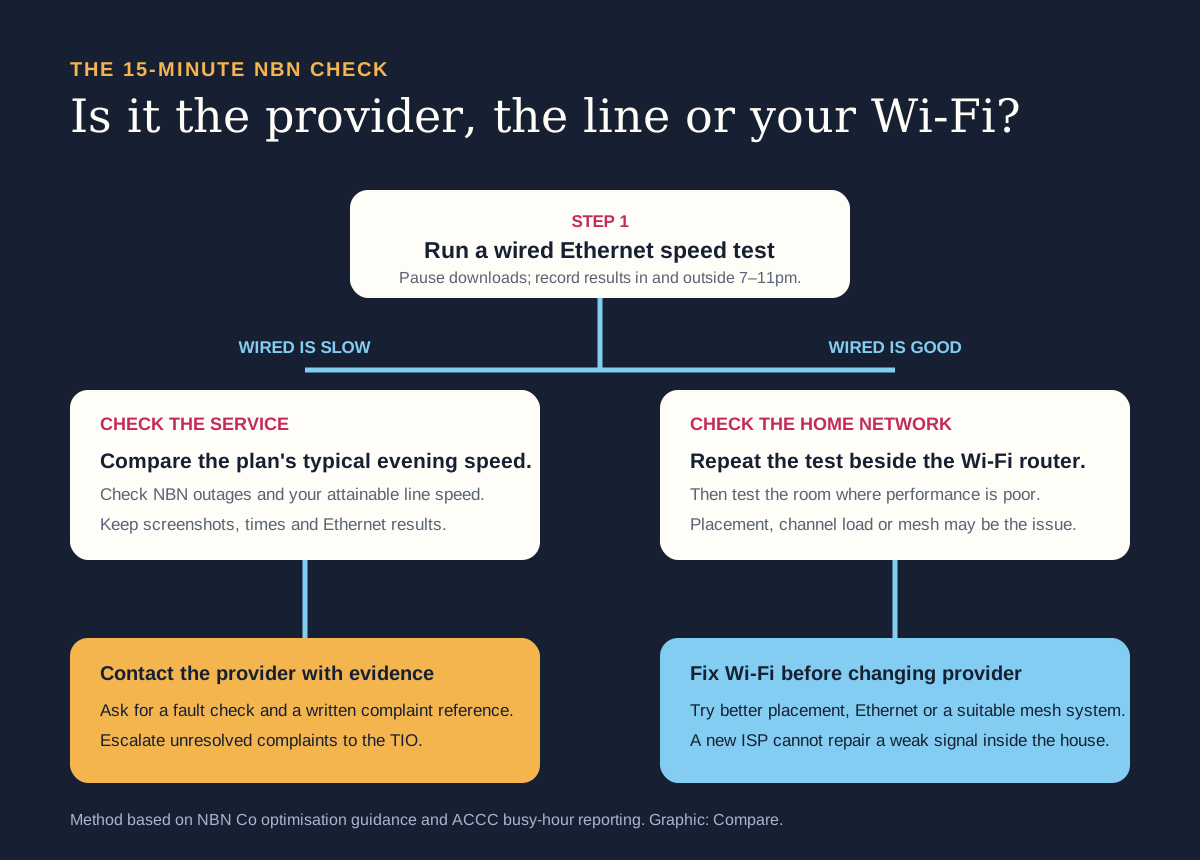
A test performed on a phone at the far end of the house mostly measures that phone, the Wi-Fi environment and the router placement. It may say very little about the NBN connection arriving at the premises. Start with a computer connected to the router by Ethernet, pause large downloads and cloud backups, and record the server, time, download, upload and latency.
Repeat that wired test during the 7pm–11pm busy period and at a quieter time. If the wired result is close to the plan's typical evening speed but the bedroom result is poor, changing provider is unlikely to fix the problem. Test beside the router and then in the problem room. Better placement, Ethernet backhaul, an access point or a suitable mesh system is the more direct solution.
If the wired result is consistently below the advertised typical-evening figure, check for a known NBN outage and ask the provider to test the service. FTTN customers should ask for the attainable line speed and whether the line is showing errors or instability. Keep screenshots and dates so the issue is a documented service problem rather than a vague report that the internet feels slow.
A single speed test is not a verdict. Servers become busy, devices update in the background and Wi-Fi changes from minute to minute. The useful evidence is a repeatable pattern across several wired tests, especially when it also appears in real applications.
The ACCC is still watching the NBN—just in a different way
The end of the Whitebox program does not remove provider obligations. In its final announcement, the ACCC said retailers remain responsible for meeting the speed and performance they advertise and that it will continue enforcement where it sees evidence of misleading claims.
The ACCC also collects quarterly service-quality and network-performance information from NBN Co under a record-keeping rule that began in 2024. That dataset covers matters such as connection timeframes, fault rectification, appointments, outages and rebates. It provides important scrutiny of the wholesale network, but it is not the same consumer product as an independently measured retailer-by-retailer speed table.
If a provider cannot resolve a service problem, make it a formal complaint and keep the reference number. ACMA's complaints rules require telcos to have a written process, try to resolve complaints at first contact where possible and explain a proposed resolution within defined timeframes. The Telecommunications Industry Ombudsman can help consumers and small businesses with unresolved phone and internet complaints.
What I would like to see next is a replacement that combines independent performance measurements with clearer retailer-level service quality. Faster wholesale products make that more important, not less: the higher the advertised tier, the easier it is for equipment, access technology and provider design to create different real outcomes behind similar marketing.
My new way to choose an NBN provider
I would start with the speed tier the household actually needs, not the provider. A stable 100 Mbps service is enough for many homes; creators, large households, frequent game downloads and heavy cloud users can justify 500 Mbps or more, while upload requirements may narrow the choice faster than download speed does.
Then I would shortlist plans by complete price and typical evening speed, remove any that lack a required feature, and choose between the remaining providers on support, router policy and flexibility. If two plans are close, I would rather take a no-contract option that is easy to leave than overanalyse a tiny claimed speed difference.
For an existing service that already delivers close to its advertised rate over Ethernet, switching purely to chase another two or three per cent is unlikely to transform the household. Switch for a clearly better price, better upload tier, useful feature or support experience. If the service is materially underperforming, document it and give the current provider a chance to identify whether the line, NBN network or retail network is responsible.
The final ACCC report does not tell us that every NBN provider is now the same. It tells us that fixed-line download throughput has become much less useful as the only ranking. The fastest provider today is the one that delivers its promise at your address, through equipment capable of using it, at a price and support level you are happy to keep paying.
Primary sources
Read the evidence.
- Households receive consistent broadband speeds on fixed-line and wireless plansAustralian Competition and Consumer Commission ↗
- Measuring Broadband Australia — Report 33 and final performance reportAustralian Competition and Consumer Commission ↗
- Report 33 appendix tables — provider, plan and technology resultsAustralian Competition and Consumer Commission / SamKnows ↗
- Guidance on broadband speed claims for retail service providersAustralian Competition and Consumer Commission ↗
- NBN service quality and network performance record keeping ruleAustralian Competition and Consumer Commission ↗
- Why your Wi-Fi router mattersNBN Co ↗
- How telcos must handle complaintsAustralian Communications and Media Authority ↗
- Internet faults and unresolved complaintsTelecommunications Industry Ombudsman ↗
The final ACCC results, current guidance and consumer-protection information were checked on 28 August 2026. Report 33 was published in June using measurements taken during March 2026; its provider results are a historical sample, not a live ranking or guarantee for an individual service.
Community
Add to the article.
Useful experiences, questions and corrections make the next reader’s decision easier.
Comments appear here after moderation.