
The short version
What you need to know.
- The waiver lets CitiPower, Powercor and United Energy share offices and branding for pole-leasing services.
- Applications must be handled in order, on the same basis as standard connections, without favouring CPU or related parties.
- This is separate from CPU’s existing charging trial; it announces no new charger addresses, tariffs or opening dates.
The driveway gap is the story
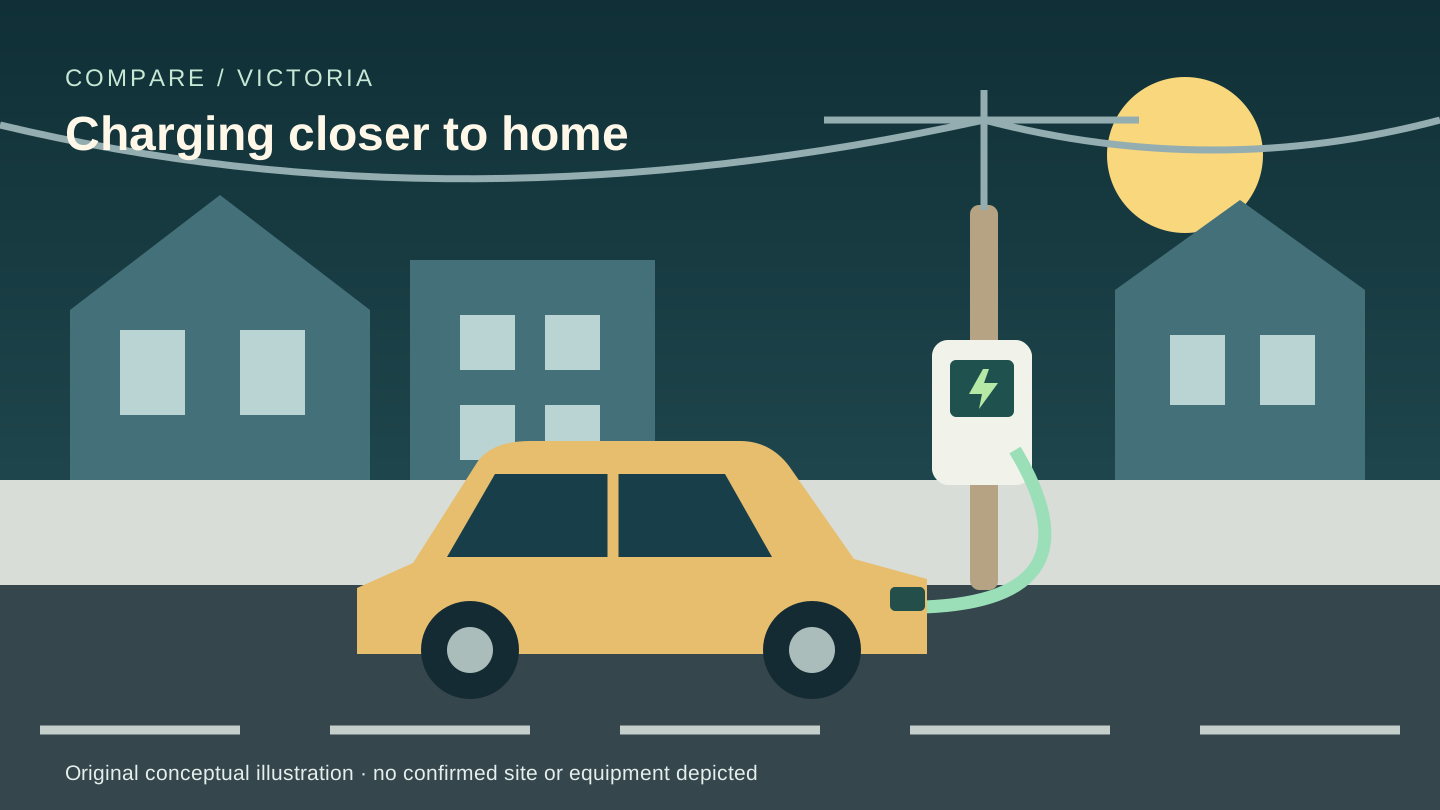
Home charging sounds wonderfully simple until your home has no driveway. If you rent, live in an apartment or park on the street, a wallbox offer can feel like someone recommending a swimming pool for your balcony. A reliable public charger within walking distance would be rather more useful.
That is why a fairly dry Australian Energy Regulator announcement on 27 October deserves attention. It concerns CitiPower, Powercor and United Energy, collectively CPU, and services that let charging providers rent electricity distribution assets such as poles. It could make that pathway less cumbersome. It does not establish that another charger has opened.
What the waiver actually changes
The AER’s service overview explains the administrative issue: these pole-rental services, alongside hot-water switching, are classified as negotiated distribution services. Ring-fencing rules impose separation requirements when network businesses provide them. CPU sought permission to use existing offices, branding and customer channels rather than duplicate those arrangements.
The 26 October decision grants relief from office-separation and branding restrictions until 30 June 2031. The AER sees a benefit in avoiding additional premises, separately branded websites and portals. That is an operating-cost argument; the decision promises no reduction in the price drivers pay to charge.
The competition condition matters just as much. CPU must handle negotiated-service applications in arrival order, on the same basis as standard connection applications, without favouring related parties or its own EV charging trial. Owning the poles should not become a shortcut to the front of the queue.
A pole is a starting point
CPU’s waiver application describes a dedicated internal team, separate management and shared customer systems. It also explains that safety, engineering and network-capacity information is needed before an application can be assessed. A convenient pole outside your building is therefore a possibility to investigate, not an automatic installation.
There are street-level constraints too. Port Phillip’s separate kerbside charging consultation says some suggested sites could not proceed because of electrical capacity, parking restrictions or limited space. Its role includes managing parking and enforcement; it does not own or operate the charging equipment.
The AER explicitly separates this new services waiver from CPU’s pre-existing waiver to own, install and lease kerbside chargers as a trial. Treat the two as different decisions. This announcement supplies no new rollout timetable, street list, charger rating or driver tariff.
What I would check before relying on it
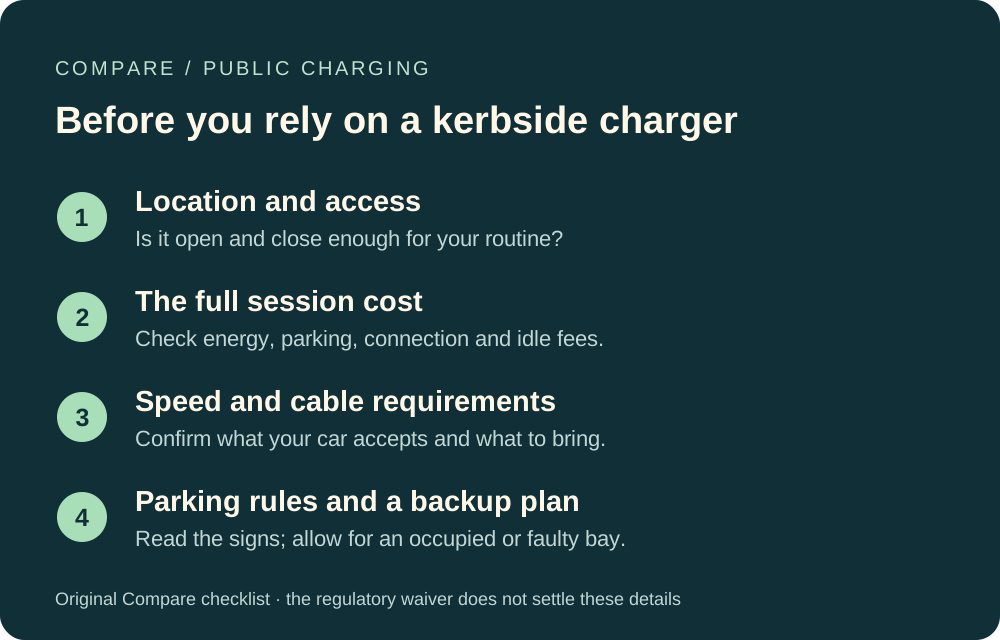
For renters and apartment residents, the useful outcome would be dependable charging close enough to fit ordinary life. Before factoring a future pole charger into an EV purchase, check the operator’s live location information and physically check the parking signs. A proposed dot on a map cannot charge your car.
Compare the full session cost, including any parking, connection or idle fees. Check operating hours, cable requirements and the charging rate your car can actually accept. Ask who handles faults and what your backup charging option would be when the bay is occupied.
My take: this is a sensible enabling step with a worthwhile fairness condition. The next consumer milestone is an accessible, working charger with published prices. Until then, use our EV charger comparison to understand equipment choices, while keeping your actual street-parking routine at the centre of the decision.
Primary sources
Read the evidence.
- Waiver announcement, 27 October 2026Australian Energy Regulator ↗
- Notice of decision, 26 October 2026Australian Energy Regulator ↗
- Negotiated distribution services overviewAustralian Energy Regulator ↗
- CPU negotiated-services waiver applicationCitiPower, Powercor and United Energy ↗
- Background: expanding kerbside EV chargingCity of Port Phillip ↗
Checked 30 October 2026 against the AER communication, decision, service overview and CPU application, plus Port Phillip’s separate consultation. Analysis of a regulatory change, not a charger test or rollout announcement. No new locations, charging prices or opening dates are established by this waiver. Original Compare illustrations show generic concepts.
Community
Add to the article.
Useful experiences, questions and corrections make the next reader’s decision easier.
Comments appear here after moderation.