
The short version
What you need to know.
- Zurich now considers FSD (Supervised) in InsureMyTesla pricing. There is no published universal discount percentage.
- At current Australian monthly prices, twelve months of FSD costs $1,788, or $900 for eligible Enhanced Autopilot owners. The insurance saving must exceed that to pay for a new subscription.
- An insurance discount does not make the car autonomous. You still need to supervise, maintain control and be ready to intervene.
A welcome development, with a bill attached
Normally, adding technology to a car gives an insurer another expensive thing to repair. So seeing a driving feature recognised as a reason to charge less is interesting. If better assistance can reduce crashes, I want owners to share in the benefit.
But there is a fairly obvious question here: how much am I spending to get that discount? A cheaper insurance policy can still leave the household paying more overall.
My starting point is positive. This could be a useful step towards insurance that better reflects what a vehicle can do. I just would not sign up for another monthly payment until I had the actual numbers in front of me.
What Zurich actually announced
On 14 September 2026, Zurich announced that Full Self-Driving (Supervised) would become a rating factor in its Australian InsureMyTesla offering. It says eligible customers can receive more affordable insurance, drawing on local and international Tesla data. Zurich describes it as an Australian industry first.
The announcement does not promise every driver the same percentage reduction. It also does not establish that InsureMyTesla will be the cheapest policy for everyone. Those are separate questions that need an individual quote.
Zurich’s product page is aimed at Model 3 and Model Y drivers. Confirm your particular vehicle, cover and FSD status with the insurer, including whether an existing policy can be reassessed or the change takes effect at renewal.
I would ask for the dollar difference, with the same driver details, cover and excess. “You qualify for a discount” is encouraging. “Your annual bill falls by this amount” is what I can actually compare.
First, put twelve months of FSD on the table
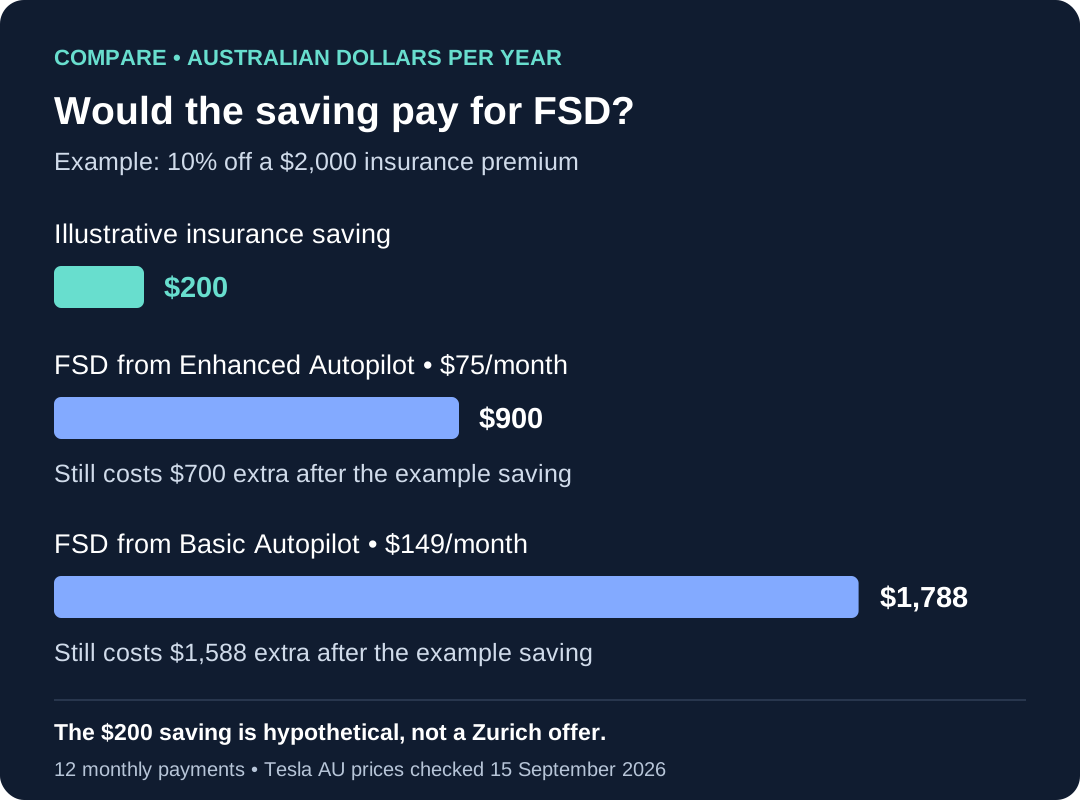
Tesla’s Australian subscription page currently lists $149 a month when upgrading from Basic Autopilot, and $75 a month for eligible vehicles with Enhanced Autopilot. Twelve monthly payments therefore total $1,788 or $900. These are Australian dollars, checked on 15 September 2026, with prices subject to change.
The $75 option is relevant if you already have Enhanced Autopilot. It is not a $75 price available to every new subscriber, and the calculation does not recover what an owner previously paid for that package.
If you already subscribe and plan to keep using FSD, a lower premium can be a straightforward bonus, provided the policy still suits you. If you are subscribing only because of this announcement, the discount has a much bigger job: it needs to cover the new subscription expense.
For an owner who previously bought FSD outright, use the costs you actually face today. There is no reason to add a hypothetical monthly subscription to that decision.
How much insurance saving would make it pay?
Here is an illustrative example, not a Zurich quote. Start with a $2,000 annual premium and assume a 10% reduction. You save $200 on insurance. Add a $1,788 subscription and you are still spending $1,588 more each year than keeping that policy without subscribing. At the $900 subscription price, the extra annual spend is $700.
Even an illustrative 20% reduction on a $3,000 premium saves $600. That leaves $1,188 of the standard annual subscription uncovered, or $300 for an eligible Enhanced Autopilot owner.
To break even on a $2,000 premium, the required reduction is 89.4% for the $149 monthly subscription, or 45% for the $75 option. On a $3,000 premium, it is 59.6% or 30%. These percentages are arithmetic thresholds, not discounts Zurich is advertising.
That is why I would be careful with the headline. Without a confirmed saving large enough to cover the subscription, insurance alone is not a demonstrated reason to buy FSD. You may still value the driving assistance. Just put that value in its own column.
The safety claim deserves a closer look
Zurich cites Tesla data indicating seven times fewer major or minor collisions with the technology compared with regular EVs. That is the company-supplied claim behind the announcement, not an independently established prediction for your next drive.
Tesla’s published methodology is worth reading. It uses vehicle telemetry, counts a collision as FSD-related if the system was engaged within the preceding five seconds, and does not assign fault. Its comparisons include manually driven Teslas with and without active safety features, plus an estimated US baseline.
Tesla acknowledges assumptions and limitations in constructing that US comparison. The published methodology is not an Australian randomised trial, and the headline ratio should not be treated as a precise reduction in every Australian driver’s personal risk.
My view is that fleet data is useful evidence, but I would want matched comparisons across road types, conditions, vehicles and driver behaviour before attributing the entire difference to software. Drivers choose when to engage assistance; that makes a simple engaged-versus-not-engaged comparison harder to interpret.
An insurer being willing to reflect the technology in its pricing is commercially meaningful. It still does not independently validate every safety claim made about FSD. We can welcome the development and keep asking for better evidence.
You are still the driver
Tesla’s Australian FSD guidance is explicit: the system does not make the car autonomous. It requires an attentive driver, and you remain responsible for speed and control even when it is operating.
That means no treating the journey as time off. Keep watching the road and be ready to take over. Follow the vehicle manual and the road rules where you are driving; a feature being available is not permission to ignore either.
Insurance pricing also does not decide fault in a particular crash. The circumstances and applicable law still matter, while whether an insurer pays a claim depends on the policy and facts. A lower premium is not a blanket promise that any incident involving FSD is covered.
I would ask the insurer directly about any conditions tied to FSD, including what happens if access is suspended or a subscription is cancelled. Get the answer before relying on an ongoing discount.
Check the hardware before paying
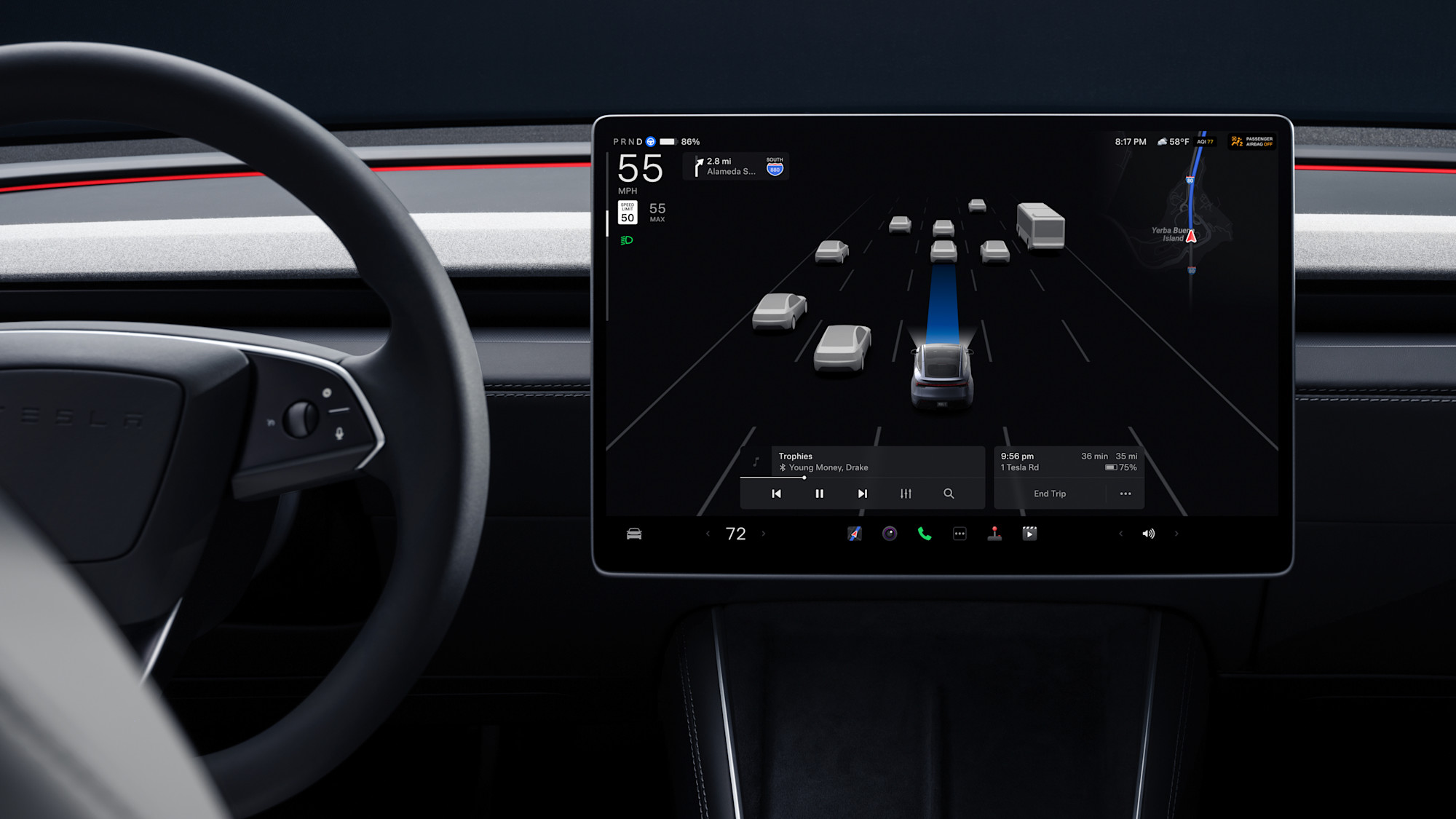
There is a distinction on Tesla’s Australian subscription page that is easy to miss. Hardware 3 and Hardware 4 vehicles can be eligible for the package, but the page says the FSD (Supervised) feature is currently available on Hardware 4, with no confirmed rollout timing for Hardware 3.
Before paying, verify the hardware and the features actually enabled on your car. Then confirm that the insurer recognises that exact configuration. A subscription button and eligibility for a particular insurance price are not interchangeable.
Tesla allows cancellation through the app, with access continuing until the billing period ends and no prorating of the monthly payment. Do not assume buying one month locks in a full year of reduced insurance. Ask Zurich how it treats changes during the policy.
Compare the whole policy, not just the FSD discount
For my own decision, I would collect the Zurich quote and at least two alternatives, using consistent details. I would compare the total payable, insured value, excess, repair arrangements, glass cover, replacement-car conditions and charging-equipment cover.
Zurich’s PDS explains that the policy includes the wording, information supplied when applying, the individual schedule and any written amendments. The quote and schedule matter alongside the headline benefits.
A purely hypothetical example: a $2,200 policy reduced to $2,000 still costs more than an equivalent $1,800 competitor. The discount is real, but it has not made the first policy the cheapest. Equally, better cover can be worth paying for; make that trade-off deliberately.
There is a commercial relationship to know about too. Tesla’s Australian insurance support page discloses a referral commission of 5% plus GST of the first-year premium, excluding statutory charges, when a customer takes a Zurich policy following a Tesla referral. That does not make the policy bad. It is another reason to compare independently.
My take: a useful bonus, not a reason to skip the maths
I like the direction. If technology helps prevent collisions, it makes sense for that benefit to reach the person paying the premium. More competition around that would be welcome.
For someone already happy to pay for FSD, this announcement is a good reason to get another insurance quote. For someone considering it purely to save money, my answer is much more cautious: show me an actual annual saving above the subscription cost first.
You might decide the assistance is worth paying for even after that calculation. Fair enough. But that is a purchase based on what the feature offers you, with a possible insurance saving on the side. It is not the same as the subscription paying for itself.
Primary sources
Read the evidence.
- 14 September announcement: FSD becomes an insurance rating factorZurich Australia ↗
- Australian FSD subscription prices, hardware eligibility and cancellationTesla Australia ↗
- FSD capabilities and continuing driver responsibilitiesTesla Australia ↗
- Vehicle Safety Report: collision definitions and comparison methodologyTesla ↗
- InsureMyTesla: eligible models and product featuresZurich Australia ↗
- InsureMyTesla policy documentsZurich Australia ↗
- Tesla insurance referral and commission disclosureTesla Australia ↗
- Official Tesla editorial photographyTesla ↗
Independent analysis by Patryk Lazarz, checked on 15 September 2026. No personal insurance quotes were obtained and no hands-on FSD testing is claimed. All example premiums and discount percentages are hypothetical Compare calculations, not Zurich offers or typical-customer estimates. Safety statistics are attributed to their producer. Confirm current pricing, eligibility and cover in your individual quote and policy documents.
Community
Add to the article.
Useful experiences, questions and corrections make the next reader’s decision easier.
Comments appear here after moderation.