

The short version
What you need to know.
- Sungrow plans PowerHarbour’s Australian unveiling at All Energy Australia, 28–29 October, Booth KK123.
- The up-to-120 kWh headline is an expansion ceiling. European documentation shows a two-group configuration and distinguishes nominal from usable energy.
- Australian pricing, final configurations, certification and stock or delivery dates were not established by the announcement.
A battery should give you a bit of breathing room
The best home-energy upgrade is the one that lets the evening carry on: dinner gets cooked, the washing gets finished and the family can stop thinking about the power bill for five minutes. A battery brochure rarely leads with that, but it is a fairly good place to start.
Sungrow’s 21 October announcement says it will unveil PowerHarbour in Australia at All Energy Australia, running at Melbourne’s MCEC on 28–29 October. The company is at Booth KK123, with its new all-in-one residential system alongside commercial and utility equipment.
That is an upcoming Australian unveiling. The release does not provide a local price, final model list or firm stock and delivery dates. I have not tested PowerHarbour, and I would wait for the Australian equipment list before treating the show announcement as an installation offer.
What sits behind the 120 kWh headline?
Sungrow describes a modular system expandable to 120 kWh. The useful word is expandable: that is a maximum system-capacity claim, rather than the size of a single battery module.
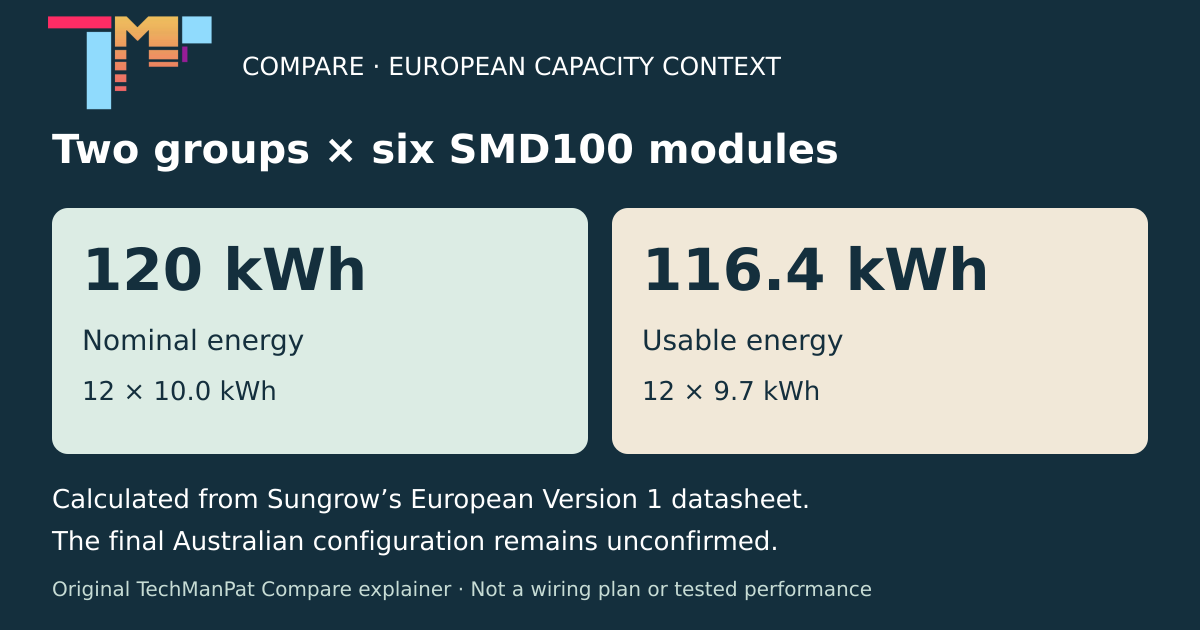
There is helpful detail in Sungrow’s European SH10/12/15TA datasheet. It lists one to six battery modules per controller and two in parallel. Its SMD100 module is rated at 10 kWh nominal, with 9.7 kWh usable energy.
Two six-module groups using twelve SMD100 modules therefore total 120 kWh nominal and 116.4 kWh usable, calculated from that table. This explains the headline through a documented European configuration; it does not confirm that exact arrangement for Australia. The local announcement does not specify whether its 120 kWh figure is nominal or usable.
Those are different measurements, and neither tells you how much power the system can deliver at once. Ask for usable storage, inverter output and backup limits separately. Most households should size around their actual evening use and desired reserve, rather than making the garage responsible for winning a capacity competition.
Show us how it makes an ordinary evening easier
An integrated design is appealing if it makes installation and everyday control simpler. At the show, I would want the explanation to start with the household: what happens when clouds arrive, someone starts cooking and the car still needs charging?
Can the owner keep a backup reserve, understand why the battery charged and change the plan without a technical support call? Nobody wants to become the unpaid night manager of their own switchboard.
The Australian release mentions AFCI 3.0 arc-fault protection. That is a manufacturer feature claim, not an independent safety finding from Compare. I would also ask which circuits and phases can receive backup, the required switching hardware, simultaneous-load limits and how solar recharging works during an outage. Overseas backup specifications should not quietly become Australian promises.
The worthwhile part comes after the demonstration
Before paying a deposit, ask for the exact Australian inverter and battery models, current approval records, applicable warranty terms and complete installed quote. Get the promised supply date in writing and find out what adding modules later would require.
For an existing solar household, have the installer explain what stays and what needs replacing. For a new installation, compare the whole system against your usage and budget, including the tariff strategy. A large maximum capacity alone does not establish good value or savings.
My take: PowerHarbour is worth watching because simpler home-energy systems could give families more control with less daily effort. The Melbourne unveiling is a chance to turn the big number into clear Australian answers. Start with what your home needs, and leave room in the budget for actually living in it.
Primary sources
Read the evidence.
- Australian unveiling announcement, 21 October 2026Sungrow via PR Newswire ↗
- European SH10/12/15TA and SMD battery datasheet, Version 1Sungrow — European specification ↗
- All Energy Australia dates and venueAll Energy Australia ↗
Checked on 22 October 2026 (Australia/Perth). The supplied Sungrow news-page URL returned 404; the manufacturer’s distributed PR Newswire release was retrieved. European documentation is used explicitly for capacity context. Final Australian configurations, usable capacity, pricing, certification, warranties, backup capability and delivery timing remain unconfirmed here. No hands-on testing or savings result is claimed.
Community
Add to the article.
Useful experiences, questions and corrections make the next reader’s decision easier.
Comments appear here after moderation.