

The short version
What you need to know.
- A fixed export cap, flexible export allowance and emergency backstop serve different purposes.
- A zero-export instruction can leave solar serving the home; disconnecting an inverter can stop generation. Ask about your exact battery and inverter.
- NSW, Victoria and WA have different requirements and exceptions. Get the applicable rules and system behaviour recorded in your quote.
The control question belongs in the quote
You buy solar to take more control of your electricity bill. Discovering that somebody else can remotely turn it down is therefore not the most relaxing item in the welcome pack.
But “they can switch off your solar” misses the useful question: what happens to your house and battery when they do? That depends on the control method, your equipment and where you live.
SolarQuotes’ recent explainer prompted a closer look. Here is our take, checked against government and network guidance rather than the more excitable version of the story.
Why have a backstop at all?
Solar reduces how much electricity households need from the wider grid. On mild, sunny days, that demand can fall far enough to make maintaining essential grid services harder. A network fault can make the situation more difficult still.
AEMO’s framework puts other actions first, including reducing grid-scale generation and increasing demand from large users. Rooftop solar management is a last resort, not the default response to a pleasant afternoon.
This is not purely theoretical. After storm damage separated South Australia from the wider network in November 2022, AEMO reports distributed-solar curtailment reaching approximately 410 MW. Interventions lasted four to nine hours on affected days. Rare does not necessarily mean a five-minute inconvenience.
Export stopped does not always mean solar stopped
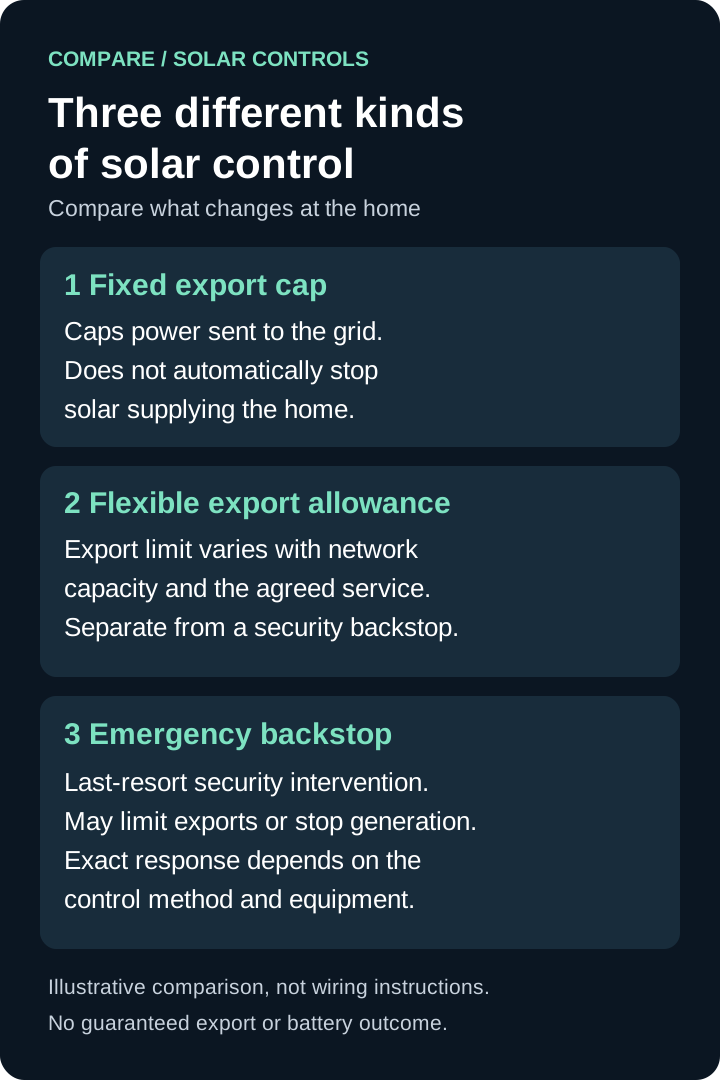
A fixed export limit caps what leaves your property. Flexible exports vary that allowance with network capacity. An emergency backstop is a separate security intervention, even when it uses the same communications system.
A zero-export instruction can leave solar supplying household loads. Disconnecting an inverter is different. In Queensland, Energex’s GSD arrangement disconnects the affected inverter from the grid. Energex says grid supply to the premises continues, but solar generation ceases and normal electricity tariffs apply.
That is why “I have a battery” is not a complete answer. Ask your installer how the exact inverter and battery combination responds, including charging and backup circuits. A normal blackout and a backstop instruction are not automatically the same operating condition.
There is no single Australian start date
NSW: New and upgraded rooftop systems up to 200 kW are being brought into the requirements from November 2026. The official rollout is phased by network and postcode, not one statewide switch. The consumer guidance says unchanged existing systems need no action and distinguishes solar-connected hybrid batteries from adding only an AC-coupled battery.
Victoria: Requirements cover new systems up to 200 kW from 1 October 2024, plus certain inverter replacements. Like-for-like and warranty replacement exceptions matter, so replacing a failed inverter is not automatically identical to installing a larger system.
Western Australia: On the southwest grid, rules from 1 May 2026 standardise capabilities for new or upgraded small solar and battery systems. There is an important choice: after installation testing, customers not participating in export products, or unable to maintain reliable internet, can use a standard 1.5 kW export limit without ongoing connectivity. That is not permission to bypass commissioning or disconnect an existing arrangement without checking its terms.
Our take: make the quote explain the behaviour
I would rather have targeted solar controls than a wider power outage. But households deserve more than a reassuring acronym and a Wi-Fi password request.
Before accepting a quote, ask:
- Does an emergency instruction stop exports, solar generation or the entire inverter?
- Can solar still supply the home and charge the battery?
- What changes if the internet drops out, and who restores the connection?
- Which rules apply to this installation, and where is that recorded?
Compare the behaviour, not just capacity
Compare battery systems on those answers as well as capacity and price. The best system is not simply the one with the biggest number on the brochure. It is the one whose behaviour you understand before an unusual day arrives.
Sources
Read the evidence.
- SolarQuotes’ recent explainerSolarQuotes ↗
- AEMO’s frameworkAEMO ↗
- AEMO reportsAEMO ↗
- Energex’s GSD arrangementEnergex ↗
- official rolloutNSW Government ↗
- consumer guidanceNSW Government ↗
- Like-for-like and warranty replacement exceptionsVictorian Government ↗
- rules from 1 May 2026WA Government ↗
Independent, source-based analysis checked 12 November 2026. SolarQuotes inspired the topic; government, AEMO and network guidance support the technical distinctions. No hands-on system testing or guaranteed battery behaviour. Requirements depend on location and installation.
Community
Add to the article.
Useful experiences, questions and corrections make the next reader’s decision easier.
Comments appear here after moderation.