
The short version
What you need to know.
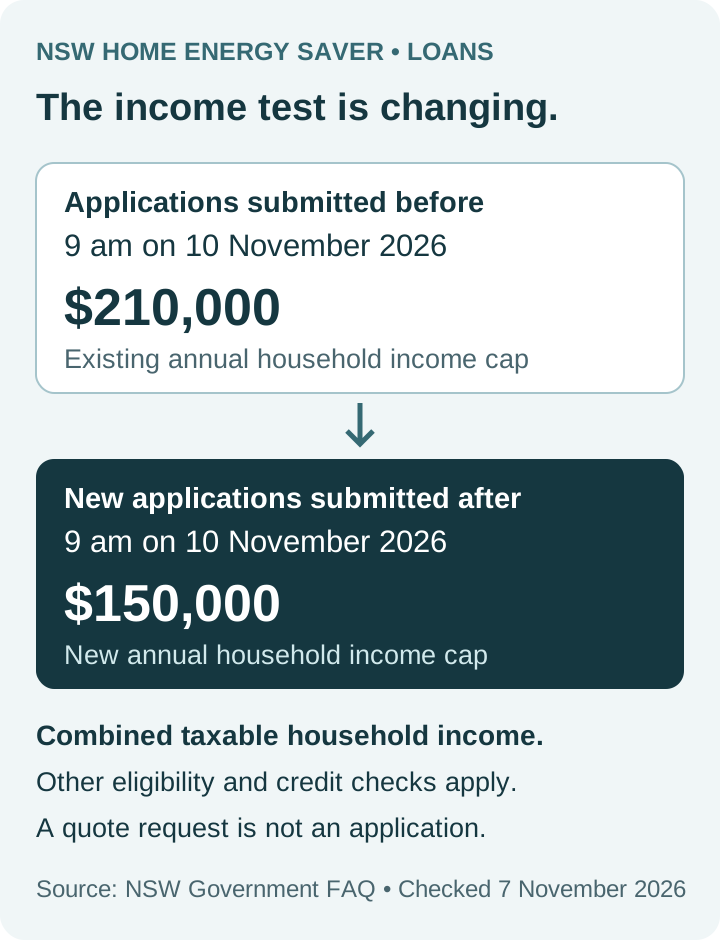
- Applications submitted before 9 am on 10 November 2026 are assessed under the existing $210,000 combined taxable household income cap.
- New applications after 9 am face a $150,000 cap. Other property-owner and credit requirements still apply; confirm the precise submission cutoff with the provider.
- Zero interest still means repayments and possible late fees. If seeking the separate discount on the same purchase, check the discount-first ordering before taking a loan.
A short runway for households planning an upgrade
NSW households planning solar, a battery or another energy upgrade have an eligibility change to check. The Home Energy Saver zero-interest loan income cap is dropping from $210,000 to $150,000. The government’s FAQ says applications submitted before 9 am on 10 November 2026 will still be assessed against the existing cap. The announcement was published on 4 November, so this is a short runway for households caught by the change.
Who loses eligibility?
The threshold measures combined taxable household income, rather than one person’s salary. For this program, the NSW Government defines the household around the property owners listed on the rates notice. Its assessment guidance refers to tax assessment notices for the previous completed financial year.
Households above $150,000 and up to $210,000 are the group directly affected. Someone at or below the new cap does not need to beat the date just to retain income eligibility, although the other requirements still apply. Someone over $210,000 was already outside the current income test.
The deadline concerns submitting an application, not installing the equipment. A quote request is not the same thing. Confirm the submission requirements and cutoff with the finance provider rather than assuming a weekend enquiry reserves your place.
Why is NSW tightening the rules?
The government says it wants to concentrate support on low- and middle-income households. More than 15,000 households have been approved for loans since the June launch, across 539 postcodes. It says 53 per cent of approvals were outside Greater Sydney.
That is a reasonable policy objective. Upfront costs are a genuine barrier to more efficient homes, and directing assistance towards households with less capacity to pay makes sense. The awkward part is the turnaround for people who have already been comparing quotes. Solar decisions deserve more consideration than a supermarket special.
What the loan actually covers
Home Energy Saver offers up to $15,000 at zero interest, with repayment terms of up to ten years. The money still needs to be repaid. Lower electricity bills are possible, but the size of any saving depends on the home, equipment and how it is used.
Brighte and Plenti deliver the loans, subject to their assessments. Eligible borrowers include owner-occupiers and landlords, with Australian citizenship or permanent residency requirements. Renters cannot simply apply for the property-owner loan themselves.
Check each provider’s available upgrades. Plenti currently lists rooftop solar, batteries, inverters and switchboard upgrades. Brighte lists options including solar, batteries, EV chargers and heat-pump hot water, plus other approved upgrades. Availability and installer accreditation matter as much as the headline product list.
Zero interest also does not remove every possible charge. Brighte lists a $4.99 late-payment fee, capped at $49.90 a year. Plenti lists a $2 weekly late fee for overdue repayments, capped at $120 per twelve-month period. Read the actual loan terms before committing.
Check the quote before chasing the deadline
Plenti’s process starts with an approved vendor, followed by a link to complete the application. Brighte similarly describes an accredited installer providing a quote and application link. Neither process turns an initial enquiry into guaranteed finance.
Compare the installed cash price, warranty coverage and repayment schedule. Check whether switchboard work or other installation costs sit outside the quoted package. A subsidised loan cannot rescue an overpriced system, and a bigger battery is not automatically a better purchase.
There is another sequencing trap for lower-income households: the separate Home Energy Saver discount, worth up to $4,000, is still described as coming soon. Brighte says eligible households wanting both forms of assistance on the same purchase should apply for the discount first. Taking the loan first can prevent that discount being applied to the same purchase.
My view: targeting support is defensible, but the short notice needs a very clear explanation. Check eligibility promptly, keep evidence of any submitted application, and do not let the date pressure you into buying equipment that does not suit your home or budget.
Sources
Read the evidence.
- Income-cap change and program approvals, 4 November 2026NSW Government ↗
- Eligibility, household definition and precise application cutoffNSW Government ↗
- Home Energy Saver loans: available upgrades, application process and feesPlenti ↗
- Home Energy Saver loans: terms, upgrades and discount-first orderingBrighte ↗
Sources checked 7 November 2026. The government’s updated FAQ controls the income threshold and exact cutoff; Brighte’s page still displays the earlier $210,000 cap. The FAQ does not specify a timezone, so confirm submission requirements with the provider. Loans require approval, must be repaid and can attract late fees. Savings are not guaranteed; the separate discount is still described as coming soon.
Community
Add to the article.
Useful experiences, questions and corrections make the next reader’s decision easier.
Comments appear here after moderation.