
The short version
What you need to know.
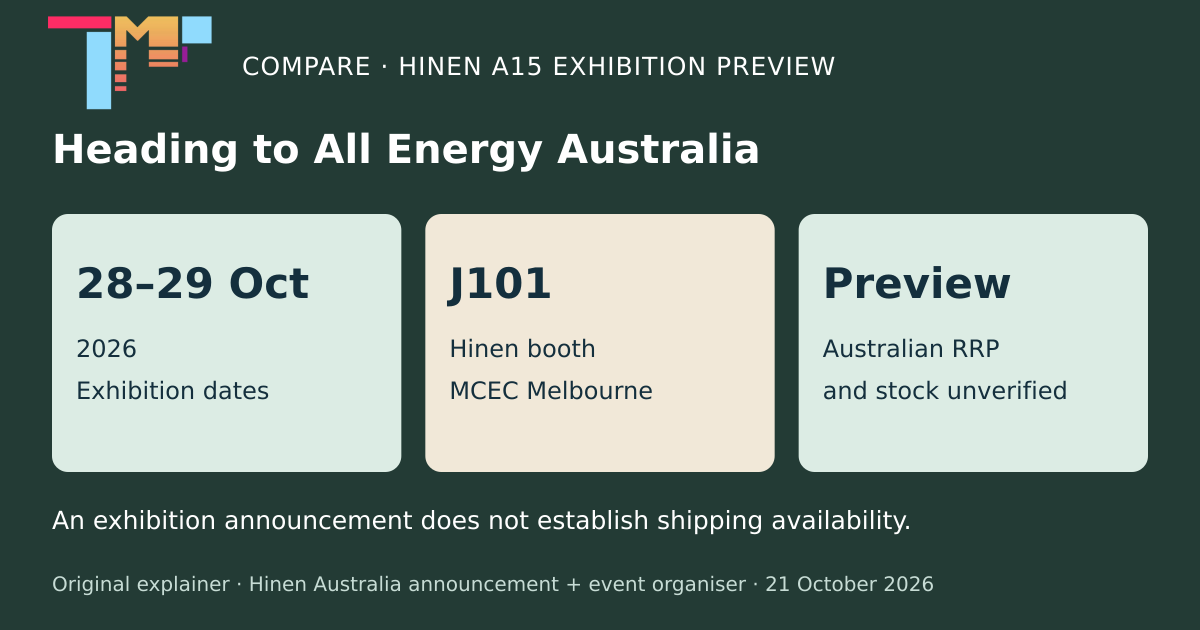
- Hinen has announced Booth J101 at MCEC, 28–29 October 2026.
- The preview describes single-phase and three-phase storage systems plus 7 kW and 11 kW AC EV chargers.
- The event announcement does not establish Australian capacity options, variant approvals, RRP or shipping dates.
A show preview, with the useful questions attached
The interesting part of a home battery is increasingly what happens around it. Solar is producing, someone plugs in the car, dinner starts and you still want enough reserve for a blackout. Getting that lot to cooperate would be more useful than another app full of animated arrows.
Hinen says it will showcase its A15 residential energy solutions at All Energy Australia, at Melbourne’s MCEC on 28–29 October. Its stand is J101. The Australian announcement was published on 9 October, with the body dated 8 October.
This is an exhibition preview. It does not establish that every system being discussed is shipping, approved in every Australian configuration or ready for installation next week. I have not tested the equipment, and I would not turn a booth announcement into a delivery promise.
What Hinen says it will bring
The Australian release describes single-phase hybrid all-in-one systems from 3.6 to 10 kW and three-phase systems from 10 to 25 kW. It also lists 7 kW single-phase and 11 kW three-phase AC EV chargers.
Those kilowatt figures describe power, not battery storage in kilowatt-hours. The announcement discusses modular capacity and expansion but does not give a complete Australian capacity table. I’m not filling that gap with a similarly named overseas product’s specifications.
For a buyer, the starting point is the home’s supply and demand. An installer needs to know the phase arrangement, existing solar, major appliances and charging requirements before a headline power range becomes a sensible system choice.
Show us what the energy controller actually does
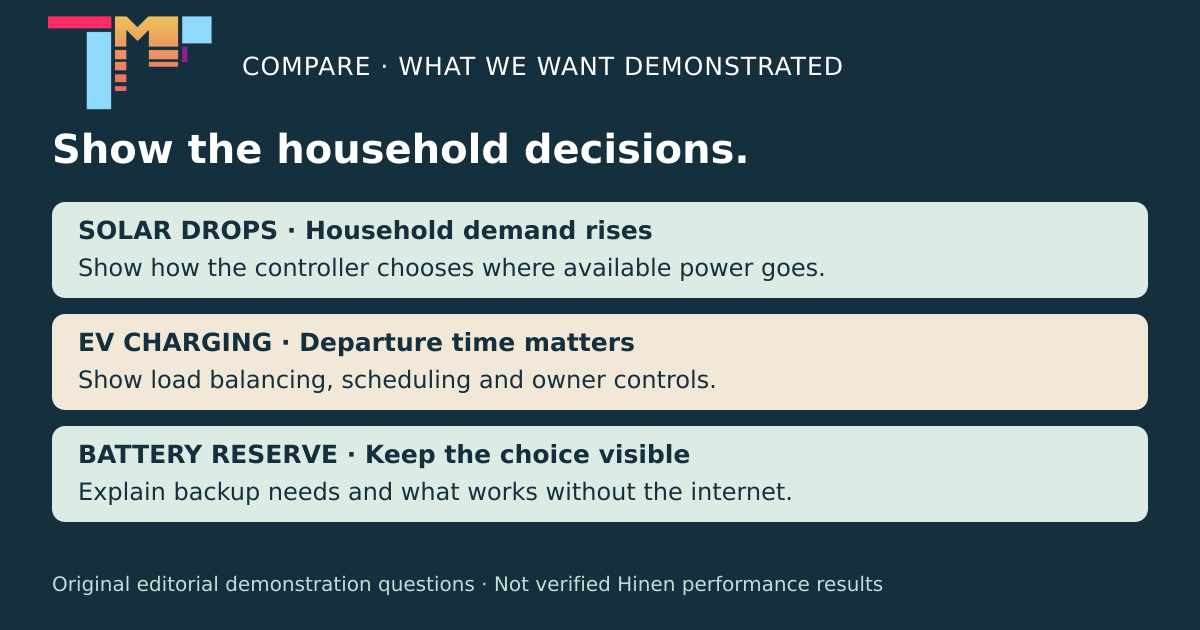
Hinen describes app control, smart load management and EV load balancing. It says the chargers can use solar and support scheduling. Those are company claims, and they raise a useful set of demonstration questions.
I’d like to see the car start charging while the home is using a meaningful load, then watch what happens when solar output drops. Does charging slow down? Can the owner prioritise a departure time? Can they protect a battery reserve without checking three separate menus?
Ask whether solar charging means using measured surplus generation or simply running on a timer. Then ask what metering and communications hardware is required. The practical difference appears on a cloudy afternoon, when a schedule and actual spare solar are not necessarily the same thing.
I would also ask what remains available if the internet drops out, whether another charger or existing inverter can join the setup, and which functions require a particular retailer or extra service. Those are questions to demonstrate, not faults I’m claiming Hinen has.
Turn the demonstration into an Australian equipment list
For backup, ask which circuits and phases remain supplied, the continuous and starting-load limits, and what happens when the battery runs low. The system’s normal grid-connected rating should not be treated as a complete outage specification.
Before paying a deposit, get the exact Australian model numbers, current approval records, usable capacity, applicable warranties and full installed price. Ask for an actual supply date and the conditions for expanding later. I could not establish Australian RRP, variant approvals or delivery commitments from this exhibition announcement.
My take: the battery-and-EV coordination is the part worth watching at J101. A good demonstration should make the household decisions visible and let the owner change them. If that can be explained clearly, it gives buyers something much more useful to compare than the size of the stand.
Primary sources
Read the evidence.
- Australian A15 exhibition announcement, published 9 October 2026Hinen Australia ↗
- Event details and visitor informationAll Energy Australia ↗
Exhibition plans and capabilities are attributed to Hinen. Overseas capacities, local approvals, delivery dates and tested coordination performance are not assumed. Checked on 21 October 2026 (Australia/Perth). This is document-based editorial, not hands-on testing.
Community
Add to the article.
Useful experiences, questions and corrections make the next reader’s decision easier.
Comments appear here after moderation.