
The short version
What you need to know.
- High-mileage electric cars performed better than comparable petrol cars in newly reported UK roadworthiness-test research.
- An MOT result cannot tell you how much usable battery capacity remains. Assess the individual vehicle.
- My view: a healthy, well-priced used EV deserves a place on the shortlist, even when its odometer looks intimidating.
This is the conversation we should be having
I’m excited about what electric cars can do when they’re new. But the more important question for plenty of Australians is what they’re like when someone else has already put a lot of kilometres on them.
The Guardian’s 22 September report highlights evidence challenging the assumption that a high-mileage EV is worn out.
My reaction? Good. I want us to get past judging a car’s remaining usefulness from one number on the dashboard. Kilometres matter, but I would rather understand what I am buying than reject it because the odometer has crossed an arbitrary line.
That is particularly relevant to used EVs. If a car still does the job, is in sound condition and costs the right amount, it deserves a proper look.
What the new research actually found
Fleet World reports that New AutoMotive analysed 47.4 million UK MOT tests for the British Vehicle Rental and Leasing Association (BVRLA). These are test records, not 47.4 million electric cars.
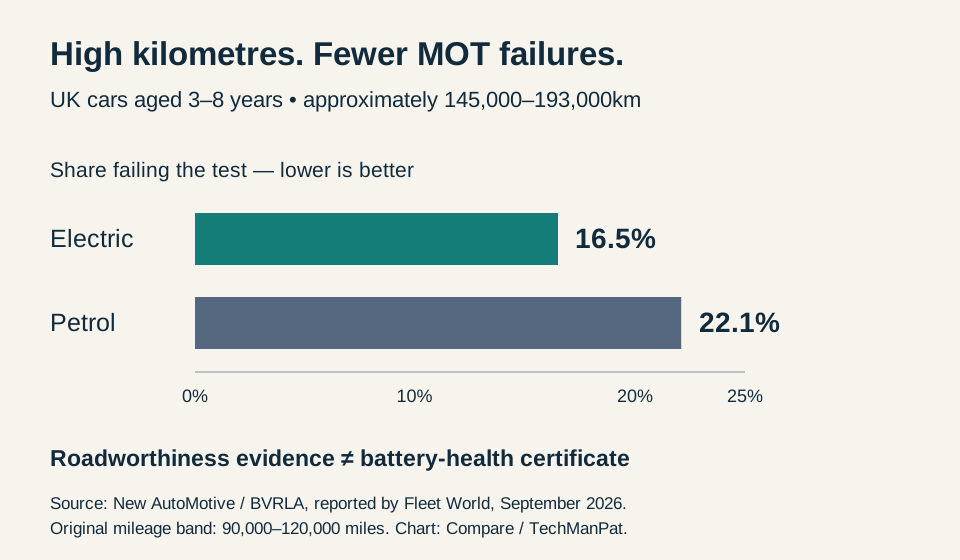
Among cars aged three to eight years with 90,000–120,000 miles recorded—roughly 145,000–193,000km—the reported failure rate was 16.5% for EVs and 22.1% for petrol cars. That is 5.6 percentage points lower, or approximately 25% lower in relative terms.
The commissioning organisation represents the rental and leasing industry, which has an interest in used-car confidence. That context belongs alongside the result.
For me, this is a useful reason to question blanket assumptions. It is not a promise about the next car in a classified ad.
Roadworthy and healthy battery are different questions
The UK government describes the MOT as a check of specified safety and environmental requirements. It covers items such as tyres, brakes, lights and steering. It is not a comprehensive mechanical inspection; the government explicitly excludes engine, clutch and gearbox condition.
Visible battery and wiring checks should not be confused with measuring the energy an EV battery can still store. Passing an MOT does not give a buyer a battery state-of-health certificate.
That also puts a limit on the word “reliable”. This is encouraging roadworthiness evidence, rather than a complete comparison of breakdowns, repair bills or remaining vehicle life. British conditions and the mix of cars tested are not identical to Australia’s.
I would use the result to keep an open mind, then investigate the particular car. Turning a favourable average into “every EV is a safe bet” would be just as unhelpful as dismissing them all.
The simpler drivetrain is a real advantage
There is a sensible engineering reason to be optimistic. The US Department of Energy explains that battery-electric cars generally require less maintenance because they have fewer moving parts and fewer fluids to replace. Regenerative braking can also reduce friction-brake wear.
An EV does not need engine oil changes. But it still has tyres, suspension, electronics and other equipment to look after. The manufacturer’s maintenance schedule still matters, and a major component failure outside warranty can be expensive.
I like the prospect of buying a car with less routine drivetrain work ahead of it. I also want a workshop that can diagnose it, parts that can be obtained and a realistic repair quote when something does go wrong. Simple ownership depends on support as well as the design of the car.
Ask for evidence about the battery
RAC WA offers battery-health checks that report remaining capacity and condition, with compatibility dependent on the vehicle. That is the sort of information I would want before committing to a used EV, preferably from an independent assessor familiar with the model.
I would ask when the report was produced, which vehicle it applies to and how the assessment was performed. A percentage without context is less useful than a dated report that somebody can explain.
Then connect it to your actual driving. As an illustration, if a car once had 60kWh of usable capacity and now retained 90% of that, the arithmetic would give 54kWh. That does not automatically tell you its driving range: consumption, conditions and the way capacity is measured still matter.
I would not need a used car to perform exactly as it did on day one. I would need it to cover my regular trips with a comfortable margin and a charging arrangement that works. Those are much more useful questions than whether the battery is still perfect.
My checklist before handing over the money
The Australian Government’s EV buying guide recommends battery-health information, service-history checks and an inspection by someone experienced with EVs. It also advises checking remaining warranty coverage and charging equipment.
Here is how I would turn that into a buying conversation:
- Battery: obtain a recent health report and have warnings or unexplained results investigated before purchase.
- Warranty: confirm the exact remaining years and kilometres, capacity conditions and whether coverage transfers to you. Ask for written confirmation for that vehicle.
- Condition: book an EV-capable pre-purchase inspection, including tyres, brakes, suspension and signs of damage. A tidy cabin is not a mechanical report.
- Charging: check the connector, supplied cables and charging operation. Make sure the car suits the chargers you will actually use.
- Costs: get an insurance quote and allow for identified repairs, tyres and any home-charging installation. Compare the full cost with alternative cars.
This is where EVs could become more accessible
The opportunity I see is a used market where buyers can separate a tired vehicle from a perfectly useful one. Better information should make that easier.
I would love to see battery-health reports become an ordinary part of a used-EV advertisement, alongside the age, kilometres and service history. A seller who can show the car’s condition should have an advantage over one who simply says there is nothing to worry about.
There is a balance here. A tempting purchase price is not enough if insurance, repairs or inconvenient charging spoil the deal. Equally, a higher odometer reading should not wipe out a car’s value when its condition and remaining capability are good.
Compare it with the alternatives available for your budget today, rather than just the original sticker price. I would pay more for a well-documented car if that reduced uncertainty. I would also be quite happy to consider more kilometres when the evidence justified it.
My verdict: inspect it, then decide
This is positive news for EV buyers, and I’m pleased it is getting attention. The conversation should be moving towards what these cars can still deliver after years of use.
A good used EV could be an appealing way into electric driving without paying for a brand-new model. The right price, a useful remaining range and confidence in the vehicle’s condition are what would make it work for me.
So yes, keep the higher-kilometre EV on your shortlist. Ask the questions, get the inspection and look at the battery evidence. The odometer gets a vote. It should not get the final say.
Primary sources
Read the evidence.
- The Guardian story that prompted this commentaryThe Guardian ↗
- Reported New AutoMotive/BVRLA study results and methodology contextFleet World ↗
- How the MOT test worksUK Government ↗
- Car parts checked at an MOTUK Government ↗
- Maintenance and safety of electric vehiclesUS Department of Energy ↗
- EV battery health checksRAC WA ↗
- Preparing to buy an electric vehicleAustralian Government ↗
Independent commentary by Patryk Lazarz. The Guardian prompted this article; study figures were cross-checked against Fleet World’s reporting. We did not independently reanalyse the DVSA dataset or test these vehicles. UK findings do not establish an Australian failure rate. Chart and kilometre conversions by Compare.
Community
Add to the article.
Useful experiences, questions and corrections make the next reader’s decision easier.
Comments appear here after moderation.