
The short version
What you need to know.
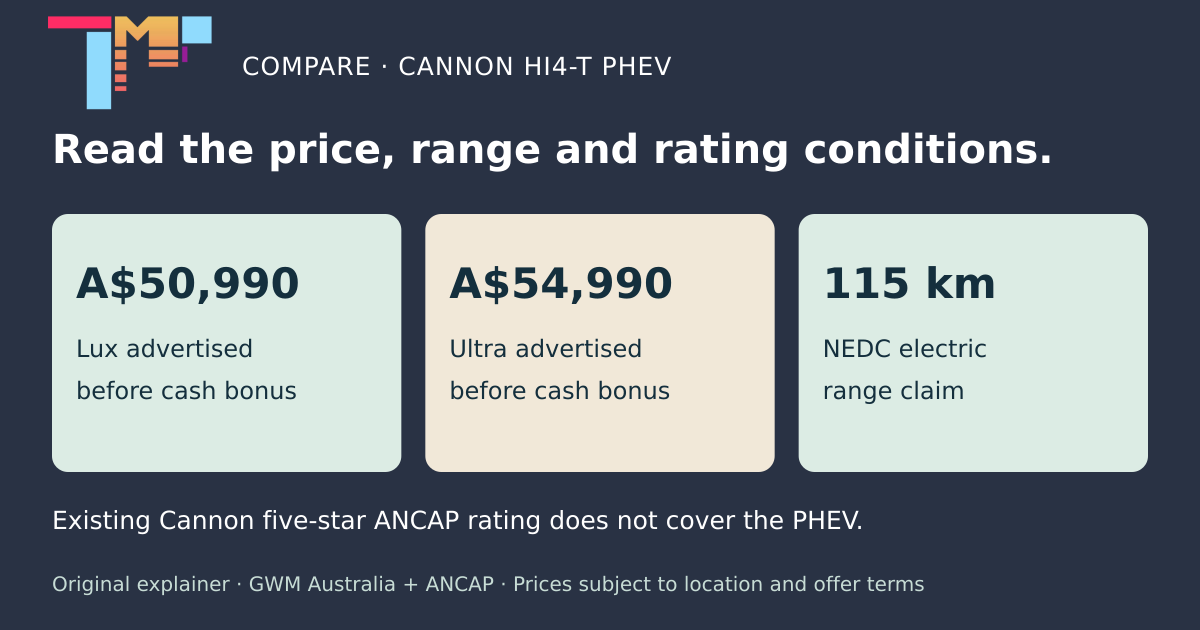
- The model page advertises A$50,990 Lux and A$54,990 Ultra before the additional cash bonus; location and conditions matter.
- The claimed 115 km electric range is NEDC, not a measured result from Compare.
- PHEV Lux and Ultra are not covered by the existing Cannon five-star ANCAP rating.
An October arrival, not a fresh announcement
An electric commute with petrol available for longer trips is an appealing ute pitch. The GWM Cannon Hi4-T PHEV is worth a look on that basis, but I’d read the offer and safety footnotes before getting carried away with the launch headline.
Launch reporting on 18 September put first dealership arrivals in mid-October. GWM’s own September event report confirms its Australian public debut at Everything Electric on 18–20 September. This is a current buying check, not a claim that the ute was announced today.
The Cannon PHEV is also a different model from the larger Cannon Alpha PHEV. Similar badges and shared technology do not make their pricing, equipment or crash-rating coverage interchangeable. Confirm which vehicle is on the quote and which is in the test-drive booking.
Two prices, then one offer choice
The Australian Cannon page advertises Lux from A$50,990 and Ultra from A$54,990 drive-away, with a A$2,000 cash bonus or a A$2,000 fuel card. Its cash-bonus terms say the amount is deducted from the advertised drive-away price.
On those advertised figures, subtracting the cash bonus gives A$48,990 for Lux and A$52,990 for Ultra. Treat that as offer arithmetic, subject to your location and eligibility, rather than a guaranteed quote for every postcode. The fuel card is an alternative, not another A$2,000 to subtract.
The model page requires cash-bonus vehicles to be ordered and delivered by 30 November 2026, while stocks last. Its fuel-card clause says purchase before 30 November, with the card provided at delivery. GWM’s central offers footer still carries older October wording, so have the dealer confirm the applicable written terms.
The A$47,990 Lux headline in September reporting was for eligible ABN buyers. I would not present it as a universal private-buyer price or assume that old offer is still available. Get buyer eligibility, delivery timing, paint and accessories itemised before comparing totals.
115 kilometres is a test-cycle claim
GWM quotes up to 115 km of electric-only range under NEDC, a laboratory test cycle. It is not an observed Australian commute result from Compare, and it should not be compared directly with a WLTP figure as though the methods were identical.
Your useful question is how the ute will operate over the week. Can you charge where it normally parks? How much driving includes freeway speeds, hills, tools or a trailer? Ask for the charging requirements and look at a realistic route rather than using the headline as a guaranteed daily allowance.
GWM also lists 3,500 kg braked towing. That rating does not establish electric towing range or how much payload remains with a particular trailer. Ask for the exact vehicle’s mass limits and work through your actual combination.
The five stars do not transfer to this PHEV
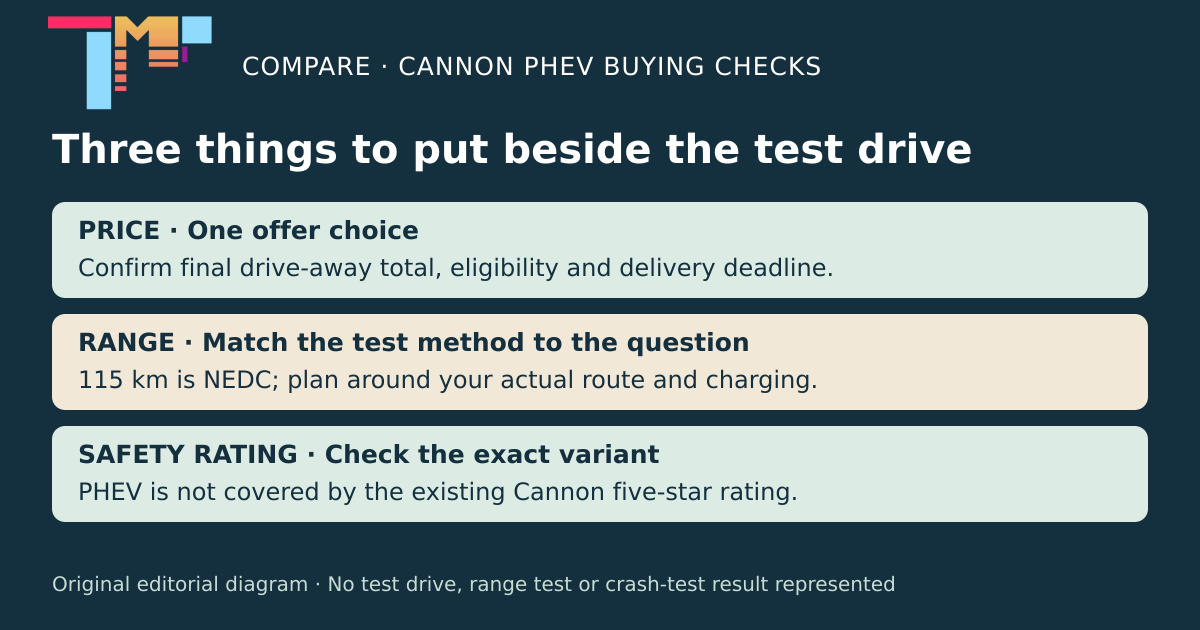
GWM explicitly excludes PHEV Lux and Ultra from its Cannon five-star ANCAP claim. ANCAP’s existing Cannon technical report lists diesel variants in its applicability table. The broad model-page summary is not a basis for giving this PHEV the same rating.
That means the PHEV is not covered by the existing Cannon five-star rating. It does not mean a zero-star result, a crash-test failure or proof that the vehicle is unsafe. Equally, the separate Cannon Alpha rating cannot be borrowed to fill the gap.
My take: put the final drive-away total, home-charging plan and exact safety-rating coverage beside each other before choosing. A test drive should answer the comfort and usability questions; the paperwork should answer which ute and which deal you’re actually buying.
Primary sources
Read the evidence.
- Australian Cannon model page and model-specific offer termsGWM Australia ↗
- Australian public debut report, September 2026GWM Australia ↗
- Cannon safety-rating summaryANCAP ↗
- Cannon technical report: rating applicability on page 1ANCAP ↗
- Dated 18 September launch context and ABN-price reportingWhichCar ↗
Offer arithmetic follows the model-specific page checked today; central-offer footer dates differ. ABN launch pricing is secondary historical context, not an independently confirmed current offer. No PHEV crash-test outcome or real-world range is inferred. Checked on 21 October 2026 (Australia/Perth). This is document-based editorial, not hands-on testing.
Community
Add to the article.
Useful experiences, questions and corrections make the next reader’s decision easier.
Comments appear here after moderation.