
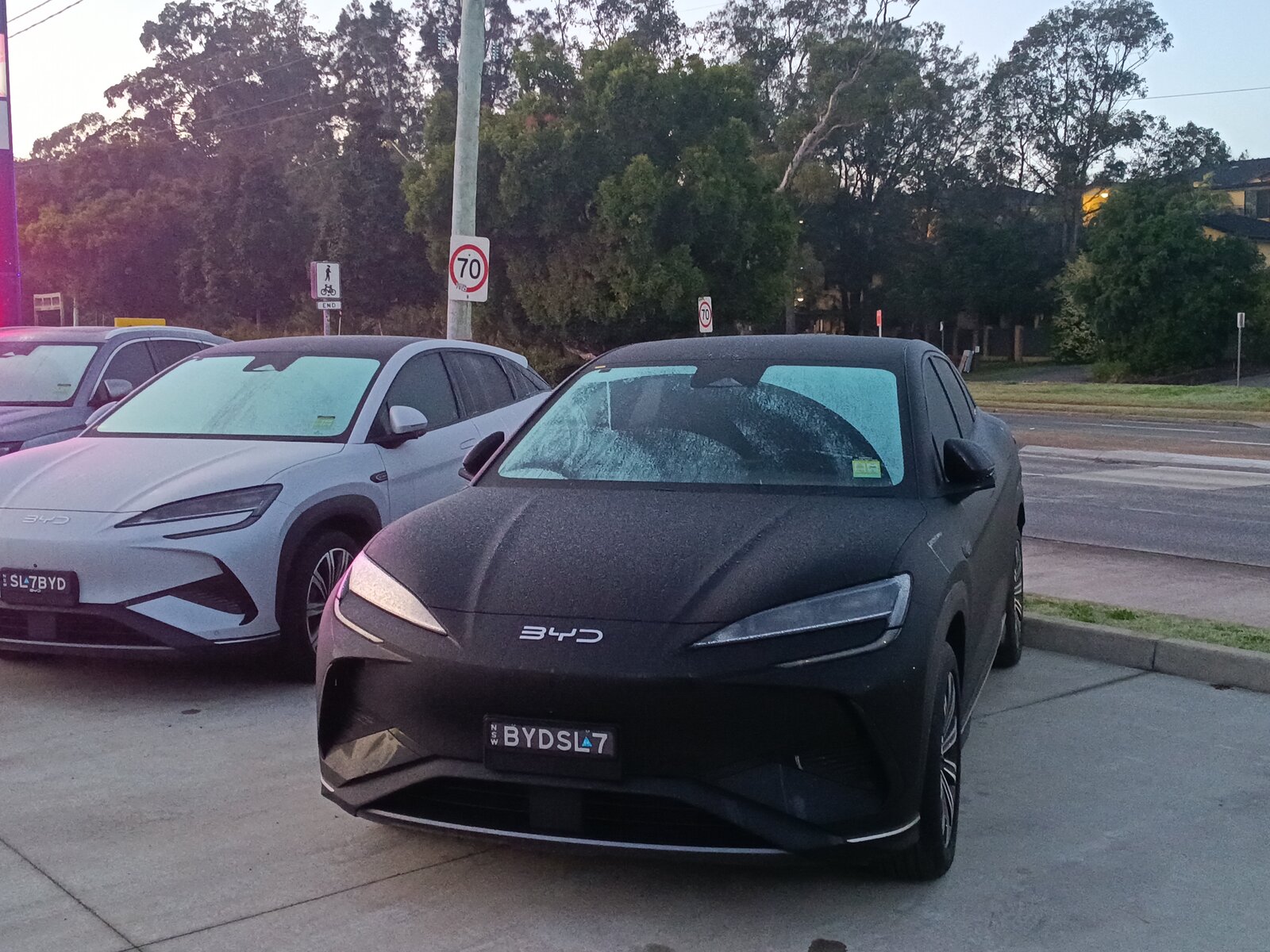

The short version
What you need to know.
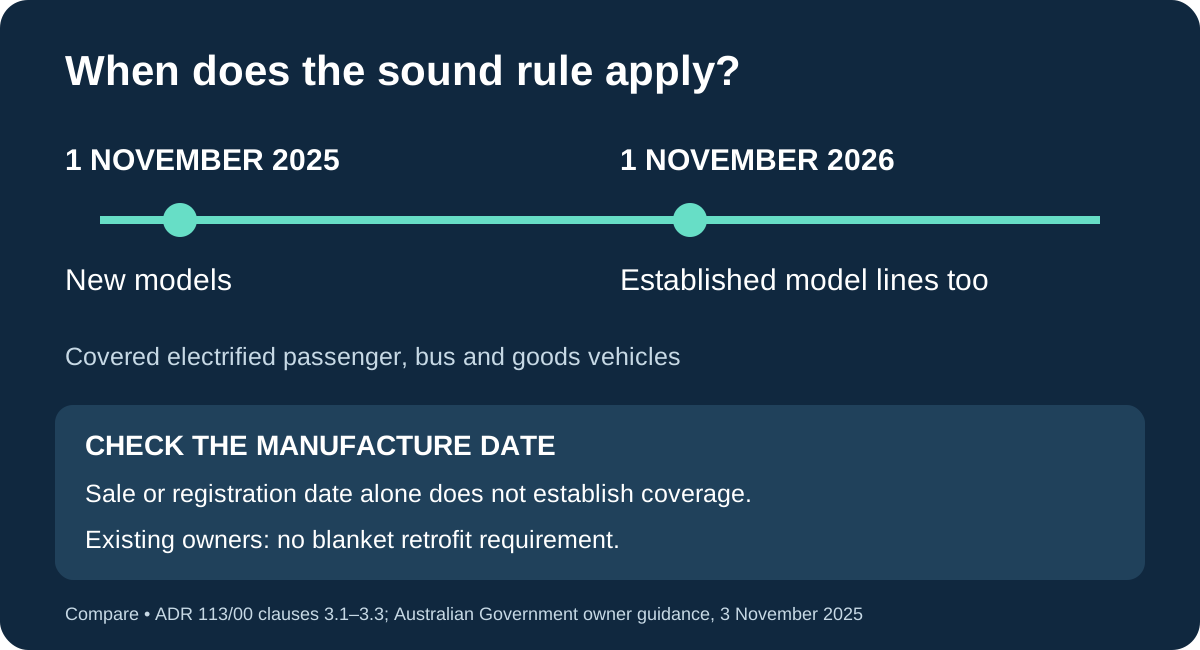
- The 1 November 2026 phase extends the sound requirement to covered vehicles from established model lines.
- Manufacture dates matter; a sale or registration date alone does not establish coverage.
- Existing EV and hybrid owners do not need to retrofit their cars under this change.
Your EV has something to say
An electric car creeping through a car park can be wonderfully quiet from the driver’s seat. For someone trying to hear whether it is approaching, that quietness is rather less helpful. The low-speed whirr is there for a reason.
Australia’s acoustic warning requirement reached its second stage on 1 November 2026. If you are shopping for an EV or hybrid, the useful question is what applies to the particular vehicle you are buying. There is no need to book your existing car in for a compulsory speaker transplant.
What changed this month
Australian Design Rule 113/00 sets minimum sound requirements for covered electrified passenger and goods vehicles that can move forwards or backwards without their combustion engine running. That includes relevant battery-electric, hybrid and hydrogen fuel-cell vehicles, rather than simply anything wearing a hybrid badge.
The first phase applied to new models from 1 November 2025. The second extends coverage to vehicles from established model lines from 1 November 2026. The current compilation, dated 24 September 2026, retains those dates.
This is a scheduled expansion of an existing rule. The government’s explanation published on 3 November 2025 described both stages; it is not a fresh announcement this week.
Build date beats showroom timing
The ADR’s applicability table and new-model definition use manufacture dates. A car being sold or registered after 1 November does not, by itself, establish which stage applies. Older dealer stock deserves a specific question rather than a guess based on the delivery appointment.
Ask the dealer to confirm the build date, the exact variant’s compliance position and how its pedestrian warning operates. Get that explanation against the vehicle you are actually buying, especially if you are comparing an outgoing model with newly built stock.
The listed categories cover passenger cars, SUVs, buses and goods vehicles. Motorcycles, mopeds and trailers are outside this ADR’s applicability table. It is not a universal noise requirement for every electric vehicle on wheels.
What the sound actually does
An Acoustic Vehicle Alerting System, or AVAS, helps pedestrians detect a quiet vehicle at low speeds. The government highlights the benefit for people who are blind or have low vision. A warning sound adds an audible clue; it does not replace checking for people before moving.
The Appendix A pathway specifies sound requirements above zero and up to 20 km/h, including reversing provisions. Operation beyond that range is permitted. Do not treat 20 km/h as a promise that every car must suddenly fall silent: the ADR also accepts specified UN and US alternative standards.
There are technical qualifications too. A sufficiently audible vehicle can meet specified requirements without an added AVAS, and a compliant reversing alarm can satisfy the reverse-direction provision. Certain completed heavy vehicles have testing concessions. Those are compliance details, not an invitation to disconnect a speaker.
What existing owners should do
The government explicitly says existing EV and hybrid owners do not need to modify their vehicles to comply. This phase does not create a blanket retrofit bill for the driveway.
If an existing warning sound stops working or the car displays a fault, follow the owner’s manual and contact the manufacturer or service agent. The absence of a retrofit requirement does not settle whether a particular vehicle has a defect or needs a recall repair.
For buyers, add pedestrian warning operation to the handover checklist alongside charging and driver-assistance controls. Our electric-car comparisons and home EV charger finder can help with the rest of the shortlist. The whirr is a small feature with a useful job; give it the same attention as the much louder sales pitch.
Sources
Read the evidence.
- ADR 113/00, current compilation dated 24 September 2026Federal Register of Legislation ↗
- New EV and hybrid rules improve pedestrian safety, 3 November 2025Australian Government ↗
Checked against the current ADR compilation on 15 November 2026, including applicability, Section 6 exceptions, alternative standards and Appendix A. The ministerial release is dated 3 November 2025. This is a practical explanation, not hands-on vehicle testing or an assessment of a particular car’s compliance.
Community
Add to the article.
Useful experiences, questions and corrections make the next reader’s decision easier.
Comments appear here after moderation.