

The short version
What you need to know.
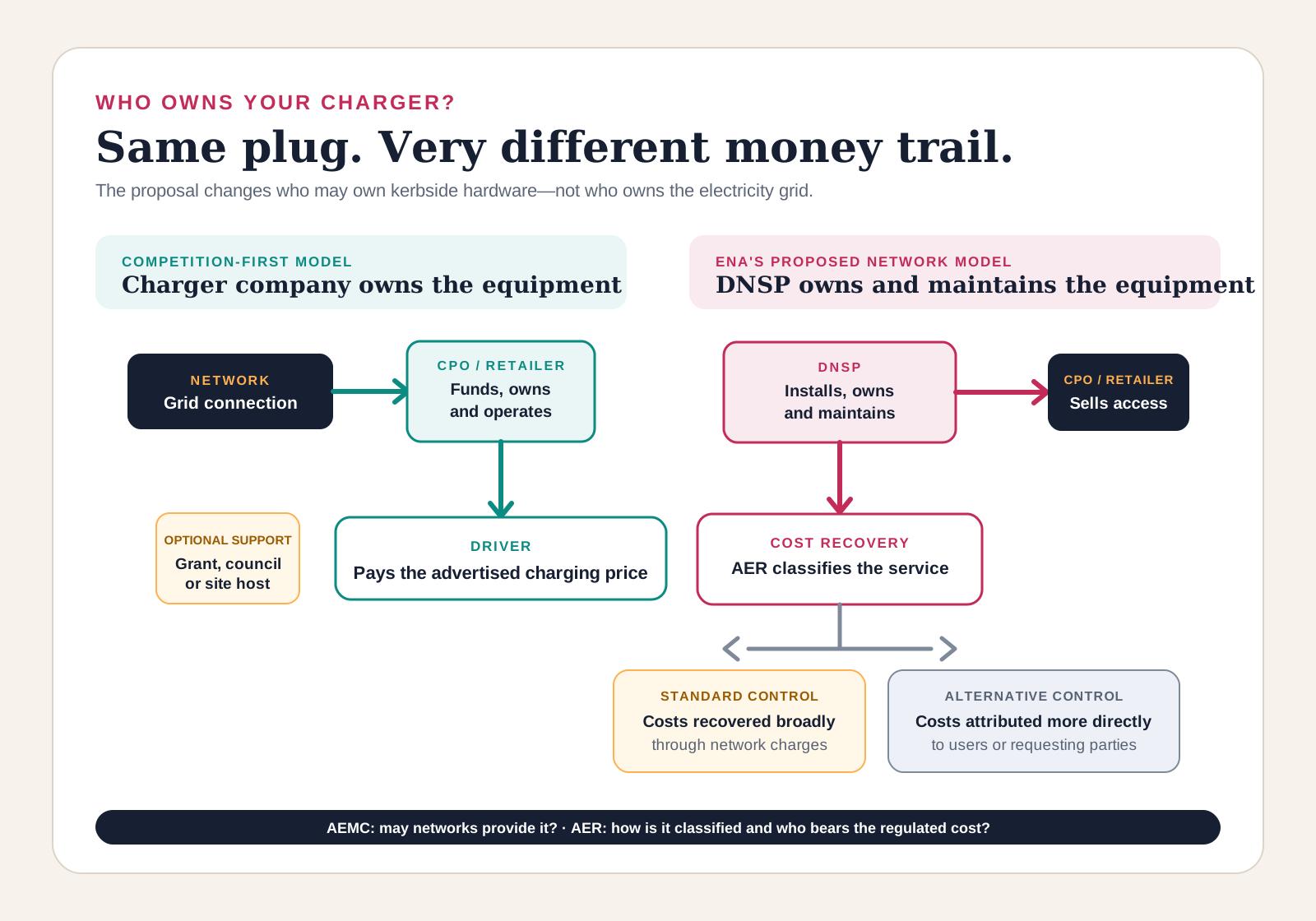
- Energy Networks Australia wants distribution networks to install, own and maintain kerbside charging infrastructure as a regulated service, while charging retailers could compete to sell access.
- The strongest case is for slower pole-mounted charging where drivers lack off-street parking—not for replacing competitive motorway and shopping-centre fast-charging networks.
- Allowing network ownership would not by itself settle who pays. The AER could later classify costs broadly across network customers or attribute them more directly to users and requesting parties.
- A targeted last-resort model could fill genuine charging gaps, but an open-ended regulated rollout risks crowding out private investment and making non-EV households fund underused assets.
This is not a vote on whether Australia needs more chargers
Australia's public-charging debate has moved beyond whether more infrastructure is required. The harder question now before the Australian Energy Market Commission is who should be allowed to own part of it—and whether a regulated electricity monopoly should expand into a service that charging companies, retailers and other investors already provide.
The immediate proposal comes from Energy Networks Australia. It wants distribution network service providers, or DNSPs, to be able to install, own and maintain kerbside electric-vehicle charging infrastructure as a regulated distribution service. The networks could use existing assets such as power poles, while retailers or charge-point operators compete to sell charging services to drivers.
The AEMC initiated that rule-change request on 25 June 2026 alongside Package 1 of its broader Electricity Network Regulation Review and a separate proposal from Nexa Advisory to strengthen ring-fencing. Public submissions include Energy Networks Australia, Tesla, the Clean Energy Council, the Australian Energy Council, Powershop, EVX, consumer advocates and network businesses. The AEMC held its first public forum on 18 August and plans another in October before completing the package.
No final rule has been made. The Commission is testing where the regulated electricity network should end and the competitive market should begin.
‘Public charging’ hides several different markets
A 7kW charger attached to a suburban power pole is not commercially equivalent to a six-bay 350kW highway hub. Kerbside AC charging may occupy a parking bay for hours and is most valuable to apartment residents, renters and households without driveways. Highway DC charging requires major power, land, amenities and enough traffic to justify a much larger investment.
The Energy Networks Australia proposal is mainly directed at the first problem. Networks already own poles, street-adjacent infrastructure and local electricity connections. They argue that installing chargers as part of a coordinated program could be quicker and cheaper than having multiple operators negotiate one location and connection at a time.
That scope matters. A tightly defined kerbside role can be assessed as a response to unequal home-charging access. A blanket permission for networks to own public charging could reach into shopping centres, destinations and fast-charging corridors where private operators are already investing. The words used in the final rule will determine whether this is gap-filling or market expansion.
The case for letting networks build
Energy Networks Australia says the current market faces a chicken-and-egg problem. Drivers are slower to adopt electric cars when convenient chargers are scarce, while private investors can struggle to justify chargers before enough local EVs exist. A regulated rollout could invest ahead of demand rather than waiting for every site to become profitable.
Networks also have practical advantages. They know where spare grid capacity exists, have electrical crews and procurement scale, and may be able to use existing poles with less street disruption. A coordinated rollout could reach lower-income suburbs, regional towns or quiet streets that a profit-led operator would not prioritise. Network maintenance obligations could also create a clearer owner for broken equipment.
Under the ENA model, the network would own and maintain the physical infrastructure but make it available to charging retailers on an open-access basis. In theory, drivers could still have competition at the service layer even when the roadside hardware has one regulated owner.
The equity argument is real. Homeowners with garages can buy electricity at residential tariffs and begin each day charged. People who park on the street can pay more in public-charging fees and spend time travelling to a charger. Well-placed kerbside infrastructure can prevent electrification becoming a benefit reserved for properties with private parking.
The case against regulated ownership
A distribution network is not an ordinary competitor. It controls the local poles and wires, manages connection requirements, has access to detailed network information and raises capital against regulated revenue. A charging company must win sites and customers while accepting the risk that a charger is underused. If a network can recover an unsuccessful investment through regulated charges, the two businesses are not competing on equal terms.
That difference can chill investment before a network installs a single charger. A private operator may avoid a suburb if it expects a regulated competitor to arrive later with lower financing costs and access to poles. The short-term result could be more network chargers; the longer-term result could be fewer independent operators, less experimentation and weaker price pressure.
Site selection is another risk. A network is rewarded for efficient regulated investment, but it does not experience utilisation risk in the same way as a charge-point operator whose revenue depends on drivers plugging in. Poorly targeted assets can remain underused while their costs continue to be recovered.
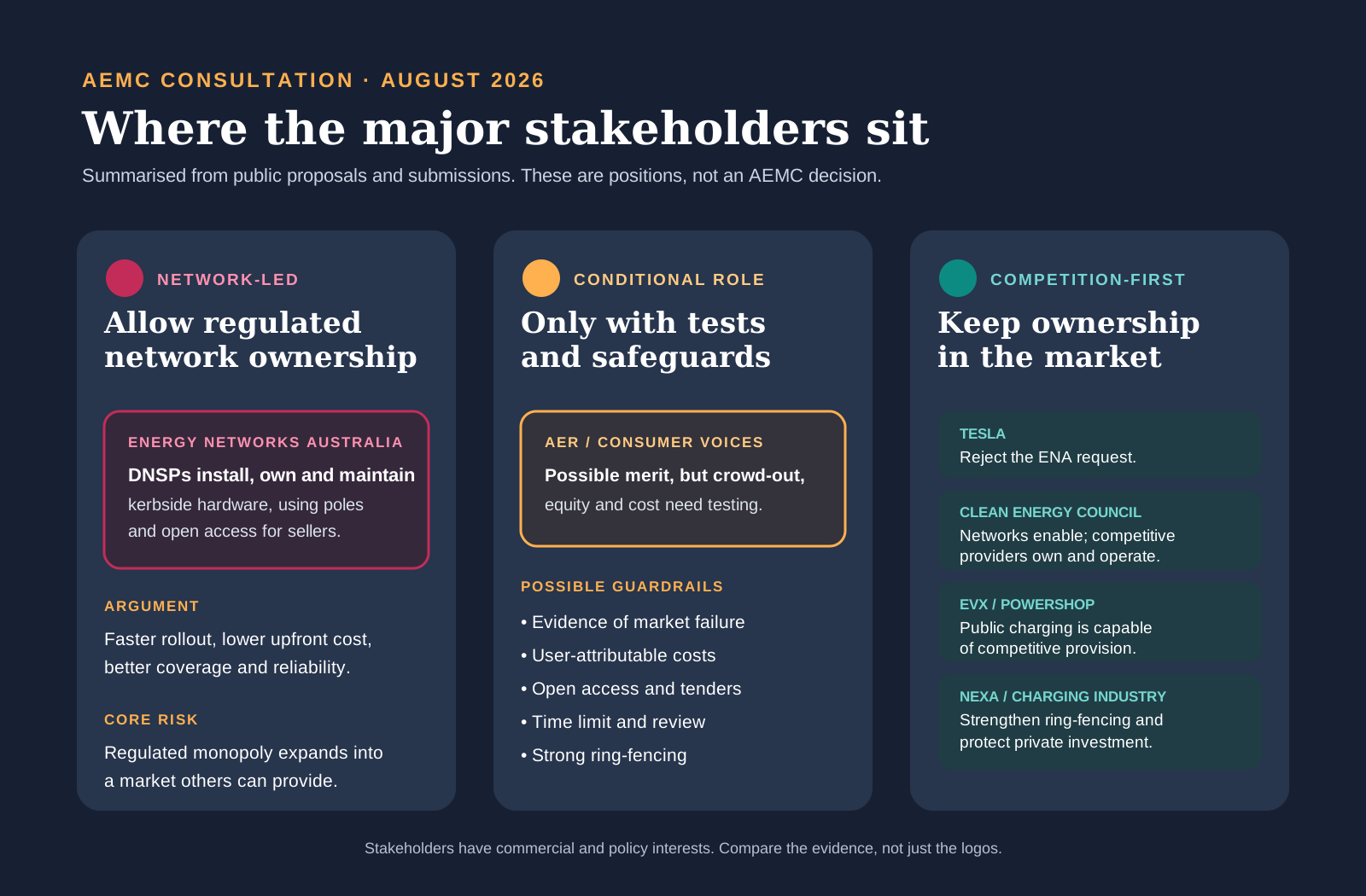
Ring-fencing rules exist because these advantages are structural, not because a particular network is assumed to behave badly. They separate monopoly functions from competitive activities, restrict cross-subsidies and attempt to keep commercially valuable network information available on fair terms. Tesla, EVX, Powershop, Nexa Advisory and other competition-first submitters argue that public charging is already capable of competitive provision and should not become a direct-control network service.
Who pays is a second decision—and it may reach your bill
The proposal is often reduced to a claim that every electricity customer will fund EV chargers. That is a possible outcome, but not an automatic one. The AEMC first decides whether this kind of charging infrastructure can be treated as a distribution service. If it can, the Australian Energy Regulator would then classify the service and determine how regulated costs are recovered.
A standard-control service is generally funded through the network's overall regulated revenue and recovered broadly through network charges. Those charges flow into household and business electricity bills, including for people who do not own an EV. An alternative-control service is more directly attributable to particular users or requesting parties, similar to other customer-specific network services.
The distinction changes the consumer argument. Broad funding can support rollout ahead of demand and recognise that lower transport emissions may benefit the community. It can also create a cross-subsidy from renters, pensioners and non-drivers to today's EV owners, who still skew wealthier. User-attributable funding protects non-users but may leave low-utilisation locations commercially impossible—the exact gap the proposal is trying to solve.
Drivers could also pay twice in a broad-cost model: once through the network component of their home electricity bill and again through the charging price set by the retailer or operator. That may still be defensible if the infrastructure cost and charging-service cost are genuinely separate, transparent and efficient. It should not happen invisibly.
The submissions agree on the problem, not the solution
Energy Networks Australia supports regulated network ownership and argues it can produce faster, lower-cost and more reliable kerbside deployment. The Clean Energy Council takes a competition-first position: networks should enable connections and deployment, but charger ownership and operation should remain with competitive providers rather than being placed on regulated asset bases.
Tesla asks the AEMC to reject the ENA request, describing public charging as a retail service already being delivered with private capital. EVX similarly says public charging is capable of competitive provision and should not be classified as a direct-control service. Powershop points to competitive kerbside models overseas and warns against treating dependency on network infrastructure as proof that the network must own the charger.
The Australian Energy Regulator has previously acknowledged possible merit in some network involvement while warning that monopoly advantages could crowd out competition and ultimately produce higher prices or poorer service. Consumer advocates have suggested a narrower approach: prove that regulated provision is needed, target costs carefully and review any permission after a fixed period.
Every position comes with an interest. Networks can add regulated assets; charging companies protect an investable market; retailers want room to develop products; consumer groups focus on bills and fairness. That does not invalidate the submissions. It means the AEMC should demand evidence on cost, utilisation and deployment speed rather than choosing the most persuasive slogan.
A targeted ‘charger of last resort’ model may be the useful middle
The choice does not need to be unrestricted network ownership or a permanent ban. A rule could permit regulated involvement only where an open market process shows that no capable provider will deliver the required service on reasonable terms. That would treat networks as gap-fillers rather than default charger owners.
A credible model would publish network-capacity data to all operators, use technology-neutral tenders, require open access, separate network and charging-service costs, and prevent the DNSP from favouring a related retailer. Site-level utilisation, uptime, maintenance time and total public subsidy should be reported so consumers can see whether the asset is working.
Cost recovery should also match the beneficiary. A council requesting chargers, a grant program, the drivers using them and the broader network can each contribute where a measured benefit exists. Broad network funding should require evidence that the whole customer base gains more than it would from an alternative use of the money.
Finally, permission should expire or be reviewed. A street that cannot attract private investment in 2027 may support several operators once EV ownership rises. A five-year checkpoint would allow the regulator to remove monopoly protection when the market becomes viable.
- Market-failure test before regulated investment is approved.
- Open tender allowing charging companies, retailers and councils to propose alternatives.
- Equal access to connection and hosting-capacity information.
- Separate disclosure of infrastructure cost and the driver's charging price.
- Minimum uptime, repair-time, accessibility and payment standards.
- Sunset date or periodic review of every network-owned charging class.
What would drivers actually notice?
If the proposal works as intended, apartment residents and people without driveways could see more chargers near home. Drivers may have a choice of retailer or charging app on shared infrastructure, and pole-mounted equipment could reduce the street works needed at some sites. Regional and low-demand locations could arrive sooner than a purely commercial forecast permits.
If the safeguards fail, the visible consequences may take longer: fewer independent networks entering the market, charging prices that are hard to separate from regulated subsidies, duplicated or underused equipment, and network charges spread across households that never plug in. Reliability will not improve merely because the asset has a regulated owner; it still needs measurable service standards and accountable maintenance.
The immediate advice for an EV buyer does not change. Compare current charging coverage on the routes and suburbs you use, check prices and payment methods, and treat a proposed future kerbside rollout as uncertain. This consultation is market design, not a promise that a charger will appear outside your home.
The consumer test is simple: more useful charging at the lowest whole cost
Networks should not be excluded because they are networks, and they should not be admitted because they own convenient poles. The test is whether their regulated involvement supplies useful charging that a fair competitive process would not deliver, at a lower whole-of-system cost after financing, connection, maintenance and market impacts are counted.
A narrow rule for underserved kerbside locations could improve access without handing the public-charging market to monopolies. An open-ended rule that socialises deployment risk would be much harder to justify while private operators continue investing in fast, destination and kerbside charging.
The AEMC's decision will shape more than the number of plugs. It will decide who carries the investment risk, who gets access to the roadside, and whether tomorrow's charging market is built around competing operators or regulated infrastructure. Consumers need the charger to work; they also deserve to know who paid for it and whether a better deal was available.
Primary sources
Read the evidence.
- Enabling DNSP-led electric vehicle charging infrastructureAustralian Energy Market Commission ↗
- Electricity Network Regulation Review — Package 1Australian Energy Market Commission ↗
- Package 1 consultation paperAustralian Energy Market Commission ↗
- Delivering efficient outcomes for consumersEnergy Networks Australia ↗
- Tesla submission — Electricity Network Regulation Review Package 1Tesla ↗
- EVX submission to Package 1EVX ↗
- Powershop submission to Package 1Powershop ↗
- Submission on EV charging infrastructure under Commonwealth grantsClean Energy Council ↗
- AER submission to the NSW EV infrastructure inquiryAustralian Energy Regulator ↗
- Street Smart: Scaling Up Kerbside EV Charging in AustraliaEnergy Networks Australia ↗
- Should electricity networks own the chargers?Australian Energy Council ↗
The AEMC process, proposals and published stakeholder positions were checked on 27 August 2026. No final rule has been made. The ENA request concerns DNSP-led kerbside charging infrastructure within the National Electricity Market; separate AEMC and AER decisions can affect service permission, classification and cost recovery.
I don't get it, why the complexity? Just put a charger on every light post, scan a QR code to pay which ever electrical company you are with...