
The short version
What you need to know.
- The strongest research finds CCTV is associated with a modest reduction in crime, with better results in residential areas and car parks than in many other settings.
- Cameras work better when actively monitored and combined with other measures. They should sit behind quality locks, secured gates, lighting and an alarm—not replace them.
- Footage can materially help investigations, but coverage, night image quality, timestamps and fast access matter more than a large resolution number on the box.
- Smart cameras manufactured from 4 March 2026 for Australian consumers should meet new cyber-security rules, including no universal default passwords and a published support end date.
The security-camera boom is real, but the promise is often backwards
ABC News recently reported that Australian home-camera purchases are growing by an estimated 10 to 12 per cent a year. One regional NSW installer told the ABC that his camera work had risen by at least 50 per cent over two years. Those are estimates and one business's experience rather than a national sales census, but they fit what I see in the market: cameras have become cheaper, easier to install and much more visible on Australian homes.
The emotional reason is obvious. After a break-in, being able to see the driveway or receive an alert can restore some sense of control. The technical reason is just as strong: a battery camera can be installed in minutes, while a wired multi-camera system that once belonged mainly to businesses is now accessible to ordinary households.
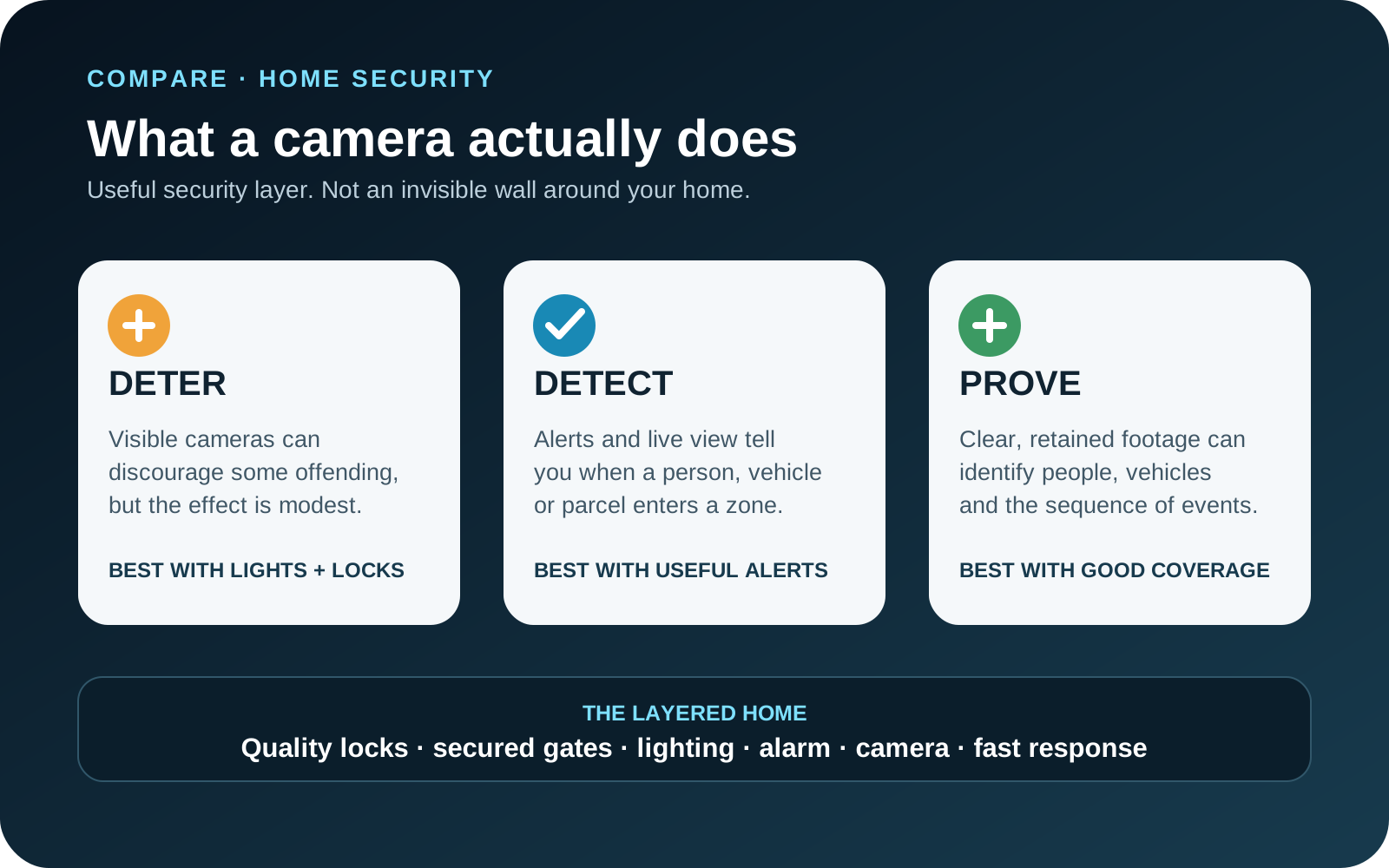
The marketing leap is to turn visibility into prevention. A camera may discourage an opportunist, but it does not physically stop a door being forced, a gate being opened or a car being entered. Masks, hoods, stolen plates and poor night angles can all reduce its deterrent and evidentiary value.
My view is that buyers should reverse the usual question. Do not ask whether a camera will stop a burglar. Ask what the camera will detect, what it will record, how quickly someone can respond and which physical security layer remains if the person ignores it.
What four decades of CCTV research actually found
A 40-year systematic review and meta-analysis published in 2019 found that CCTV was associated with a statistically significant but modest reduction in crime. The largest and most consistent reductions appeared in car parks, with meaningful results also found in residential areas. That is more encouraging than saying cameras do nothing, but much less dramatic than a security advertisement implies.
The conditions mattered. Actively monitored schemes produced larger effects than passive recording, and cameras worked better when combined with other interventions. The researchers specifically warned against deploying CCTV as a stand-alone crime-prevention measure.
There is an important limit when applying that finding to a single Australian house. Much of the research covers organised systems in public areas, transport, car parks and housing complexes—not one battery camera above a suburban garage. A visible home camera may change an opportunist's decision, but we do not have a clean percentage that tells every homeowner how much safer one device makes them.
This explains the apparent disagreement in the news coverage. A criminologist can reasonably say the home-deterrence evidence is weak or minor, while a systematic review finds a modest overall benefit. Both point to the same buying conclusion: a camera is a useful layer, not the foundation of home security.
Cameras may be more valuable after an incident than before it
Police value footage because it can establish the time of an offence, show a vehicle's direction, corroborate a witness and connect repeated activity across several properties. In the ABC report, Murrumbidgee Police said residential CCTV had become integral to investigations and was helping with a local spike in aggravated break-ins.
Australian Institute of Criminology research gives that claim some measurable support, although it studied the NSW rail network rather than homes. Matters where CCTV footage was requested had a 24.8 per cent clearance rate, compared with 21 per cent where it was not requested. When requested footage was actually provided, it was associated with an estimated 20 per cent increase in clearance rates. That does not prove the same uplift for residential burglary, but it shows why usable footage matters to investigators.
Another AIC study found nine in ten investigators used requested CCTV when it was available. One in three still encountered a problem with image quality or coverage. This is the detail consumers often miss: owning a 4K camera and capturing an identifiable face, registration plate or sequence of events are not the same thing.
If an incident occurs, preserve the original clip, export the period before and after the event, keep the correct timestamp and avoid compressing the only copy through social media. Call 000 if a serious offence is in progress or someone is in danger; otherwise use your state or territory's police assistance channel. In WA, past stealing or property-damage incidents can also be reported through WA Police's online services where eligible.
A camera that records the top of a hoodie is not a security system
Camera placement should be designed around evidence, not symmetry. Start with the paths a person must use: the front door, side access, driveway, garage approach and any rear entry that cannot be seen from the street. A wide establishing view is useful, but at least one angle should be close enough to capture a face rather than only proving that a person existed.
Test every camera at the time an incident is most likely. Bright porch lights can blow out a face, infrared can reflect from a nearby wall or spider web, and a number plate can become a white rectangle at night. Walk the route wearing a cap, approach from both directions and check the recorded clip—not just the live preview.
Resolution is only one variable. Lens angle, subject distance, shutter speed, compression, lighting and sensor quality determine whether extra pixels contain extra information. A sharp 2K image from the correct angle can be more useful than a wide 4K view where the person occupies a tiny part of the frame.
- Cover entry routes rather than trying to see every square metre.
- Avoid mounting so high that every face becomes the top of a head.
- Use overlapping views where one camera can capture context and another can capture identification detail.
- Check night footage for glare, infrared reflection and motion blur.
- Confirm the date, time and time zone after power failures or daylight-saving changes.
- Test how quickly you can export an original-quality clip for police.
Battery cameras and wired CCTV solve different problems
Battery cameras are excellent for quick installation and event alerts. Their weakness is that they sleep to conserve power, wake after motion is detected and may miss the beginning of fast activity. Heavy traffic can also turn a long battery-life claim into frequent charging. Solar helps only when the panel gets useful light.
A powered Wi-Fi camera can remain awake and may support continuous recording to a card, hub or cloud plan. A PoE camera receives power and data through one Ethernet cable and records to an NVR, making it the more dependable option for 24/7 coverage. The trade-off is cable installation and finding a secure place for the recorder. An offender who can take the visible NVR can take the evidence unless another copy exists.
Cloud history protects footage if equipment is stolen and makes remote access easy, but creates an ongoing fee and places video under a provider's account, security and retention rules. Local storage reduces that dependency, although a microSD card inside the camera can disappear with the camera. The strongest setups use local continuous recording plus a protected or off-site copy of important events.
Alerts also need restraint. If branches, insects and passing cars generate dozens of notifications, the household will eventually ignore them. Person and vehicle detection, carefully drawn zones and schedules often improve real security more than another jump in resolution.
The layers in front of the camera do most of the stopping
NSW Police home-security guidance puts cameras alongside quality security doors, windows, locks, alarms, lighting, warning signs and secured gates, sheds and garages. That ordering makes sense. A locked gate changes access. A quality strike plate and lock increase the effort needed to enter. Lighting removes concealment. An alarm creates attention and a reason to leave. The camera observes what happens around those barriers.
For most homes, I would spend the first security dollar fixing the easiest physical entry, not upgrading a 2K camera to 4K. Check whether side gates can be opened from the street, garage remotes are left in cars, sliding doors can be lifted, windows are left open and tools are available in an unlocked shed. Then use cameras to cover the approaches and verify the result.
Visible cameras and signage may add deterrence. A light or audible warning linked to a meaningful detection can make the system feel actively monitored. But aggressive automated sirens for every detection will annoy neighbours and train everyone to ignore the alarm. The response needs to match confidence in the alert.
Australia's new 2026 smart-device rules belong on your camera checklist
A camera intended to protect your home can also become an internet-connected microphone and viewing point inside it. From 4 March 2026, most consumer smart devices manufactured for the Australian market must meet new minimum cyber-security requirements under the Cyber Security (Security Standards for Smart Devices) Rules 2025.
The rules prohibit universal default passwords for in-scope devices, require manufacturers to publish a way to report security vulnerabilities and require a published end date for security support. In-scope products must also be supplied with a Statement of Compliance. Stock manufactured before 4 March 2026 is not retrospectively covered, which means two boxes on the same shelf may sit on different sides of the requirement.
This is a baseline, not a security quality score. It does not guarantee long support, private cloud design, local storage or perfect software. A manufacturer can comply while offering a support period shorter than you would prefer. The useful consumer move is to ask for the support end date and Statement of Compliance before buying, then compare those answers alongside image quality and subscription cost.
After installation, use a unique account password, enable multi-factor authentication where offered, keep firmware and apps updated, review shared users and remove old devices from the account. If a camera does not need remote internet access, consider whether a local-only recording design would reduce exposure.
- Ask when the specific unit was manufactured.
- Find the published security-update end date.
- Request or locate its Statement of Compliance if manufactured from 4 March 2026.
- Check whether footage and AI processing are local, cloud-based or both.
- Confirm what stops working without a subscription or internet connection.
- Use multi-factor authentication and audit everyone with account access.
Pointing the camera responsibly matters too
The federal Privacy Act generally does not cover a security camera operated by an individual in a private capacity, but that does not give homeowners an unlimited right to record anything. State and territory surveillance laws, local rules and other legal principles may still apply. Audio recording can raise different issues from video, and a camera aimed into a neighbour's private space can create a serious dispute even when its owner believes the angle is convenient.
Keep the field of view focused on your property and the approach you genuinely need to protect. Use privacy masks where the app provides them, avoid bedrooms, bathrooms, private yards and neighbouring windows, and think carefully before enabling audio. If a neighbour raises a concern, show the masked live view rather than expecting them to trust a verbal description.
The OAIC recommends checking state or territory law and contacting the relevant Attorney-General's department or local council when necessary. If the installation involves a shared strata area, rental property or workplace, the legal and governance position can be different again. This article is general buying guidance, not state-specific legal advice.
So, should you still buy a security camera?
Yes—if you buy it for the job it can reliably perform. A well-positioned camera can tell you someone is present, let you assess an alert, document an incident and give police a much better starting point. A visible, actively monitored system used with lighting and other measures may also discourage some offending.
No—if the plan is to attach one camera above the garage and assume the house is now secure. The research does not support that confidence, and a poor angle can leave you with little more than a notification and a blurry hooded figure.
For my own home, I would rather have sensible 2K or 4K coverage with dependable power, useful night footage, local retention and tested alerts than the most impressive camera specification sheet. The camera should be the witness. Locks, gates, lighting and an alarm should make sure there is less for it to witness.
Primary sources
Read the evidence.
- Security camera installation in homes is on the rise. Will it deter crime?ABC News ↗
- CCTV Surveillance for Crime Prevention: A 40-Year Systematic Review with Meta-AnalysisUS Office of Justice Programs ↗
- Does CCTV help police solve crime?Australian Institute of Criminology ↗
- How do police use CCTV footage in criminal investigations?Australian Institute of Criminology ↗
- Protect your HomeNSW Police Force ↗
- Security Standards for Smart DevicesAustralian Department of Home Affairs ↗
- Internet of Things devicesAustralian Signals Directorate ↗
- Security cameras and privacyOffice of the Australian Information Commissioner ↗
- Cam-Map WAWestern Australia Police Force ↗
The news report, research findings, government rules and consumer guidance were checked on 27 August 2026. The crime-prevention research covers a range of CCTV settings and should not be read as a guaranteed percentage reduction for an individual home. State and territory surveillance laws vary; the privacy section is general information rather than legal advice.
Community
Add to the article.
Useful experiences, questions and corrections make the next reader’s decision easier.
Comments appear here after moderation.