
The short version
What you need to know.
- ATMOCE says the 15-year Australian extension includes MS-7K-U units already shipped, from the original warranty start date.
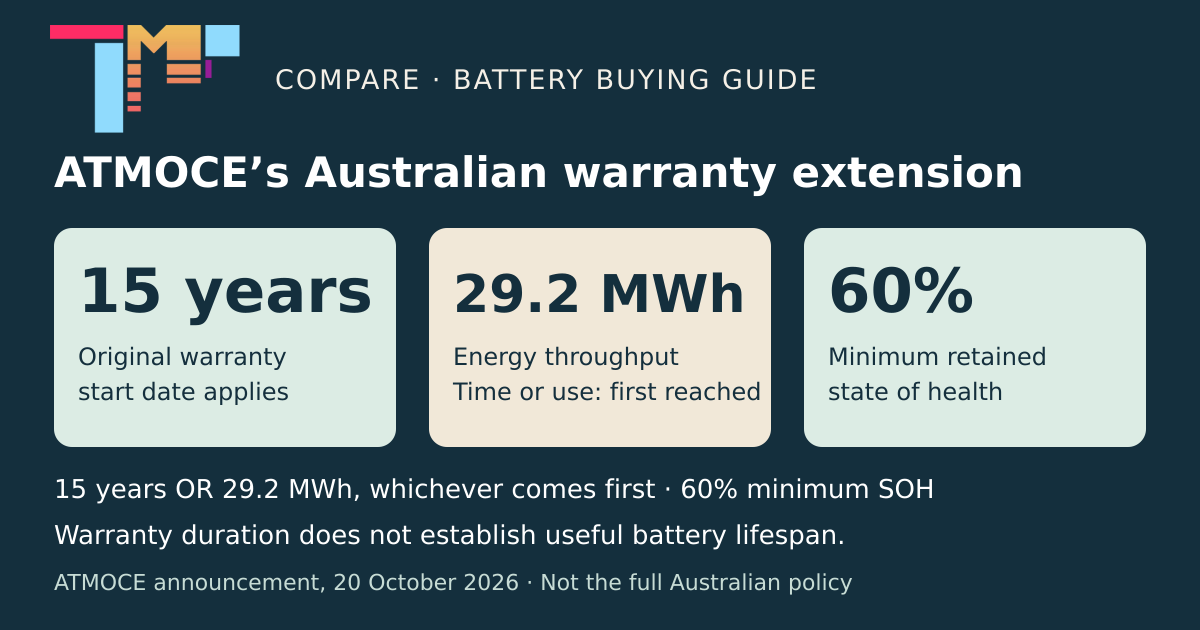
- The announcement specifies 15 years or 29.2 MWh throughput, whichever comes first, with at least 60% retained state of health.
- The revised full Australian policy could not be retrieved. Ask for current terms covering claims, costs and intended use.
A longer promise, with more to check
A longer battery warranty is welcome when you’re spending thousands on something you expect to keep using well after the installer has packed up. But I’d still read past the big “15 years” badge before choosing what goes on the wall.
ATMOCE announced on 20 October that its Australian M-ELV 7 kWh battery, model MS-7K-U, now has a 15-year standard warranty, extended from 12 years. The announcement also covers units already shipped to Australia, including batteries customers have already bought.
That’s the useful part for existing owners. You don’t need to be buying a new system to be included in the announcement. The company says the period runs from the original warranty start date, though, rather than restarting now.
The three numbers worth understanding
ATMOCE’s announcement sets out 15 years or 29.2 MWh of energy throughput, whichever comes first, with a minimum retained state of health of 60%.
Those figures describe different things. Years measure time. Throughput measures cumulative energy use. State of health describes how much capacity remains compared with the battery’s original condition.
A throughput allowance can matter if you plan to work the battery hard, rather than mainly store afternoon solar for the evening. Before joining a virtual power plant or setting up frequent grid charging, ask how that use is counted under the actual warranty.
I wouldn’t turn the headline throughput figure into a neat promise about daily cycles without checking its measurement rules. Whether the policy counts energy at the cells or elsewhere in the system matters to that calculation.
And 60% retained capacity is a warranty threshold, not a prediction that every battery will reach that point. It also isn’t a promise of full original capacity for 15 years. Warranty years do not establish how long the battery will remain useful for your household.
What we could verify
ATMOCE’s Australian product page now advertises the 15-year warranty. It identifies the MS-7K-U as a 7 kWh AC-coupled battery, an arrangement worth considering when adding storage to an existing solar installation.
The headline has therefore made it onto the local product page, rather than appearing only in a press release.
However, at publication we could not retrieve the revised full Australian warranty document setting out all the conditions behind this extension. That limits what we can responsibly say about claim procedures, exclusions and associated costs.
Before signing, get the current document
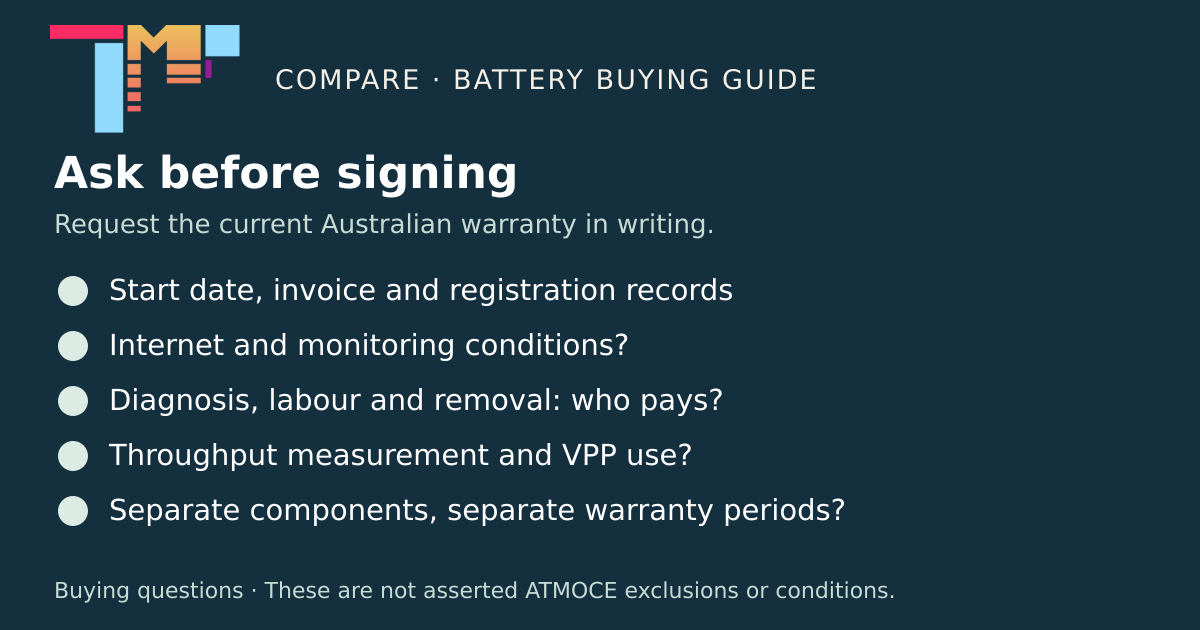
For a new quote, I’d ask the installer to supply the updated Australian warranty alongside the equipment list. Then get clear answers to a few practical questions:
These are buying questions, not a claim that ATMOCE excludes those items. A battery system contains more than the battery, and the paperwork should make that distinction easy to understand.
Existing owners should keep the announcement with their invoice and ask for written confirmation of the updated coverage for their system.
- What records establish the warranty start date and registration?
- Are internet connectivity or monitoring conditions attached?
- Who pays for diagnosis, labour, removal and reinstallation if there’s a covered fault?
- How is throughput measured, and does the intended VPP or tariff strategy affect coverage?
- Which separate components have different warranty periods?
My take
Including existing Australian units makes this a worthwhile announcement. It’s also a good reason to compare warranties properly rather than sorting batteries by the largest number of years.
I’d put the extension alongside the installed price, system suitability and the support available when something needs fixing. A longer promise is useful; understanding how to use it is better.
Finally, the manufacturer’s warranty sits alongside Australian Consumer Law guarantees. As the ACCC explains, those rights can still apply after a written warranty ends.
Primary sources
Read the evidence.
- Australian MS-7K-U warranty extension announcement, 20 October 2026ATMOCE via PR Newswire ↗
- Australian M-ELV battery product pageATMOCE Australia ↗
- Warranties and consumer guaranteesACCC ↗
Primary sources checked on 21 October 2026. Independent buying analysis, not hands-on testing. The 15-year extension and performance figures are manufacturer announcement claims. The revised full Australian warranty could not be retrieved; older Australian or New Zealand policy conditions have not been applied to the extension. Images are original editorial diagrams using the actual TechManPat logo.
Community
Add to the article.
Useful experiences, questions and corrections make the next reader’s decision easier.
Comments appear here after moderation.