
The short version
What you need to know.
- Start with parking rights, permissions and measured electrical capacity before choosing a charger.
- Compare an own-meter connection, managed private bays and communal charging against actual parking and driving needs.
- Agree capital costs, electricity billing, subscriptions, ownership, maintenance and supplier exit before signing.
- Rules and incentives vary by state. NSW’s EV ready buildings applications are currently closed.
Start here: five things to do before buying a charger
Apartment charging is a building project before it is a shopping decision. The box on the wall gets the glamour shot, but the cable route, available power and billing agreement do most of the work. My starting point would be a small, properly scoped feasibility exercise, then a decision the next resident can use as well.
This guide is for existing Australian apartment buildings, including renters and strata committees. Build-to-rent sites with one owner can make decisions differently from strata schemes with many lot owners. Neither arrangement makes electrical capacity unlimited.
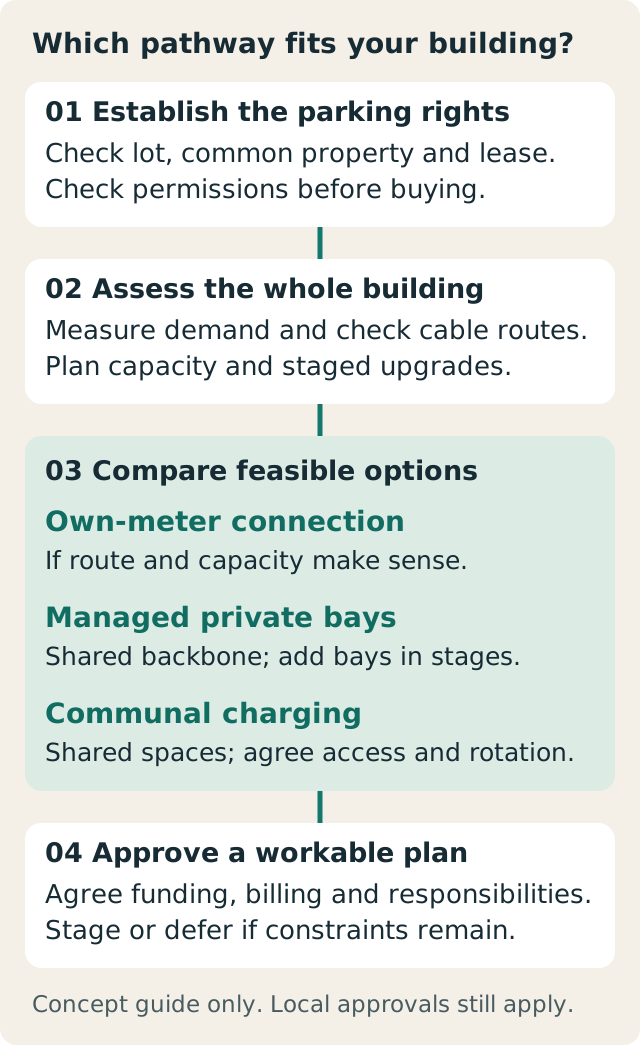
- Check your parking rights: is the bay part of your lot, common property, leased or allocated under an exclusive-use arrangement? Ask for the plan and relevant by-laws or rules.
- Ask the strata or building manager for the existing EV policy, electrical assessment and approved equipment list. A nearby socket is not evidence that charging is approved.
- Record what you need: daily kilometres, usual arrival and departure times, car model, and whether the car stays home during the day.
- Renters: approach your landlord or managing agent about permission, costs and what happens when you leave. Owners: ask which works and funding decisions need formal approval.
- Ask for a building-wide capacity assessment and a staged plan before ordering hardware. Set a date to review the findings and a named person to coordinate them.
The Melbourne news: access is growing, but count the right thing
NOX Energy’s release dated 22 October 2026 says charging is live for residents in more than 1,000 apartments across four Kensington and Brunswick sites. Its nearly 1,900-home headline also includes more than 800 homes in two Footscray and Coburg developments nearing completion. Those are homes served or planned to be served, not 1,900 installed chargers.
The company describes a mix of its Intelligent Power Sockets and MSI 7kW Eco series chargers, managed through its platform. That is useful evidence of different charging speeds being deployed together. It does not establish the cost, availability, performance or suitability of a system in your building.
My takeaway is that apartment residents should be part of the charging conversation. It is not a reason to skip competing quotes or sign a platform contract because a headline sounds impressive. This is a source-based practical guide, not an installation test or a recommendation of NOX.
Choose the pathway that fits the parking
First, establish whether a safe, approved connection from your own electricity supply to your bay is feasible. Short cable runs in a small complex can make this worth assessing. In a tower, the route through common property and the building’s overall demand can change the answer entirely. Your own meter does not remove the need to coordinate capacity.
If individual connections are impractical, compare a shared electrical backbone feeding private bays with communal charging bays. A backbone means planned boards, cable routes and controls that later residents can join. It does not require buying a charger for every space on day one.
Communal chargers can be a sensible first step where suitable bays exist. Agree bookings, maximum dwell times, access for residents with disability, enforcement and what happens when an already-charged car stays overnight. Do not assume a visitor or accessible bay can simply be reassigned.
If neither option is feasible yet, document the constraint and a review trigger, such as switchboard renewal or increased demand. Check dependable workplace or public charging before committing to an EV. A realistic interim plan beats an expensive installation that nobody can expand.
Size it for the driving, not the brochure
The Australian Government’s charging guide describes dedicated AC home charging at 7 to 22kW. The actual rate also depends on the car’s onboard AC charger, available phases, the circuit and any shared limit. A 22kW label does not mean every car receives 22kW.
Use energy, measured in kilowatt-hours (kWh), to work out the overnight job. Power, measured in kilowatts (kW), is how quickly you can do it. As an illustration only, 40km of driving at an assumed 18kWh/100km uses 7.2kWh in the car. Allow extra electricity for charging losses. A steady 2kW for eight hours supplies 16kWh before losses, if that power remains available. Those assumptions are not a range promise for your car.
Lower-power managed outlets can therefore deserve a quote alongside faster wallboxes for cars parked overnight. High-mileage residents or short parking windows may need more. Ask the designer to model the difficult day, including multiple late arrivals, rather than just an average commuter. Do not use extension leads or an unassessed common-area socket as a substitute for a designed installation.
Shared capacity: what dynamic load management actually does
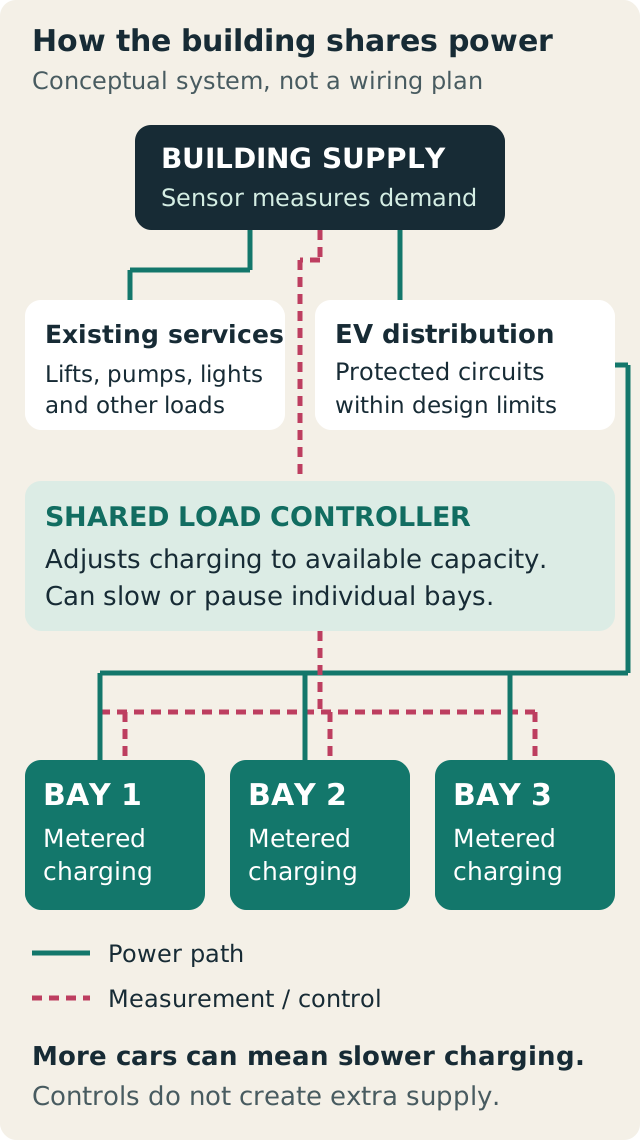
An apartment building has a finite electrical supply. Lifts, pumps, ventilation and other connected loads are already using it. An electrical assessment should examine the relevant boards, phases, circuit limits and measured demand over a representative period, including seasonal peaks. The number printed on the main switch is not a spare-capacity report.
Dynamic load management measures demand and changes the charging allowance as conditions change. When other loads rise, EV charging slows or pauses; when capacity returns, it can increase. A fixed charging cap is different: it stays at a predetermined limit. Ask which approach is proposed and where the sensors will sit.
Illustrative arithmetic: if a designer allows a 30kW EV budget at one moment, ten cars sharing it equally would average 3kW each, not 7kW each just because the wallboxes carry that rating. With fewer cars, an individual rate may rise within its own limits. Real systems have minimum charging currents, phase constraints and scheduling rules, so division alone is not a design.
Load management can reduce the need for a supply upgrade, but it cannot create energy or guarantee every battery is full by morning. Get the priority rules in writing: equal sharing, rotation, departure time or another method. Ask what safe fallback applies if a sensor, network link or controller fails.
Billing: agree the whole bill, not just cents per kWh
The Australian Government’s resident guide outlines personal metering and charging through the building’s common-area electricity account. It also flags possible load-management or billing subscriptions. The available arrangements depend on the building, meter locations and approvals.
For an own-meter connection, establish which account records charging and whether a new meter or supply charge is involved. For a shared supply, identify how each session or outlet is measured, who reconciles that against the building’s bill, and who reimburses the owners corporation. An app showing a number is only the start of that conversation.
For a managed service, ask who sets and can change the tariff. Request an example invoice showing energy, subscriptions, transaction charges, idle fees, tax and any minimum monthly payment. A low energy rate with a subscription can work differently for someone driving twice a week than for a daily commuter.
Agree how time-of-use periods, demand charges, charging losses and common infrastructure costs are allocated. Do not promise non-EV owners will pay nothing unless the actual funding and recovery agreement supports that claim. Ask how disputed readings, payment failures, refunds, account closure and tenant changes are handled. Where electricity on-selling or embedded-network arrangements are involved, get advice on the applicable consumer and regulatory obligations.
Renters: make the move-out conversation happen now
A renter needs a usable service and clear permission, not an infrastructure bill attached to somebody else’s asset. Ask the agent to confirm the landlord’s position and the building’s process in writing. In a build-to-rent building, ask the operator about enrolment, eligible bays, tariffs, queues and whether access follows your tenancy or a particular space.
If you are paying towards equipment, agree ownership, removal, reinstatement and any reimbursement before installation. Check whether a replacement tenant can use it and whether an account can be closed without ongoing fees. Include the cost of a new bay allocation if parking is not fixed.
Queensland has a specific fixtures approval process, including Form 23 and a 28-day landlord response period. Body corporate approval may still be required and has a different timetable. Do not treat that Queensland process as an Australia-wide deadline or as automatic permission to start work.
Approval is local: the rules are not one national vote
Before the meeting, have the manager or a qualified strata adviser identify the required resolution, any by-law or rule, common-property permissions and the lawful cost allocation for the actual proposal. Approval of a feasibility budget is not approval of the installation contract. Keep the proposed works, financing and ongoing obligations explicit.
NSW: current government meeting guidance says a sustainability infrastructure resolution is decided by unit entitlement, with votes against needing to be less than 50% for approval. Ask whether that pathway applies to your works and associated by-laws. Do not replace the rule with “half the apartments said yes” or assume a tied vote passes.
Victoria: the EV-ready guidance updated on 29 September 2026 brings technical, commercial and legal decisions together. The approval level depends on the proposal and the owners corporation’s powers. Use it to develop a strategy and check the resolution and funding pathway for your building, rather than importing the NSW voting rule.
ACT: official multi-unit guidance describes changes intended to prevent unreasonable restrictions on sustainability infrastructure. It also distinguishes new-building EV-ready requirements from retrofits. That does not mean an existing building must immediately fund your charger or that works can proceed without a process.
Elsewhere, check your state or territory’s strata and tenancy authorities and your scheme documents. This is a project checklist, not a determination of legal rights for a particular lot.
Grants and costs: get a building quote, not a magic number
As checked on 26 October 2026, the NSW EV ready buildings program says stage 1 applications closed on 8 October 2025 and stage 2 applications are closed because the current funding allocation has been reached. Existing submissions continue to be assessed. Do not sign assuming that old grant advertising means new funding is available.
The Victorian EV-ready resource cited here is guidance, not a confirmed charger rebate offer. Check current state, territory and council programs directly, including eligibility, approval-before-purchase conditions and closing dates. This guide does not establish an open apartment charger incentive in every jurisdiction.
There is no honest universal installed price for an apartment bay. Cable distance, switchboard condition, supply upgrades, fire-rated penetrations, communications, metering and the number of initial users can dominate the quote. The NSW building costing tool is useful for exploring infrastructure costs; its estimates are a guide, not a quote for your site.
Ask each bidder for the same scope: assessment and design; shared infrastructure; the first active bays; the next ten bays; required upgrades; commissioning; annual platform and maintenance charges; and replacement or exit costs. State GST, exclusions, provisional sums and who pays. A free upfront installation can still carry a long contract or higher ongoing charges.
For your own comparison, calculate annual charging cost as metered kWh multiplied by the applicable tariff, plus fixed and usage fees, then add the agreed share of capital and maintenance costs separately. Model low and high use, tariff changes and more residents joining. Compare against your actual alternatives. Solar is useful only when it is electrically available to the charging system and the car is there to use it; it does not make every session free.
Ownership and maintenance: plan for year five
Write down who owns the backbone, controller, communications equipment, meters, wallboxes and software accounts. Ownership can be split between the owners corporation, lot owner and service provider. Record responsibility for faults, vandalism, accidental damage, insurance excesses, software updates and end-of-life replacement.
Ask who answers an after-hours fault, how a damaged charger is isolated by an authorised person, and whether the rest of the system keeps operating. Require handover drawings, circuit identification, certificates, warranties, access credentials for the authorised building administrator and a maintenance schedule.
Check supplier exit provisions before signing. Can another operator manage the installed hardware? Request evidence for the exact charger, controller and platform combination, including any OCPP support. The Open Charge Point Protocol can help equipment talk to a management platform; the acronym alone does not guarantee an easy migration. Ask about licence transfers, configuration access, data export and removal charges.
For shared bays, assign someone to manage bookings and abandoned sessions. For private bays, define how new residents join and how capacity is allocated fairly as uptake grows. Review actual demand and complaints after commissioning, then again when the number of users increases.
Safety and access belong in the design brief
Require a licensed electrical contractor and the appropriate design, testing and compliance documentation. Ask about cable protection, suitable electrical protection, isolation, water exposure, vehicle impact and safe cable storage. Keep paths, exits and accessible circulation clear. A charger that technically fits on a column can still make the bay awkward to use.
Fire and building requirements must be assessed for the site. Fire and Rescue NSW’s position statements identify EV parking and charging as matters for the certifier to consider in relevant building applications. That is NSW fire-service guidance, not proof that every Australian basement needs the same retrofit or that EVs are universally prohibited.
Bring the building insurer and relevant fire or building practitioner into the proposal early. Confirm any notification, assessment and documentation requirements. Ask for emergency instructions residents can understand, including how to report a damaged cable or a car showing signs of a battery fault. Do not attempt electrical repairs yourself.
A shared bay still needs shared rules
The electrical design cannot stop somebody leaving their car plugged in for three days. Publish clear resident instructions covering eligible users, booking windows, moving the car, guest access, fault reporting and charges. Give people a support route if the app fails or they cannot use a smartphone.
Check how cables reach different vehicle inlet positions without crossing a walkway. Confirm that signage, lighting and access arrangements suit the actual users. Where shared chargers are an interim step, record the point at which demand will trigger more bays or a move to private-bay infrastructure.
Ten questions to put to every installer
Use these questions for each quote so the committee can compare the same job. Ask for the answers in writing and make unresolved items visible in the decision paper.
- What demand measurements and assumptions underpin the design, and what changes at 10%, 50% and full EV uptake?
- Which supply, board and phase limits does load management protect, and what happens when communications or sensors fail?
- What energy can typical residents expect during their parking window under the proposed sharing rules?
- Which upgrades are essential now, which are optional, and what will adding the next bays cost?
- Who obtains approvals, checks fire and building implications, and provides compliance and commissioning records?
- How is each user’s electricity measured, priced, reconciled and refunded if a reading is disputed?
- What are all recurring fees, minimum terms, price-change provisions and early exit costs?
- Who owns each component and who pays for faults, updates, insurance and replacement?
- Can another provider operate this exact system, and what evidence, access and data support that claim?
- Who supports renters, new owners, residents without a smartphone and people needing accessible charging?
Your proposal checklist for the next strata meeting
My preference is a proposal that a non-EV owner can read and understand: what is being built, what it costs them, what it enables later and who fixes it. “Future-proof” on a sales slide does not answer any of those questions.
The Australian Government’s owners corporation toolkit provides resident-survey and quote templates. Use those as a starting point, then put the following project-specific material into your meeting pack.
- Purpose and demand: resident survey, current users, parking windows, expected future uptake and the person coordinating the project.
- Site plan: parking rights, proposed bays, cable routes, affected common property, access and future expansion routes.
- Technical report: measured demand, capacity limits, preferred design, charging allocation, failure behaviour and alternatives considered.
- Comparable quotes: identical scope, staged costs, exclusions, GST, contingencies and ongoing fees, with funding eligibility verified directly.
- Approval paper: required motions and by-laws or rules, advice on cost allocation, landlord permissions where relevant, and insurer or building requirements.
- Operating agreement: asset ownership, tariffs, metering, payment recovery, access rules, maintenance, support, privacy and supplier exit.
- Handover plan: commissioning acceptance, certificates, drawings, resident instructions, named administrator and review dates.
Primary sources
Read the evidence.
- Melbourne expansion release, 22 October 2026 (full release on news archive)NOX Energy ↗
- Owners corporation installation guide and downloadable toolkitAustralian Government ↗
- Personal charger guide for strata residentsAustralian Government ↗
- Charging speeds and methodsAustralian Government ↗
- EV charging in strata buildings, updated 29 September 2026Victorian Government ↗
- Strata meeting and sustainability resolution rulesNSW Government ↗
- EV ready buildings: current application statusNSW Climate and Energy Action ↗
- Building EV charging costing toolNSW Climate and Energy Action ↗
- EV charging in multi-unit buildingsACT Government ↗
- Fixtures and structural changes: tenant processQueensland Residential Tenancies Authority ↗
- Building fire safety position statementsFire and Rescue NSW ↗
Primary sources checked on 26 October 2026. The NOX archive reproduces the dated release; apartment access figures are company-reported and include planned sites in the nearly 1,900 total. This is document-based guidance, not installation testing, legal advice or a site-specific electrical design. Numerical charging examples are explicitly illustrative. No grant eligibility, installed price or savings are guaranteed.
Community
Add to the article.
Useful experiences, questions and corrections make the next reader’s decision easier.
Comments appear here after moderation.