

The short version
What you need to know.
- The regulator is consulting, not opening enrolment.
- Moving electricity use can help a local network without reducing how many kilowatt-hours you use.
- A tariff saving, a payment for participating and a long-term network benefit are three different things.
Same charge, different time
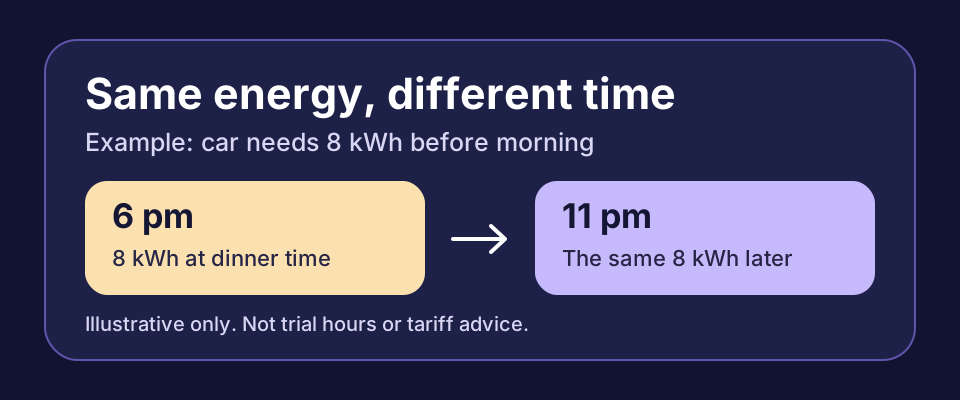
Say you plug in your EV at 6pm. It needs 8 kWh by morning, not necessarily right now. If you move that charge to 11pm, the car still takes roughly the same energy. What changes is when your street needs it. One car won’t make much difference, but a group of homes on the same busy part of the network might.
That’s load shifting. The useful bit is matching the timing to the local problem. An evening peak might call for less charging at dinner time. A sunny area with lots of rooftop exports might benefit from more local electricity use in the middle of the day. An overnight rate on your bill doesn’t tell you where the network is under pressure.
Who knows what, and why share it?
AGL is the retailer: it bills customers and would coordinate participating homes. Endeavour Energy operates the poles, wires and equipment that deliver power in its NSW territory. It knows which sections of its network could use help and when. Being an AGL customer by itself doesn’t mean you’re connected to Endeavour’s network, let alone to the part that needs help.
The proposal has two stages. First, the companies would match network needs with customers and equipment that could respond. Then they would test buying and delivering some of those services. Their application seeks temporary exemptions from specific information-sharing and ring-fencing rules. The proposal distinguishes public, aggregated network needs from meter-level information shared between the companies. The applicants aren’t seeking a waiver of privacy-consent obligations.
A lower bill isn’t the same as a trial payment
Moving that EV charge can save you money if the new time is cheaper on your tariff. On a flat rate, the same 8 kWh generally costs the same. A trial payment would be separate: the notice says selected AGL customers would be paid if services are procured in the trial stage. That isn’t a rate card, an offer to every household, or a reason to buy a battery today.
The longer-term idea is different again. If local flexibility can safely defer a network upgrade and costs less than the alternative, it could reduce what the network needs to spend. That’s something to test, not a promised cut to anyone’s bill.
What I’d ask before agreeing
If invited, ask what equipment can be controlled, how to override a change, exactly what meter or device data is shared, and what happens when you leave. The regulator’s usual conditions cover informed consent, an opt-out and a dispute process. The applicants propose that some people taking a substantial equipment incentive might have to repay part of it if they leave early. That’s a proposal, not a final term. In particular, ask what happens if you need a full charge sooner than usual.
The proposed trial would invite eligible AGL customers based on their location and technical suitability, and would exclude registered hardship and life-support customers from active participation. It’s not open for enrolment. The AER’s consultation closes 22 January 2027, after which it will consider submissions and make its decision. For now, I’d check your existing tariff and whether charging can fit your routine, rather than making a purchase based on an unapproved trial.
Sources
Read the evidence.
- FlexTogether waiver consultation and full notice, including Attachment AAustralian Energy Regulator ↗
- AER announcement, 17 November 2026Australian Energy Regulator ↗
The application and 17 November consultation notice were checked on 19 November 2026. The charging scenario is illustrative, not a proposed event, tariff or payment.
Community
Add to the article.
Useful experiences, questions and corrections make the next reader’s decision easier.
Comments appear here after moderation.